webentail
Copyright © 2021–2026 Jos De Roo, KNoWS office of IDLab, Ghent University – imec. This book is licensed under Creative Commons Attribution 4.0 International. You may copy, share, and adapt it for any purpose, including commercially; please give appropriate credit, link to the licence, and indicate changes.
WebEntail turns facts and rules into answers and inspectable proofs. This book is an original introduction to the habits of logic programming: describe a world, state the relationships that hold in it, and let unification and search connect the two.
This book is also the reference for the WebEntail implementation. WebEntail is a standards-based reasoning system: programs use the documented and tested ISO Prolog profile, while RDF 1.2 provides an interoperable data boundary. Chapters 38–40 define the supported ISO Prolog profile, built-ins, and execution interface, describe every supported built-in predicate, and document the command-line interface. The explanatory chapters give the reasoning and operational context needed to use those details correctly.
Its subject is not syntax alone. A logic program has two inseparable aspects: the relation described by its clauses and the procedure induced when goals are selected and clauses are tried. The first tells us what answers are justified; the second tells us whether and how the machine will find them. Learning to program with WebEntail means learning to move comfortably between these views.
The name WebEntail combines EYE with pl: EYE-style reasoning through Prolog. WebEntail implements a broad ISO Prolog profile with facts, clauses, terms, lists, control, arithmetic, dynamic predicates, operators, streams, and standard built-ins. Automatic tabling, explicit integrity checks, proof output, and RDF adapters are implementation capabilities around that standards-based foundation. WebEntail does not attempt to claim formal certification of every ISO processor edge case.
Standards are crucial because knowledge and rules often outlive the software that first processes them. Using ISO Prolog for programs and RDF 1.2 for interchange keeps the representation teachable, inspectable, and portable across tools. WebEntail aims to provide a compact implementation of those standards with explanations and practical host integration, not another proprietary rule language.
This places WebEntail in a tradition that joins automated deduction, database querying, and programming. Jacques Herbrand’s doctoral work made ground terms and ground instances central to proof theory; Robinson’s later resolution principle turned unification and refutation into a general proof procedure; early Prolog showed that Horn clauses could also be executable programs; deductive databases emphasized finite relations and fixed points. WebEntail borrows from all three traditions without pretending that they are identical. Its clauses are logical statements, its query execution is an ordered computation, and its proof terms make the connection between the two available for inspection.
That history explains a recurring theme of the book. Logic programming is not the claim that control disappears. It is the discipline of stating the relation clearly enough that control can be studied and improved separately. Robert Kowalski’s phrase “algorithm = logic + control” names this separation; WebEntail’s focused surface makes it unusually easy to see in running examples.
Complete WebEntail code displays from the book are also available as files under
examples/book/, grouped by chapter. From a source checkout,
use Node.js 18 or newer, install the dependencies, and run the CLI:
npm install
node bin/webentail.js examples/socrates.pl
The WebEntail command should print:
type(socrates, mortal).
holds_result(test, true).
Then ask for the derivations:
node bin/webentail.js --proof examples/socrates.pl
Readers who do not want to install anything can begin in the
browser playground. Paste
the source of examples/socrates.pl into the editor and run it. The playground
and local CLI accept the same in-memory Prolog source and load the same portable
WebEntail library by default, so relations such as append/3 and member/2 need no
extra switch. The page starts a dedicated ES-module worker for each run. Serve a
local checkout over HTTP(S), rather than opening the page as a file: URL.
Filesystem predicates and include/1 are Node-only; URL and embedding examples
require their documented host environment.
The best way to read is beside a running interpreter. Before each run, predict
the answer; after it, change one fact or query and explain the difference.
Use npm run generate after editing the book to refresh the extracted
examples/book/ files.
Reading conventions
Code displays serve three different purposes:
- an
webentailblock is Prolog source accepted by WebEntail; complete blocks are extracted underexamples/book/, although a short block may rely on facts introduced in the surrounding chapter; - a
textblock shows output, a trace, a data shape, or pseudocode and is not necessarily accepted as WebEntail input; - a
shorjsblock is a host command or embedding example.
Top-level programs under examples/ are the complete runnable
cases. Their exact outputs live under examples/output/; selected proof
outputs live under examples/proof/. Use the chapter extractions for copying a
particular display and the top-level corpus for end-to-end experiments.
The promise of this book
This book treats logic programming as a craft, not a collection of clever tricks. By the end, a reader should be able to:
- state a domain as relations whose ground instances have an unambiguous meaning;
- read every clause both as a logical sentence and as a computation;
- design finite searches, justify termination, and recognize when a calling mode is unsafe;
- construct programs from examples and invariants, then improve their control without quietly changing their meaning;
- test conclusions, detect inconsistent inputs explicitly, and inspect proofs as evidence; and
- connect a Prolog rule set to JavaScript and RDF without hiding the knowledge boundary.
That is the stake in the ground: a focused implementation of standard Prolog
is enough to teach the large ideas when semantics, execution, and evidence
remain visible together.
The implementation is therefore part of the argument. The examples are
programs, the reference chapters are the reference for the running system, and
npm test checks the complete code displays, local references, and
built-in index against the source tree.
A working discipline
Approach each example through the same six moves:
- Sentence. Say what one ground instance means.
- Question. Choose the bindings with which the relation will be called.
- Prediction. Write the expected answers before running the program.
- Search. Trace the first choice, the bindings it adds, and the next goal.
- Evidence. Inspect a proof and distinguish it from the failed search branches that were explored.
- Revision. Change one fact, query, goal order, or representation and explain what should remain invariant.
This rhythm deliberately joins declarative reading, operational reading, and program construction. Readers new to logic programming can follow Parts I–III in order. Experienced Prolog programmers can begin with Chapters 3, 13, and 17 to see where WebEntail’s hybrid execution and proof-oriented design differ. Chapter 41 gives further routes through the material.
When a run surprises you
Do not change several clauses at once. Use this recovery loop:
- reduce the issue to the smallest ground question whose answer you dispute;
- confirm that every predicate in that question has one clear sentence;
- write the bindings available before each body goal from left to right;
- run with
--proofif an unexpected answer succeeds; - run with
--statsor hand-trace the first branch if an expected answer is missing or slow; - preserve the discovery as a test before repairing the program.
No output can mean a legitimate absence, suppression of a queried source fact, an unready built-in, or an unfinished search. Chapter 1 introduces source-fact suppression, Chapters 7 and 11 distinguish failure from printed output, and Chapter 32 develops the full debugging method.
Choose a route
The book supports several paths; reading every chapter in order is not a test of seriousness.
| Reader | Suggested route | What to postpone |
|---|---|---|
| New to programming | Chapters 1–10, 11–12, 18–20, then Laboratories 1–4 | The formal parts of Chapter 3, embedding, RDF, and Parts V–VI |
| Programmer new to logic | Parts I–II, Chapters 11–13 and 17–25, then Part VII | Detailed history and mathematical foundations on the first pass |
| Experienced Prolog programmer | Chapters 3, 7, 11–13, 16–17, and 31–33 | Introductory syntax and list material |
| Knowledge engineer | Chapters 7, 11–16, 25, 31–33, then Laboratories 9–12 | Symbolic mathematics unless it serves the domain |
| Mathematics reader | Chapters 1–5, 19, and 26–30 | Embedding and RDF until an application needs them |
| Instructor or study group | Parts I–III, one route through Part V or VI, then selected laboratories | Reference chapters until reference work begins |
On a first pass, treat sections marked Deeper foundations as optional. They make the semantics precise but are not prerequisites for writing and running the next program.
The construction order
The sequence follows the teaching architecture associated with The Art of Prolog: begin with the meaning of a relation, make the relation executable, study the control it induces, and then return to the same ideas at a larger scale through transformation, search, interpreters, and applications. Each part therefore ends by asking the reader to construct, test, or improve a program rather than merely recognize syntax. Reference material follows practice, laboratories turn the methods into work, and checkpoint notes close the loop with retrieval and diagnosis.
Balance here does not mean that every chapter has the same length or the same number of pictures. A language catalog should be searchable; a construction chapter should be argumentative; a laboratory should leave an artifact. The recurring balance is instead between four readings of a program:
| Reading | Question carried through the book | Typical evidence |
|---|---|---|
| Meaning | What does each ground relation claim? | a domain sentence and examples |
| Computation | How are answers actually found? | a trace, finite bound, or termination measure |
| Construction | Why is the program shaped this way? | a worked refinement and rejected alternative |
| Judgment | What has been established, and what remains assumed? | tests, proofs, counterexamples, and a trust boundary |
Diagrams follow the same rule. Scenes introduce an intuition; structural diagrams expose a term, proof, or dependency; process diagrams guide a piece of work; maps help navigate reference and review. A diagram earns its place by making a relationship visible that prose alone would make easy to miss.
Contents
Chapters are numbered continuously across the twelve parts, from Chapter 1 to Chapter 46.
Part I — Relations
Chapters 1–5
- 1. A program is a little theory
- 2. Terms, variables, and substitution
- 3. Rules and their two readings
- 4. Recursion: describing reachability
- 5. Lists as relations
Part II — Search
Chapters 6–10
- 6. Arithmetic and finite generation
- 7. Failure, negation, and quantification
- 8. Collecting and choosing answers
- 9. Structured data, strings, and contexts
- 10. From puzzles to models
Part III — Trustworthy reasoning
Chapters 11–16
- 11. Queries, answers, and proofs
- 12. Integrity checks as ordinary predicates
- 13. Termination, tabling, and performance
- 14. Knowledge engineering
- 15. RDF 1.2 as the interoperable data boundary
- 16. Embedding WebEntail
Part IV — The craft of logic programming
Chapters 17–20
- 17. Logic and control
- 18. Constructing a program
- 19. Correctness and termination
- 20. Improving a program
Part V — Advanced relational design
Chapters 21–25
- 21. Reading the computation
- 22. Trees, languages, and symbolic evaluation
- 23. Transforming programs
- 24. Designing finite search
- 25. Case study: an auditable decision service
Part VI — Mathematics made executable
Chapters 26–30
- 26. A proof can be a computation
- 27. Recursion is induction in motion
- 28. Algebra, symmetry, and representation
- 29. Search as experimental mathematics
- 30. What mathematics promises
Part VII — The reasoning laboratory
Chapters 31–33
- 31. Testing a theory
- 32. Debugging by meaning, search, and proof
- 33. A pattern catalog for reasoning
Part VIII — Standard Prolog in practice
Chapters 34–37
- 34. Control, exceptions, and grouped solutions
- 35. Reflective terms and atomic conversion
- 36. Dynamic predicates, directives, and operators
- 37. Streams and term I/O
Part IX — Reference as practice
Chapters 38–43
- 38. Language and ISO profile
- 39. Built-in predicates by programming role
- 40. Running WebEntail: command line and corpus
- 41. Study paths, review, and further examples
- 42. Standards, limits, and implementation boundaries
- 43. Glossary and notes for continued study
Part X — Laboratories
Chapter 44
Part XI — Review
Chapter 45
Part XII — Development note
Chapter 46
Part I — Relations
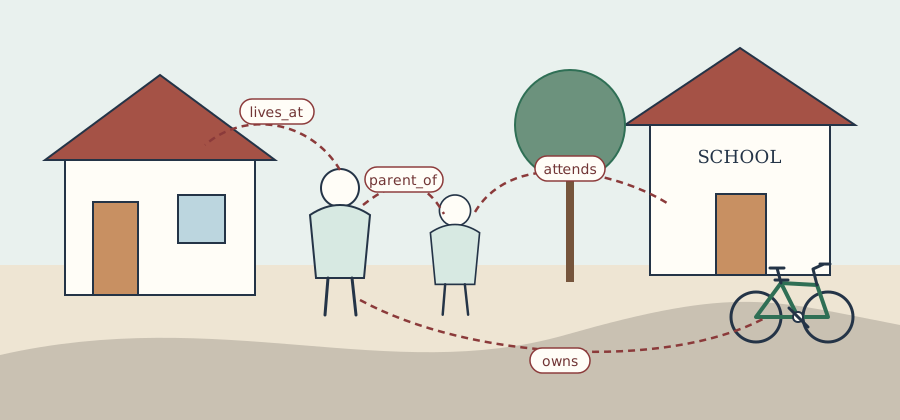
We begin with connection rather than calculation. Facts place points in a relational world; variables draw threads between them; rules make one pattern follow from another.
1. A program is a little theory
Logic programming begins with a change of emphasis. Instead of listing the steps that calculate an answer, write sentences that are true in the problem domain.
parent(ada, byron).
parent(byron, clara).
parent(clara, diego).
Each line is a fact. parent/2 is a relation: the name is parent and the
arity is two. Arity matters. parent/2 and parent/3 are different predicates.
A query declaration selects the relation whose ground answers WebEntail prints:
child(Child, Parent) :- parent(Parent, Child).
webentail --goal 'child(X, Y)' program.pl
The answers are:
child(byron, ada).
child(clara, byron).
child(diego, clara).
WebEntail distinguishes solutions found by the solver from answers printed by the
CLI. A query such as webentail --goal 'parent(X, Y)' program.pl can find the three source facts
internally, but the normal CLI output suppresses answers that merely repeat
source facts. Derived child/2 answers are printed. Chapter 11 explains this
output policy; it does not change what calls inside rules can prove.
The program did not copy values through named slots. It found substitutions
for Child and Parent that made the rule body true, then applied those same
substitutions to the head.
Before writing a relation, ask:
- What does one ground fact mean as a sentence?
- Which arguments are normally known when it is called?
- Is the relation finite in that calling pattern?
For parent(Parent, Child), a ground fact reads naturally from left to right.
Calling it with a parent enumerates children; calling it with a child enumerates
parents; calling it open enumerates the finite database. A good relation has a
clear sentence and useful modes.
Facts are data, not commands. Clause order can affect search order, but a fact does not mean “do this now.”
Learning to see relations
The shift from functions to relations takes practice. A function is normally introduced with a direction: put an input in one side and receive an output from the other. A relation begins with a set of tuples. Direction enters only when somebody asks a question.
Take parent/2. The program does not store a procedure named “find children.”
It stores pairs for which the relation holds. From that single relation, one
may ask for a child’s parents, a parent’s children, whether two named people
stand in the relation, or every known pair. The source text stays fixed while
the binding pattern changes.
This is why the wording of a predicate matters. Before adding a rule, read a ground instance aloud:
parent(ada, byron)means that Ada is a parent of Byron.
Now replace one name at a time with a question:
For which
Childis Ada a parent?Who is a
Parentof Byron?Which
Parent–Childpairs are known?
If those questions feel like natural uses of one statement, the relation is probably well shaped. If each reading requires a different interpretation of an argument, split the concept before the ambiguity spreads into later rules.
Exercise. Add grandparent/2 using two calls to parent/2. Query all
grandparents, then only the grandparents of diego.
Checkpoint. Before continuing, make sure you can (1) read
parent(ada, byron) as a sentence, (2) explain what the two variables in
webentail --goal 'child(X, Y)' program.pl ask for, and (3) predict which output changes after adding
parent(diego, elena).
2. Terms, variables, and substitution
Prolog programs accepted by WebEntail are built from terms:
- atom constants:
ada,accepted,'atom with spaces'; - strings:
"sensor too hot"; - numbers:
42,-7,3.14159,1.2e3; - variables:
X,Person,_temporary; - compound terms:
point(3, 4),reading(temp, 91); - lists:
[],[red, green, blue],[Head | Tail].
Plain atom constants begin with a lowercase ASCII letter. Variables begin with
an uppercase letter or underscore. The bare _ is anonymous and every
occurrence is fresh. _Name is a named variable; repeated occurrences refer to
the same variable within its clause. Variables are local to a clause.
Unification
Unification asks whether two terms can be made identical by binding variables.
reading(Sensor, 91)
reading(temp, Value)
They unify with Sensor = temp and Value = 91. Structure must agree
recursively. point(X, X) unifies with point(2, 2) but not point(2, 3).
Functor and arity must agree.
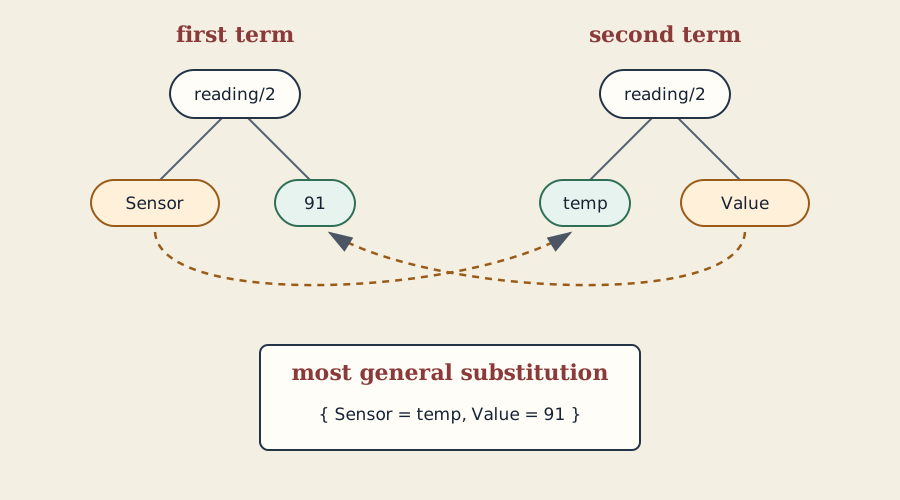
The picture is worth lingering over. Unification does not assign values in a one-way parameter list. It aligns two structures. A variable on either side may receive a binding; a nested pair of compounds causes the same comparison to continue recursively. The result shown is the most general substitution: it commits to exactly what structural agreement requires and nothing more.
WebEntail exposes unification as =/2:
same_shape(Pair) :- (Pair = pair(X, X)).

webentail --goal 'same_shape(pair(red, red))' program.pl
webentail --goal 'same_shape(pair(red, blue))' program.pl
Only the first query succeeds. \=/2 succeeds when two resolved terms are not
structurally equal.
Compound terms retain domain structure:
measurement(battery_1, sample(17, volts(28.4), amps(12.1))).
route(a, d, path([a, b, d], cost(9))).
As a fact head, measurement(...) is an atomic formula. Nested terms are data.
The same surface form serves both roles; context decides which.
ready is an atom constant and "ready" is a string. Keep symbolic vocabulary
as atoms and human text as strings. Quoted atoms remain atoms:
label(sensor_1, "Cabin temperature").
web_name(sensor_1, '<https://example.org/sensor/1>').
Exercise. Write diagonal/1, which succeeds for point(X, X). Then write
same_ends/1 for a three-element list whose first and last values agree.
Checkpoint. Without running WebEntail, decide whether each pair unifies:
point(X, X) with point(red, red), point(X, X) with
point(red, blue), and [Head | Tail] with [a, b, c]. Then run a small
=/2 query to check each prediction.
3. Rules and their two readings
The executable-clause idea emerged from work on automated theorem proving. Robinson’s resolution principle supplied a general proof rule, while the development of Prolog specialized proof search around clauses that could be read as procedures. WebEntail begins further downstream: it offers a compact definite-clause language rather than a general first-order theorem prover. The restriction buys a direct correspondence between a rule body and the subquestions used to establish its head.
A rule has a head and a comma-separated body:
eligible(Person) :-
  age(Person, Years),
  (Years >= 18),
  registered(Person).
Read it declaratively: a person is eligible if the person has an age of at least 18 and is registered. Read it operationally: to solve the head, solve the body goals in their written dependency order, carrying bindings into later goals. WebEntail normally selects from left to right. As a safe optimization, it may run a ready deterministic built-in filter early; such a filter cannot add alternative answers and already has the inputs its registered mode requires.
Both readings matter. The declarative reading checks the model. The operational reading helps make search finite and selective. Put a generator before a built-in that needs its input:
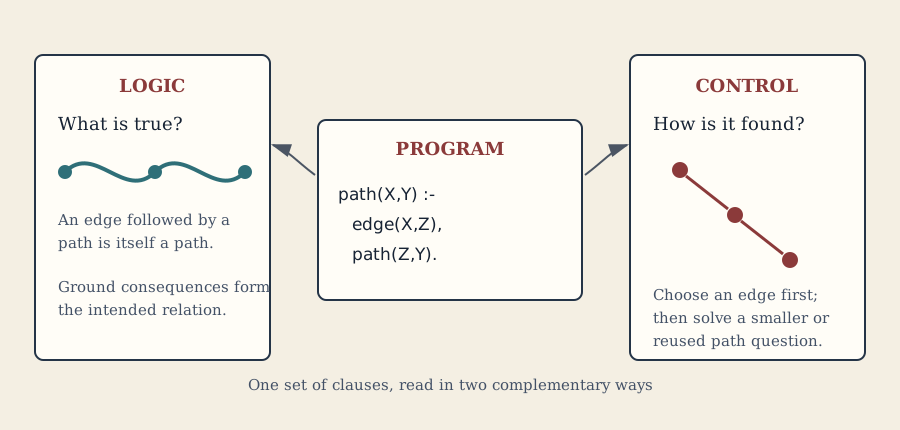
The two readings are not rivals. The logical reading prevents an efficient program from quietly answering the wrong question. The operational reading prevents a beautiful specification from wandering forever without producing an answer. Much of the craft in this book consists of keeping one reading steady while improving the other.
adult(Person) :-
  age(Person, Years),
  (Years >= 18).
Multiple clauses express alternatives:
can_enter(Person) :- staff(Person).
can_enter(Person) :- visitor(Person), escorted(Person).
Helper predicates reveal the model and improve explanations:
high_score(Case) :-
  score(Case, Score),
  threshold(Threshold),
  (Score >= Threshold).

status(Case, accepted) :- high_score(Case).
reason(Case, "score meets threshold") :- high_score(Case).
Deeper foundations: Herbrand’s move
This section through “Meaning is not the search strategy” supplies the formal model behind the earlier examples. On a first practical reading, it is safe to continue at Chapter 4 and return here after writing a recursive relation.
The terminology in the next section honors a remarkably early source. Jacques Herbrand developed the relevant ideas in his 1930 doctoral thesis, Recherches sur la théorie de la démonstration (“Investigations in proof theory”). His fundamental theorem connected first-order derivability with propositional reasoning over suitably chosen ground instances. In broad terms, quantified proof obligations could be studied through formulas obtained by substituting constructed terms for variables.
That move supplied more than names. It made syntax usable as a mathematical universe: constants and function symbols generate ground terms, and atomic formulas over those terms provide a concrete space in which proofs can be analyzed. This viewpoint became foundational for automated theorem proving. Unification can be understood as finding substitutions that bring symbolic formulas together, while later proof procedures can search among clause instances without first assigning terms to an unrelated external domain.
The historical distinctions matter. Herbrand did not invent Robinson’s 1965 resolution calculus, nor did his thesis state the later least-model semantics of logic programs in its modern form. Rather, his proof theory laid essential groundwork. Resolution supplied a powerful subsequent inference mechanism, and van Emden and Kowalski later gave definite logic programs their fixed-point and least-Herbrand-model account. WebEntail sits downstream of this sequence:
Herbrand: ground terms and instances as a proof-theoretic foundation
  -> Robinson: resolution and unification as a proof procedure
  -> logic programming: executable clauses and least-model semantics
  -> WebEntail: a focused Prolog implementation with inspectable derivations
Herbrand completed this work while still in his early twenties and died in
- The scale of its later influence—in proof theory, automated deduction, and logic programming—is one reason the word Herbrand recurs throughout this book rather than appearing only as historical attribution.
The Herbrand world
The declarative reading needs a precise answer to a deceptively simple question: what can a term denote? WebEntail uses Herbrand semantics. Its universe contains exactly the ground terms that can be constructed from the program’s atom constants, strings, numbers, list constructors, and compound functors. There are no unnamed elements hiding behind the notation. A ground term denotes itself.
This separates the Herbrand universe, whose members are terms such as
pat, 3, [red, blue], and ticket(alice), from the Herbrand base,
whose members are ground atomic formulas such as person(pat) and
owns(alice, ticket(17)). A term is not true or false merely by existing:
pat is a possible argument, whereas person(pat) is a proposition that an
interpretation may make true.
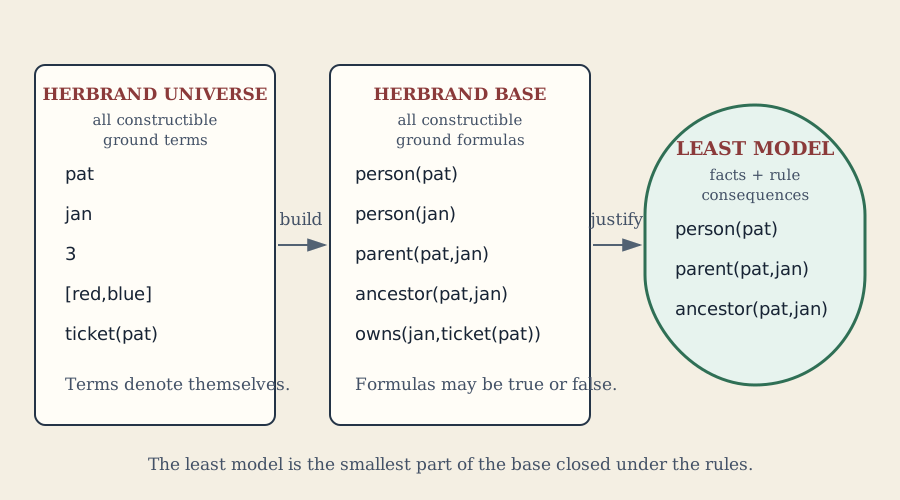
This three-level distinction answers several recurring questions. A newly constructed term does not automatically assert anything. A formula that can be written is not automatically true. And the model is not an arbitrary collection of convenient formulas: it is the smallest collection forced by the program. Keeping those levels separate makes symbolic data safe to inspect without confusing mention with assertion.
A Herbrand interpretation is a set of ground atomic formulas regarded as true. A source fact contributes one such formula:
parent(pat, jan).
A rule stands for all of its ground instances. Thus:
ancestor(X, Z) :- parent(X, Y), ancestor(Y, Z).
says that for every substitution of X, Y, and Z by Herbrand terms, truth
of both body formulas entails truth of the head formula. Variables in rules
are implicitly universally quantified.
The declarative meaning of a pure Prolog program is its least Herbrand model: the smallest interpretation containing every fact and closed under every rule. One mathematical way to obtain it is the immediate-consequence operation. Begin with the facts; add each ground rule head whose ground body is already true; repeat until reaching the least fixed point. This construction defines meaning. It does not prescribe that the implementation enumerate the model from the bottom up.
Why terms denote themselves
Herbrand semantics is a particular form of ordinary model theory, chosen because logic programs inspect and construct symbolic terms. Consider:
different(alice, bob) :- (alice \= bob).
different(ticket(alice), ticket(bob)) :-
  (ticket(alice) \= ticket(bob)).
In an unrestricted first-order interpretation, alice and bob could denote
the same object unless a unique-name axiom forbids it. Even if they denote
different objects, the interpretation of ticket need not be injective.
Additional axioms would be required to show that ticket(alice) and
ticket(bob) differ.
In the Herbrand universe those terms differ by construction. Different atom
constants are different terms; compound terms are free constructors and are
identical only when functor, arity, and corresponding arguments are identical.
Lists follow the same rule through [] and the internal ./2 constructor.
Unification, read-back, witness construction, and proof explanations therefore
share one predictable notion of identity.
This is a property of the representation, not a claim that two names can never
refer to one real-world entity. If robert and bob name the same person, say
so with same_as(robert, bob) or normalize them to one canonical term. The
Herbrand layer keeps names unambiguous; domain rules express equivalence.
The runnable
examples/herbrand-semantics.pl example and
its normal and proof outputs make this distinction concrete.
Quantification and visible witnesses
Variables range over Herbrand terms, not external records, pointers, or host-language objects. Variables in a selected goal are existential in the logic-programming sense: WebEntail searches for substitutions that make the goal follow from the program.
WebEntail has no blank nodes or existential variables in rule heads. When a rule needs to name a consequent object, construct an explicit witness:
has_parent(Child, parent_of(Child)) :-
  person(Child).

registration(Student, Course, registration_of(Student, Course)) :-
  takes(Student, Course).
The same inputs construct the same witness term; different inputs construct different terms. The witness is printable, queryable, and visible in a proof, rather than being an anonymous object created behind the program’s back.
Equality, unification, and the occurs check
Equality in the pure Herbrand reading is syntactic identity after substitution. Operationally, unification discovers a substitution that makes terms identical. WebEntail performs an occurs check whenever unification would bind a variable. It therefore uses finite-tree unification and rejects a binding when the variable occurs anywhere in the proposed value. For example, this call fails rather than constructing a cyclic term:
(X = wrapper(X)).
Meaning is not the search strategy
WebEntail’s evaluator is goal-directed. It resolves selected goals against facts, rules, and built-ins using ordered conjunction, clause selection, indexing, tabling, and deterministic host operations. Written order defines the normal dataflow; a mode-ready deterministic built-in may be selected early as a pure filter. For the pure Horn-clause fragment, the answers it finds are intended to belong to the least Herbrand model. The evaluator is not, however, a complete bottom-up enumerator. Infinite generation or nonterminating recursion can prevent it from reaching a true answer.
Built-ins extend the pure core. Relational built-ins such as =/2,
append/3, and member/2 are readily understood over Herbrand terms.
Arithmetic, date handling, regular expressions, aggregation, once/1, and
negation have additional operational definitions. They still consume and
produce Prolog terms: X is 2 + 3 binds X to the Herbrand number term 5,
not to an invisible host value.
\+ Goal succeeds when the current finite search finds no solution for
Goal; it does not insert a negative formula into the Herbrand model.
User-defined negative dependencies should be stratified. In a stratified
program, positive dependencies may remain in the same or a lower layer, while
every negative dependency points strictly downward:
closed(X) :- blocked(X).
open(X) :- candidate(X), \+ closed(X).
A cycle containing a negative edge is not stratified:
p(X) :- q(X).
q(X) :- \+ p(X).
The CLI reports such portability problems with --warnings. JavaScript
embedders can inspect stratifiedNegation, negationStratificationErrors,
negationDependencies, and per-group negationStratum; request eager analysis
with analyzeNegation, reject it with strictNegation, or call
program.assertStratifiedNegation().
Checkpoint. Read one rule twice: first as a sentence about all its ground instances, then as a left-to-right sequence of subquestions. Identify which body goal first binds each variable. If you took the practical route, defer Herbrand bases and interpretations without guilt; recursion is next.
4. Recursion: describing reachability
Recursive rules define an unbounded family of finite proofs. An ancestor is a parent, or a parent of an ancestor:
ancestor(X, Y) :- parent(X, Y).
ancestor(X, Z) :- parent(X, Y), ancestor(Y, Z).
webentail --goal 'ancestor(X, Y)' program.pl
The first clause is the base case. The second reduces an ancestor question to a subquestion one edge farther through the graph. To design recursion, draw one proof, find the repeated subquestion, and ensure some path reaches a base case.
Constructing the recursive argument
A recursive program should expose the same argument that would justify its
result on paper. For ancestor/2, that argument has four parts:
| Design obligation | ancestor/2 answer |
|---|---|
| Smallest supported case | one known parent/2 edge |
| Repeated question | whether the intermediate parent is an ancestor |
| Progress | advance from X to the next vertex Y |
| Finite reason | a finite graph gives finitely many endpoint pairs to table |
The progress column is deliberately not “the term gets smaller.” Structural recursion over a list usually consumes a tail; graph recursion moves through a finite relation; arithmetic recursion may decrease a number. State the actual well-founded argument for the intended mode instead of borrowing the language of a different recursion pattern.
Clause order then expresses a control preference. Trying the direct edge first finds short proofs early, but it does not change which ancestor pairs the two clauses mean. Reversing the recursive clause’s body is different: it asks an open recursive question before selecting an edge and may destroy the useful mode. Meaning and control must be reviewed separately.
Real graphs contain cycles. Naive depth-first recursion can revisit a call
forever. WebEntail analyzes predicate dependencies and automatically tables
suitable positive recursive groups. A table records answers for a recursive
call, iterates cyclic calls to a fixed point, and reuses results. Authors
describe path/2; the engine chooses the recursive strategy.
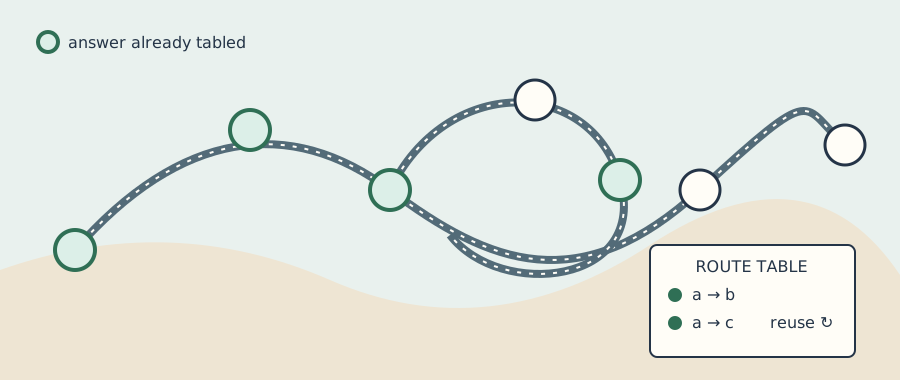
Tabling does not make every open relation finite. A rule that constructs ever-larger terms can still produce infinitely many distinct calls or answers. Keep the selected query and its generators finite.
A relation can construct a witness:
path(X, Y, [X, Y]) :- edge(X, Y).
path(X, Z, [X | Rest]) :-
  edge(X, Y),
  path(Y, Z, Rest).
On cyclic graphs, track visited vertices and use not_member/2 to obtain finite
simple paths rather than arbitrary walks.
Notice that ancestor/2 and path/3 make different promises. Endpoint
reachability has at most one logical pair for each pair of vertices, whereas
path construction may have many witnesses for the same endpoints. Table the
finite relation you need; bound or simplify the richer witness relation. This
distinction reappears in grammars, planning, proof search, and program analysis.
Checkpoint. In the three-edge family from Chapter 1, predict the direct and
indirect ancestor/2 answers. Point to the base clause and recursive clause,
then say what becomes smaller or moves closer to a known fact in one successful
derivation.
5. Lists as relations
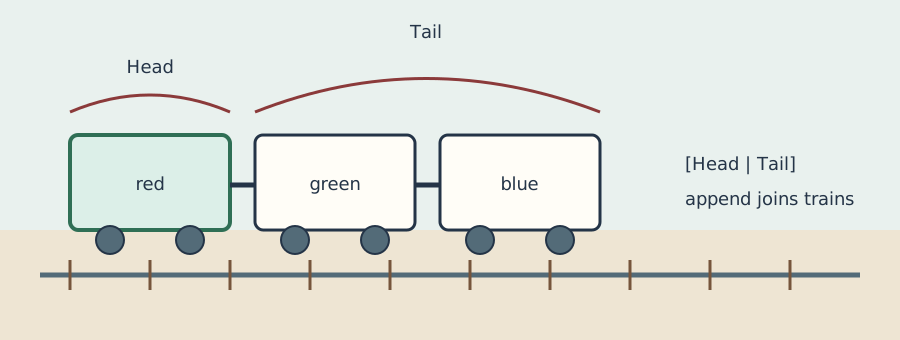
[a, b, c] abbreviates nested cons cells. [Head | Tail] exposes one cell;
[] is empty.
first([Head | _], Head).

contains_item(X, [X | _]).
contains_item(X, [_ | Rest]) :- contains_item(X, Rest).

joins([], Ys, Ys).
joins([X | Xs], Ys, [X | Zs]) :- joins(Xs, Ys, Zs).
Different modes give joins/3 different uses. It can construct a concatenated
list, enumerate every prefix/suffix split, or find a missing part. This is the
practical meaning of a relational definition.
Some algorithms carry explicit state through an accumulator:
reverse_acc(List, Reversed) :- reverse_go(List, [], Reversed).
reverse_go([], Acc, Acc).
reverse_go([X | Xs], Acc, Reversed) :-
  reverse_go(Xs, [X | Acc], Reversed).
No mutation occurs; every call receives a new term. WebEntail also includes
member/2, append/3, select/3, nth0/3, reverse/2, length/2,
sort/2, slicing helpers, and numeric summaries. Improper lists such as
[a | Tail] are valid terms, but operations requiring a proper finite list
fail unless the tail is [].
Checkpoint. Trace joins([a], [b, c], Whole) by hand. Then reverse the
question: bind Whole to [a, b, c] and predict all prefix/suffix splits.
Finally explain why [a | Tail] is not yet known to be a proper finite list.
Part I summary
Part I established the relational eye:
- a program is a theory of ground sentences, not a sequence of assignments;
- variables acquire meaning through consistent substitution;
- unification connects a question to facts and rule heads by structure;
- every rule has both a declarative and an operational reading;
- recursion describes an unbounded family of finite proofs;
- lists are inductive terms whose relations can support several modes.
You should now be able to read a program aloud, predict a unifier, write base and recursive clauses, and explain why a list relation may construct as well as inspect its arguments. Carry forward one habit: begin with a meaningful ground instance, then ask which variables may safely replace which parts.
Historical note: clauses become a programming medium
The ingredients of Part I were assembled across several traditions. First-order logic supplied variables, substitution, and quantified formulas. Herbrand made ground terms and ground instances central to proof theory. Robinson’s 1965 resolution principle gave automated deduction a uniform, machine-oriented inference rule whose practical force depended on unification.
Prolog emerged when these ideas met a natural-language project in Marseille in the early 1970s. Colmerauer and Roussel stress that the project did not begin as an abstract attempt to invent a programming language: the need to analyze French drove the development of executable clauses and their control. Lists then became more than containers. They naturally represented sentences, syntax, proof states, and sequences of goals. The familiar two-clause list program condenses a much older mathematical pattern—definition by constructors and structural induction—into executable form.
Part II — Search

A theory may justify many conclusions, but an evaluator must still find them. This Part studies the finite domains, constraints, failure, and choice that turn a field of possibilities into a productive computation.
6. Arithmetic and finite generation
Arithmetic uses the standard is/2 predicate, conventionally written with
infix operator syntax:
next(X, Y) :- (Y is X + 1).
area_rectangle(W, H, Area) :- (Area is W * H).

hypotenuse(A, B, C) :-
  (A2 is A * A),
  (B2 is B * B),
  (C2 is A2 + B2),
  (C is sqrt(C2)).
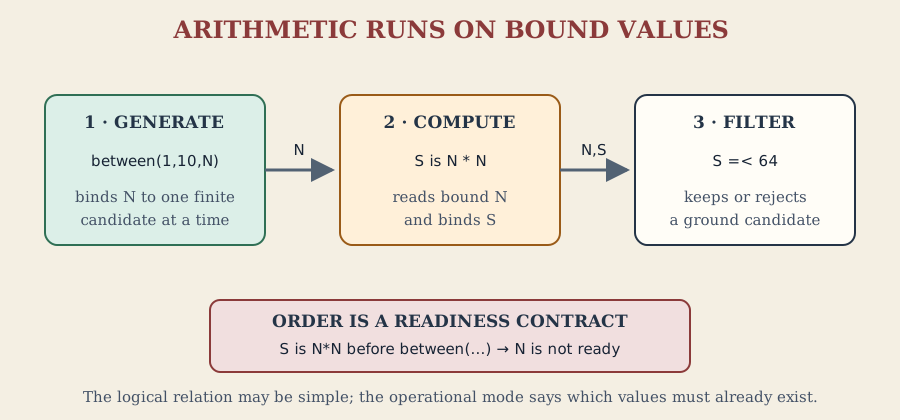
Inputs must be bound to suitable numbers before a numeric function runs. Comparisons filter generated solutions:
safe_reading(Sensor, Value) :-
  reading(Sensor, Value),
  (Value >= 0),
  (Value =< 80).
between(Low, High, Value) enumerates an inclusive integer range or checks an
already-bound value:
square(N, Square) :-
  between(1, 10, N),
  (Square is N * N).
Finite generators turn loops into searches. Recurrences need intended modes:
factorial(0, 1).
factorial(N, F) :-
  (N > 0),
  (Previous is N - 1),
  factorial(Previous, PF),
  (F is N * PF).
The intended call direction belongs in the predicate’s tests and surrounding documentation; it does not require executable metadata.
Checkpoint. For every arithmetic goal above, mark which arguments must be
numbers before the goal can run. Explain why between/3 is a generator in
square/2 but merely a check when its third argument is already bound.
7. Failure, negation, and quantification
A goal fails when no clause or built-in proves it under current bindings. Failure prunes that branch and search tries another choice.
Failure is an operational event, not automatically a statement about the
world. Turning failure into \+ Goal is justified only relative to the
program and the current bindings. This is the closed-world move familiar
from databases: for some bounded relation, what cannot be derived is treated
as absent. It differs from the open-world stance common on the Web, where a
missing claim may simply be unknown. Neither stance is universally right; the
modeler must say which knowledge boundary is complete.
\+ Goal succeeds when Goal has no solution:
allowed(User) :-
  user(User),
  \+ blocked(User).
This means “blocked cannot be proved from this program,” not classical
negation. Bind variables before negating. Putting \+ blocked(User) before
user(User) asks whether there is no blocked user at all, not whether this
particular user is unblocked.
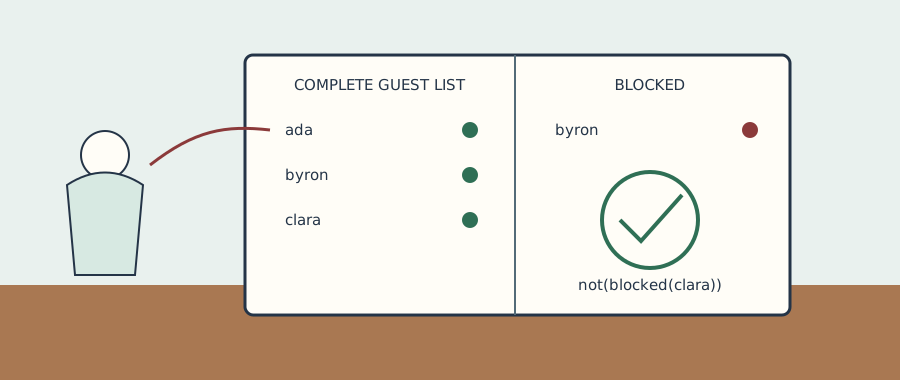
Negative dependencies should be stratified: compute a lower relation, then
negate it from a higher layer. Use --warnings to report negative recursion:
webentail --warnings program.pl
Universal checking needs no extension predicate: define the counterexample and negate it.
all_tests_pass(Suite) :-
  \+ failing_test(Suite).

failing_test(Suite) :-
  test_in(Suite, Test),
  \+ passed(Test).
Use negation where the knowledge boundary is closed: a complete roster,
configuration, or finite result set. In open-world data, model explicit states
such as confirmed_absent instead of deriving absence from silence.
Checkpoint. Compare user(User), \+ blocked(User) with
\+ blocked(User), user(User). State the question each ordering asks and the
completeness assumption needed before calling either result “allowed.”
8. Collecting and choosing answers
Finite aggregation asks about a solution set:
findall(Template, Goal, List).
countall(Goal, Count).
sumall(Value, Goal, Sum).
outgoing_costs(Node, Costs) :-
  findall(Cost, edge(Node, _, Cost), Costs).

total_outgoing(Node, Total) :-
  sumall(Cost, edge(Node, _, Cost), Total).
findall/3 returns [] for no answers; counts and sums return zero.
Choose a collector from the question, not from convenience:
| Question | Result shape | Empty search |
|---|---|---|
| Which witnesses were found? | findall/3 returns a list |
[] |
| How many derivations succeeded? | countall/2 returns an integer |
0 |
| What is their numeric total? | sumall/3 returns a number |
0 |
| Which candidate has the least or greatest key? | aggregate_min/5 or aggregate_max/5 returns one candidate |
failure |
Counting solutions is not necessarily counting distinct domain objects: two
proofs may resolve the visible value in the same way. When identity matters,
collect the identifying template and deliberately canonicalize it with
sort/2; when derivation multiplicity matters, retain the duplicates. Making
that decision explicit prevents a database-style summary from silently
changing the question.
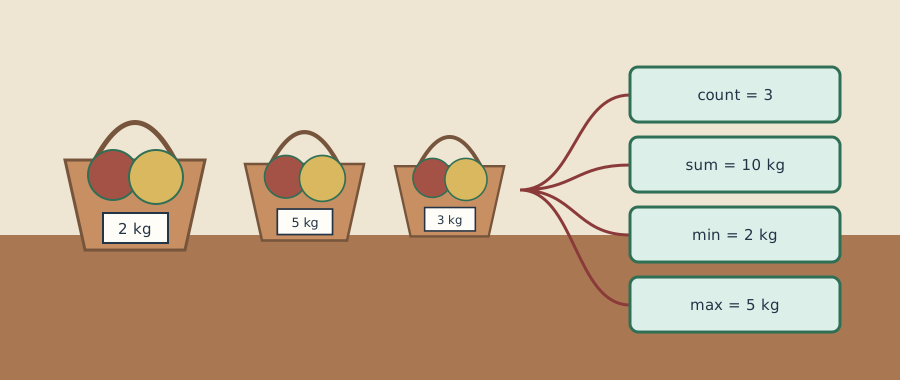
Optimization can retain only a best solution:
best_route(From, To, Route, Cost) :-
  aggregate_min(
    [CandidateCost, CandidateRoute],
    CandidateRoute,
    route(From, To, CandidateRoute, CandidateCost),
    [Cost, Route],
    Route
  ).
The key [Cost, Route] supplies deterministic tie-breaking through term order.
aggregate_min/5 and aggregate_max/5 fail when their goal has no answers.
An aggregate opens a smaller query scope inside the surrounding proof, and its
inner search must be finite.
Keep candidate generation separate from choice. A relation such as
route/4 should explain which routes exist and how their costs arise;
best_route/4 states a policy over that finite relation. This separation lets
the same candidates be inspected, counted, tested, or optimized without
burying their meaning in a single committed search. It also makes an empty
candidate set visible: “there is no route” is different from inventing a
sentinel route with an artificial cost.
Checkpoint. For an empty route relation, predict the behavior of
findall/3, countall/2, sumall/3, and aggregate_min/5. Then identify the
finite generator that bounds each aggregate in a program of your own.
9. Structured data, strings, and contexts
Term predicates decompose or construct general terms:
functor(Term, Name, Arity).
arg(Index, Term, Value).
(Term =.. [Name | Arguments]).
arg/3 uses one-based indexes. Prefer direct pattern matching when the shape
is known; use inspection for generic transformations.
Text is best normalized at the model boundary:
normalized(Input, Words) :-
  trim(Input, Trimmed),
  lowercase(Trimmed, Lower),
  split(Lower, " ", Words).
Conversions include number_string/2, atom_string/2, and term_string/2.
Pattern operations include contains/2, matches/2, not_matches/2, and
named-capture matches/3. Turn text into structured terms early; keep central
rules relational.
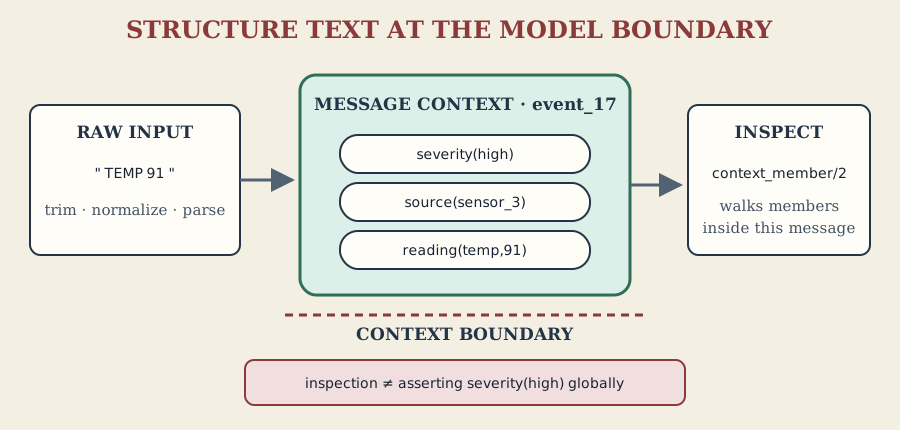
Parenthesized comma terms can serve as context data:
message(event_17, (severity(high), source(sensor_3), reading(temp, 91))).

context_member((Left, _right), Member) :- context_member(Left, Member).
context_member((_left, Right), Member) :- context_member(Right, Member).
context_member(Member, Member) :- Member \= (_left, _right).

hot_event(Id) :-
  message(Id, Context),
  context_member(Context, severity(high)),
  context_member(Context, reading(temp, Value)),
  (Value > 80).
context_member/2 is an ordinary program relation: it walks a comma-context
from left to right. When the member’s shape is not known in advance, decompose
it with (Member =.. [Name | Arguments]). Context members remain quoted data;
inspecting them does not assert them as ambient facts.
Checkpoint. Distinguish the atomic formula message(...) from the nested
data term (severity(high), source(sensor_3), reading(temp, 91)). Explain why
context_member/2 can inspect the latter without asserting severity(high)
globally.
10. From puzzles to models
A robust finite search has three layers: generate candidates, constrain them, and present a concise answer.
color(red).
color(green).
color(blue).

coloring(A, B, C) :-
  color(A),
  color(B),
  (A \= B),
  color(C),
  (B \= C),
  (A \= C).

answer(colors(A, B, C)) :- coloring(A, B, C).
webentail --goal 'answer(X)' program.pl
Place cheap, selective constraints as soon as their inputs are bound. For state-transition problems, represent state and moves explicitly:
plan(State, State, _, []).
plan(State, Goal, Seen, [Move | Moves]) :-
  transition(State, Move, Next),
  not_member(Next, Seen),
  plan(Next, Goal, [Next | Seen], Moves).
The visited list makes a finite state space explicit. WebEntail is strongest when the result is a logical consequence with a compact witness: a path, matching, classification, schedule, proof, or bounded model. Mutable arrays and large numerical kernels generally belong in a host, with WebEntail as the decision layer.
For the coloring program, the six printed answers are the permutations of
red, green, and blue:
answer(colors(red, green, blue)).
answer(colors(red, blue, green)).
answer(colors(green, red, blue)).
answer(colors(green, blue, red)).
answer(colors(blue, red, green)).
answer(colors(blue, green, red)).
Checkpoint. Label the generator, each constraint, and the final witness in
the coloring program. Before changing it, predict how many answers remain if
A \= C is removed; then run the program and account for every additional
answer.
Part II summary
Part II turned relations into finite computations:
- arithmetic relations need their operational inputs bound;
- generators state where finite candidates come from;
- failure prunes a branch, while
\+/1makes finite failure a closed-world test; once/1makes search order observable;- aggregates turn a finite solution space into a list, count, sum, or optimum;
- structured terms and contexts belong at explicit modeling boundaries;
- puzzles become programs by separating generation, constraint, and witness.
You should now be able to justify a query’s finiteness, order goals by binding dependency, distinguish negation as failure from classical negation, and explain why optimization is search plus an ordering.
Historical note: control, databases, and finite failure
Early Prolog made a decisive engineering choice: clauses would be tried in an order and subgoals would normally be selected left to right. That choice made logic executable, but also made control visible. A logically symmetric conjunction could behave asymmetrically when one order supplied a value and another asked arithmetic to run too soon.
The meeting of logic programming and database research in the 1970s sharpened questions about finite relations, closed-world reasoning, and query evaluation. Keith Clark’s 1978 account did not identify failure with unrestricted logical negation; it related negation as failure to a completed database reading. Later work on stratification disciplined negative dependencies. Aggregation continued the database lineage: a set of solutions could itself become data, provided the nested search was finite.
These distinctions explain WebEntail’s conservative treatment. Negation and aggregation are powerful because they expose a bounded subcomputation. Their safety comes not from punctuation but from a mathematical argument about scope and termination.
Part III — Trustworthy reasoning
An answer becomes useful when its grounds remain visible. Here reasoning is treated as an accountable structure: queries define the question, proofs retain support, integrity checks expose invalid states, and knowledge boundaries stay explicit.
11. Queries, answers, and proofs
WebEntail goals are supplied by the host, for example
webentail --goal 'child(X, Y)' program.pl. WebEntail prints ground answers, removes
duplicates, and suppresses answers that merely repeat source facts. Answers
are not inserted back into the running program.
An answer and a derivation serve different audiences. An answer records what the theory supports; a derivation records how this run supported it. In mathematics that distinction resembles theorem versus proof. In data systems it resembles result versus provenance. The proof is not a substitute for valid source data or sound domain rules, but it makes both reviewable: a user can trace a decision to clauses, facts, bindings, and built-in operations instead of trusting an opaque status code.
Use --proof or -p to add a machine-readable why/2 fact after every answer:
webentail --proof examples/socrates.pl
why(
  type(socrates, mortal),
  proof(
    goal(type(socrates, mortal)),
    by(rule("socrates.pl", clause(4))),
    bindings([binding("X", socrates)]),
    uses([
      proof(
        goal(type(socrates, man)),
        by(fact("socrates.pl", clause(3)))
      )
    ])
  )
).
Proof output is valid WebEntail input:
webentail --proof examples/socrates.pl > socrates.why.pl
A normal answer is one resolved ground term followed by a period. Strings,
quoted atoms, lists, and compounds are rendered in supported source syntax so
the output can be read back. Enabling --proof, --warnings, or --stats
must not change which answers are found.
The second argument of why/2 is an abstract proof term of the general shape
proof(goal(G), by(Method), bindings(Bindings), uses(Proofs)). User clauses
are identified as fact(Filename, clause(N)) or
rule(Filename, clause(N)), with one-based source clause numbers. Built-ins
are identified as builtin(Name, Arity). Explanation data is outside the
logical semantics of the input program: it describes the derivation but does
not participate in finding it.
A second program can query why/2. Read a proof as an argument. If it contains
irrelevant detours, improve the helpers. If a key premise is hidden inside an
opaque value, model it as a fact. Designing for a good explanation often
produces a better theory.
Checkpoint. Run examples/socrates.pl once normally and once with
--proof. Confirm that the ground answers are unchanged. In one proof,
identify the queried goal, the rule that derived it, the source fact used, and
the binding carried between them.
12. Integrity checks as ordinary predicates
Integrity conditions are ordinary relations that describe invalid input states:
invalid_probability(Disease, Probability) :-
  probability(Disease, Probability),
  (Probability > 1).
A host that requires validated input queries the integrity relation explicitly before it asks for domain decisions. This keeps the policy visible: the host may reject the input, report every defect, or continue in a diagnostic mode.
false/0 keeps its ISO meaning: it is a built-in goal that always fails. It is
a protected static procedure, so false. and clauses of the form
false :- Body. are rejected with
permission_error(modify, static_procedure) rather than acquiring special
pre-query behavior.
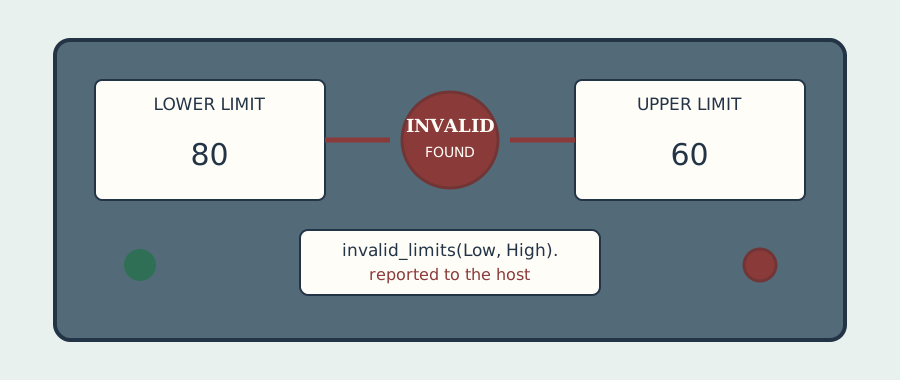
invalid_assignment(Person, Role, Other) :-
  assigned(Person, Role),
  incompatible_roles(Role, Other),
  assigned(Person, Other).
The logical reading is that the program can derive witnesses for an inadmissible combination. The operational response is outside the relation itself and remains an explicit host decision.
Designing an integrity relation
Start with a sentence that must never be accepted, then translate its witnesses into positive, finite goals. “No person has two incompatible roles” becomes the relation above. A useful integrity check is:
- domain-specific: it names an impossible or inadmissible state;
- finite: its intended validation query can be checked completely;
- diagnostic: its arguments identify the offending records; and
- explicit: callers can choose whether to reject, report, or inspect defects.
Four outcomes that can look like “failure” at a shell prompt have different meanings:
| Outcome | Interpretation | Appropriate response |
|---|---|---|
| query has no answer | this theory did not derive the selected goal | inspect data, rules, and closed-world assumptions |
| integrity query has an answer | the supplied input contains a forbidden combination | repair, reject, or report the input |
| resource ceiling is reached | the computation exceeded an operational budget | bound or redesign the search |
| parser or type error | the program or call violates the language contract | correct the source or interface |
Do not treat every undesirable business result as invalid input. A declined application, unavailable route, or negative test may be a perfectly valid answer of the theory. Reserve integrity relations for states whose witnesses must be handled before trusted downstream decisions.
To see the explicit validation path, run:
node bin/webentail.js examples/integrity-check.pl
It prints the invalid-state witness and the resulting diagnostic status. Nothing runs implicitly before the supplied goals.
Checkpoint. Explain the difference between an ordinary query with no answer and an integrity query that returns a defect. Write one invalid-state relation and one ordinary negative result that should remain query failure.
13. Termination, tabling, and performance
Declarative clarity and operational care reinforce each other. Bind selective arguments early, keep generators finite, and make decreasing structure visible.
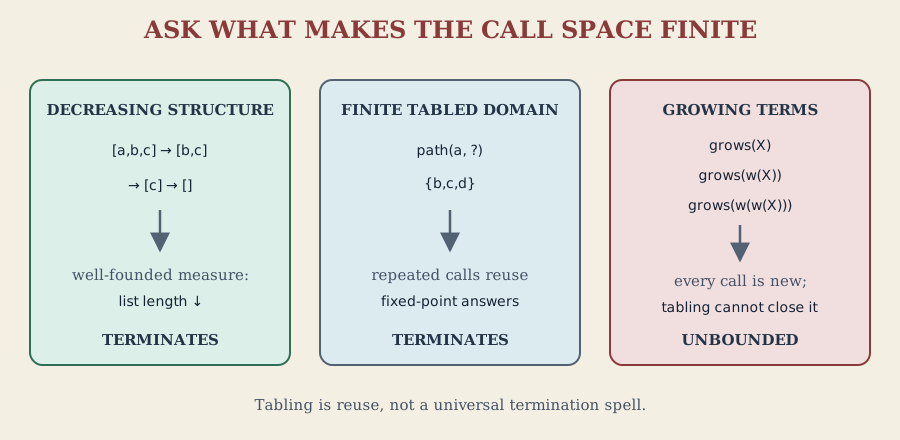
Naive depth-first search can revisit the same recursive question indefinitely. Tabling changes the unit of work: a call pattern becomes a shared subproblem, its answers are remembered, and consumers reuse answers rather than expanding the same call again. This idea connects logic programming to memoization and dynamic programming, but tabling also has a semantic role: over a finite positive recursive domain, repeated rounds can compute the least fixed point. It is therefore especially natural for reachability, grammars, dependency analysis, and other recursive relations with overlapping subproblems.
Ordinary goals use indexed depth-first resolution. Positive recursive groups are tabled automatically. Bound recursive calls reuse answers and cyclic calls iterate toward a fixed point. Fully open or structurally unbounded calls may retain ordinary resolution. Recursive components with negative dependencies are not positive fixed points.
Deeper implementation: how clause indexing stays semantic
This section explains why an optimization does not change clause meaning. Readers focused on modeling may skip to the statistics command and return when performance or implementation portability becomes relevant.
Every predicate group keeps compact indexes for scalar values in each argument
position. Index keys include the scalar type, so 7, '7', and "7" remain
distinct even though their printed payload is the same. A clause whose indexed
head argument is a variable or structured term
stays in a fallback set, and the selected candidates are merged back into
source order before unification. An index narrows where to look; it never
decides whether a clause matches.
For groups of at least ten clauses, a call with several bound scalar arguments may cause a wider combined index to be built on demand. The admission policy rejects indexes with too many variable fallbacks or too little expected speedup, and requires a combined index to improve substantially over the best single-argument index. These choices are performance details: removing every index should change running time, not answers or clause order.
Authors choose query modes, finite domains, visited-state representations, negation strata, and witness size. They normally do not choose the engine’s search strategy.
Inspect counters without changing answer output:
webentail --stats examples/observability-log-correlation.pl
The reported counters include completed goal lists, calls to the goal solver and single-goal solver, unification attempts, maximum depth and goal-list size, deterministic built-in successes and failures, and table fixed-point rounds. They describe work performed, not logical truth. Compare counters only across equivalent queries and the same implementation version.
Common sources of nontermination are recursive calls made before constraints, ever-growing terms, infinite open mathematical queries, negative cycles, and path enumeration without a visited set. Repair the model by strengthening the query, adding a finite domain, tracking states, or exposing a decreasing argument.
Checkpoint. Classify three recursive calls: one justified by a decreasing list, one by finitely many tabled graph answers, and one that constructs terms without bound. State why the first two may terminate and why tabling does not repair the third.
14. Knowledge engineering
A maintainable theory separates:
- source facts: measurements, records, and asserted relationships;
- helpers: normalization, classifications, and reachability;
- decisions:
status/2,action/2,risk/2, andreason/2; - integrity constraints: rules headed by
false; - outputs: focused host-supplied goals.
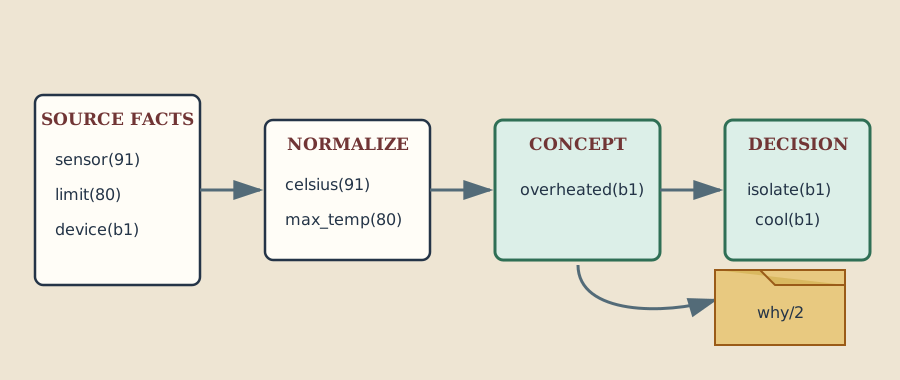
Prefer positive domain concepts. Use negation only across a closed boundary. Represent confidence, alternative worlds, and provenance explicitly rather than hiding them in rule order.
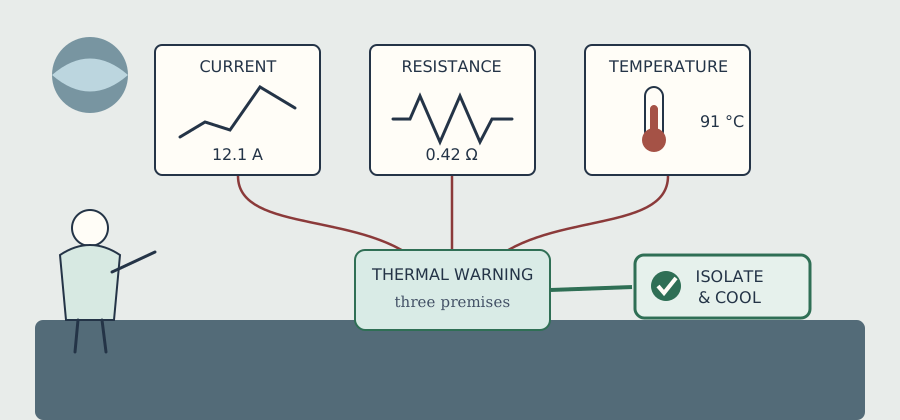
An evidence-backed diagnosis can separate physics from policy:
heating(Battery, Watts) :-
  current(Battery, Amps),
  resistance(Battery, Ohms),
  (I2 is Amps * Amps),
  (Watts is I2 * Ohms).

thermal_warning(Battery) :-
  heating(Battery, Watts),
  heating_limit(Limit),
  (Watts > Limit),
  temperature(Battery, Celsius),
  temperature_limit(TLimit),
  (Celsius > TLimit).

action(Battery, isolate_and_cool) :- thermal_warning(Battery).
Physics, limits, redundant sensing, and policy become distinct proof steps. See
examples/spacecraft-battery-diagnosis.pl for a complete case.
Test theories with successful derivations, expected failures, boundary values, duplicate paths, contradictory inputs, and proof premises. The repository’s conformance cases, example goldens, and proof goldens demonstrate these levels.
Checkpoint. Draw four columns for the battery example: source, physical concept, decision, and integrity. Place each predicate in a column, then list the measurements and policy thresholds that a proof cannot authenticate by itself.
15. RDF 1.2 as the interoperable data boundary
WebEntail keeps RDF 1.2 at an explicit standards boundary. Adapter tools translate
datasets into ordinary rdf(Subject, Predicate, Object, Graph) facts, allowing
standard RDF data to be queried by the supported ISO Prolog profile:
This chapter is an application route, not a prerequisite for Part IV. Readers who do not work with Web data can retain one principle—translate external data at an explicit boundary—and continue at Chapter 17.
RDF is a data model before it is a file format. Its basic unit is a directed, labeled statement identified with Web IRIs; concrete syntaxes such as Turtle, JSON-LD, and RDF/XML are different ways to serialize that model. Datasets add named graphs, and RDF 1.2 adds triple terms and directional language strings. Keeping the adapter explicit prevents serialization concerns from leaking into ordinary Prolog rules and makes the boundary between Web identity and local logical terms visible.
The four-argument representation is intentionally conservative. It does not claim that an RDF graph and a Prolog rule set have the same semantics. It preserves RDF terms and graph membership as data, after which Prolog rules may derive application-specific conclusions. This separation matters because RDF normally supports open-world data integration, whereas a Prolog rule may use a closed finite relation, negation as failure, or an explicit integrity relation.
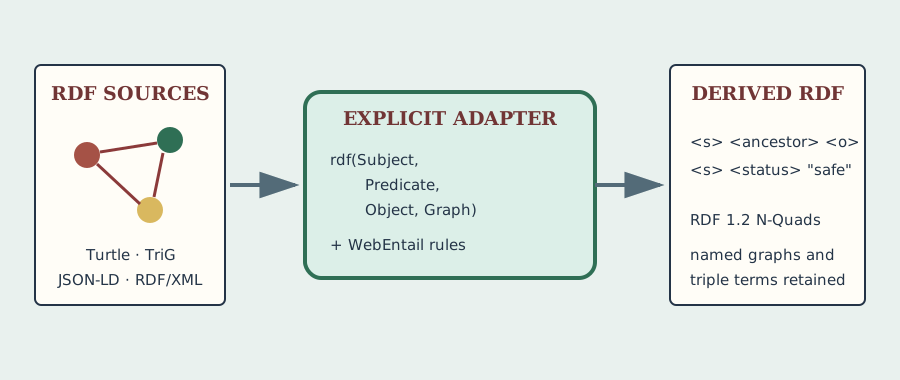
node tools/rdf-to-webentail.mjs --rules rules.pl data.trig -o program.pl
webentail program.pl > derived.pl
node tools/webentail-to-rdf.mjs derived.pl -o derived.nq
Supported inputs include RDF 1.2 Turtle, TriG, N-Triples, N-Quads, RDF/XML,
JSON-LD, RDFa, Microdata, Notation3, and SHACL Compact Syntax. For stdin, supply
--format; use --base for relative IRIs.
| RDF value | Prolog term |
|---|---|
| IRI | iri(Value) |
| Blank node | bnode(Scope, Label) |
| Typed literal | literal(Value, datatype(IRI)) |
| Language string | literal(Value, lang(Language)) |
| Directional string | literal(Value, lang(Language, ltr)) or lang(Language, rtl) |
| RDF 1.2 triple term | triple(Subject, Predicate, Object) |
| Default graph | default_graph |
Scopes distinguish blank nodes from different documents. Triple terms may nest, and named graphs occupy the fourth argument.
rdf(S, iri("https://example/ancestor"), O, G) :-
  rdf(S, iri("https://example/parent"), O, G).
By default, source quads support inference but are not copied to output. Pass
--include-source to retain them. Output is RDF 1.2 N-Quads. See
tools/README.md for the full adapter contract.
Checkpoint. For one RDF statement, identify its subject, predicate, object, and graph term after conversion. Then explain why preserving a triple term as nested data does not assert that nested triple as a global WebEntail fact.
16. Embedding WebEntail
The JavaScript API exposes a convenience runner and lower-level types:
import { run, Program, Solver } from 'webentail';

const result = run(`
webentail --goal 'answer(X)' program.pl
answer(ok) :- ok = ok.
`);
console.log(result.stdout);
console.log(result.stats);
The first console.log prints answer(ok). followed by a newline. The second
prints numeric work counters; those counters describe this run rather than an
additional logical answer.
run/2 accepts source text or an already parsed Program. Its options include
proof (with why and explain as aliases), maxDepth, solutionLimit, a
custom registry, and strictNegation or analyzeNegation. It returns
stdout, the solver’s numeric stats, and a nullable haltCode; it does not
write to the process streams.
For applications that inspect or prepare a theory before running it, use
Program directly:
const source = `
webentail --goal 'path(a, X)' program.pl
edge(a, b).
edge(b, c).
path(X, Y) :- edge(X, Y).
path(X, Z) :- edge(X, Y), path(Y, Z).
`;

const program = Program.parse(source, { analyzeNegation: true });
const path = program.findGroup('path', 2);

console.log(program.queries);
console.log(program.stratifiedNegation);
console.log(path?.recursive, path?.tabled, path?.tableInputPositions);

const solver = new Solver(program, {
  maxDepth: 50_000,
  solutionLimit: 100_000
});
The limits are safety ceilings, not logical declarations. Reaching one may truncate search; it does not prove that no further answer exists.
Implementation boundary
The source layout mirrors the public registry boundary. src/iso.js contains
the isolated ISO processor predicates and registry. src/library.js contains
the complete WebEntail library predicates as native JavaScript
builtins described in Chapter 39. No bundled Prolog source is parsed or
overlaid at startup. Normal CLI, JavaScript, solver, and proof execution uses
that composed registry. The browser entry src/playground-worker.js constructs
the same registry explicitly before calling run(), which keeps library
availability independent of CLI flags and stale worker state. Advanced
embedders and conformance tests can still select the ISO-only registry
explicitly. All paths share the parser, term representation, solver, streams,
and proof machinery.
Extending the built-in registry
An embedder can start from the default WebEntail registry and add a host relation. A handler is a generator over environments. It should clone before binding and yield only environments in which its result unifies:
import {
  atom,
  createWebEntailRegistry,
  run,
  unify
} from 'webentail';

const registry = createWebEntailRegistry();

registry.add(
  'host_status',
  2,
  function* ({ goal, env }) {
    const next = env.clone();
    if (
      unify(goal.args[0], atom('service'), next) &&
      unify(goal.args[1], atom('ready'), next)
    ) {
      yield next;
    }
  },
  { deterministic: true }
);

const result = run(`
webentail --goal 'answer(X)' program.pl
answer(X) :- host_status(service, X).
`, { registry });
Only mark a built-in deterministic when it can produce at most one environment
for a call. A mode-sensitive extension can additionally provide ready,
fallbackWhenNotReady, and shouldUse metadata. This metadata affects
dispatch and safe early filtering, so it belongs to the extension’s contract.
The ISO false/0 built-in always fails, and source clauses that attempt to
define it raise permission_error(modify, static_procedure). Programs expose stratification diagnostics through
stratifiedNegation, negationStratificationErrors, and
assertStratifiedNegation().
Treat remote source as executable logic. Although WebEntail has no arbitrary host call primitive, search can consume CPU and memory. Embedders should impose appropriate depth, solution, input-size, and time limits.
Those ceilings are operational safeguards. If one is reached, report an incomplete computation rather than turning truncation into a negative domain conclusion.
Sockets: naming the knowledge boundary
Rules often outlive the source of their facts. Today parent/2 may be written
in the same file as ancestor/2; tomorrow it may come from a database adapter,
a document extractor, or an agent. An WebEntail Socket gives that opening a
name and a contract:
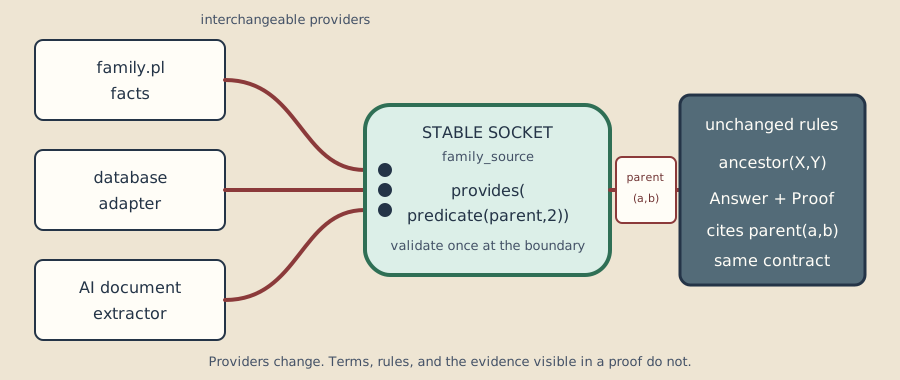
socket(family_source, provides(predicate(parent, 2))).
plug(family_file, family_source).

parent(pat, jan).
parent(jan, emma).

ancestor(X, Y) :- parent(X, Y).
ancestor(X, Z) :- parent(X, Y), ancestor(Y, Z).
The portable vocabulary is deliberately small:
socket(Name, Contract).
plug(Provider, Name).
provides(Signature).
requires(Signature).
These are ordinary facts, not magic solver directives. A host may validate or act on them, but the core proof procedure does not. This modest design is useful: a host that knows nothing about sockets can still read the program, reason with the supplied clauses, and explain its answers. A host that does know about them can check that a provider offers the promised predicate.
Sockets are particularly valuable at an AI boundary. A model can propose
claims, but the claims should enter the theory as visible facts or rules. The
socket states what kind of knowledge may enter; WebEntail checks and combines the
result; why/2 records which supplied clauses actually supported an answer.
Checkpoint. Name three separate responsibilities in an embedded service: what the host validates before constructing terms, what WebEntail derives from those terms, and what resource limits may interrupt the run. None can safely stand in for the other two.
Part III summary
Part III moved from obtaining answers to trusting them:
- a query selects a question; a proof records one successful justification;
- an explicit integrity query identifies input that a host may reject;
- automatic tabling computes fixed points for eligible positive recursion;
- indexing and ready filters improve control without changing intended meaning;
- knowledge engineering separates sources, concepts, decisions, and reasons;
- RDF adapters preserve external distinctions at an explicit boundary;
- embedding and sockets divide logical derivation from host authority.
You should now be able to distinguish proof trees from search trees, state what an integrity query establishes, explain the finite-answer argument behind tabling, and name which trust duties remain outside the solver.
Historical note: from answers to accountable inference
The least-model semantics developed by van Emden and Kowalski in 1976 connected definite programs to a mathematical fixed point: repeatedly add supported ground consequences until nothing new appears. Tabled logic programming later turned fixed-point ideas into a goal-directed technique that shares recursive calls and accumulates answers. WebEntail’s automatic positive tabling is smaller than the general systems in that literature, but inherits their central insight: remembering a recursive question can change termination without changing what the relation says.
In parallel, deductive databases and Semantic Web systems asked where facts come from, how vocabularies align, and how derived claims retain provenance. EYE belongs to that proof-producing Semantic Web tradition. WebEntail adopts the expectation that conclusions should be inspectable while implementing a focused ISO Prolog profile and explicit RDF 1.2 adapters.
The historical lesson is architectural. A proof procedure can attest that a conclusion follows from supplied clauses. It cannot authenticate a database, calibrate a sensor, or authorize a request. Systems became more trustworthy when those boundaries became named rather than implicit.
Part IV — The craft of logic programming
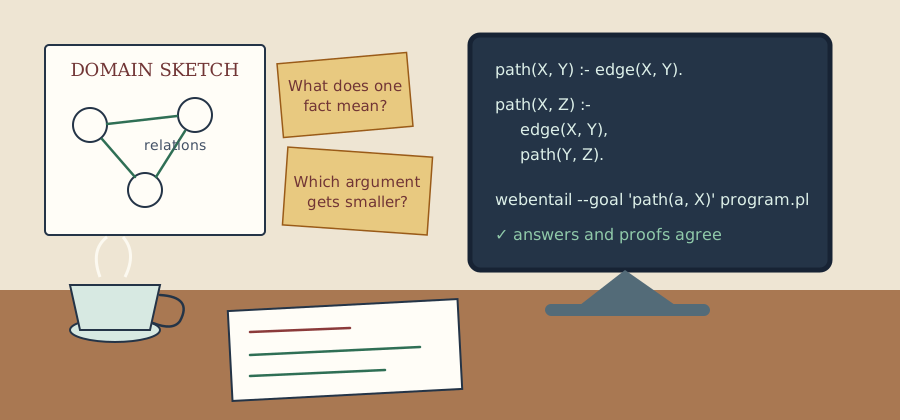
This Part turns from implementation features to habits of construction. A good program rarely arrives whole; it is discovered through examples, corrected by invariants, and refined without losing sight of the relation it means.
17. Logic and control
The central pleasure—and central difficulty—of logic programming is that a short definition plays two roles. Consider:
This distinction is one of logic programming’s oldest and most durable design ideas. The logical component describes admissible answers; the control component determines which consequences are explored, in what order, and with what resource cost. A change in indexing, goal order, or tabling policy should ideally preserve the first while improving the second. In practice, modeful built-ins and incomplete searches mean that programmers must reason about both.
path(X, Y) :- edge(X, Y).
path(X, Z) :- edge(X, Y), path(Y, Z).
As logic, the clauses say that every edge is a path and that an edge followed by a path is a path. As control, they tell the solver to try a direct edge first, then choose an outgoing edge and continue from its endpoint.
It is useful to write the relation first as a sentence:
path(X, Y)holds when there is a finite sequence of edges fromXtoY.
That sentence is independent of clause order. It is the specification against which examples and counterexamples can be judged. Only then ask procedural questions: which argument will normally be known, which goal generates a finite set, and which recursive call is smaller or already tabled?
The same relation, a different computation
Conjunction is logically commutative, but its textual order guides search. These two rules have the same intended ground consequences:
adult(Person) :- person(Person), age(Person, Age), (Age >= 18).

adult(Person) :- (Age >= 18), age(Person, Age), person(Person).
The first is executable in the natural open mode because person/1 and
age/2 bind values before >=/2 inspects them. The second asks a comparison
to operate on unbound variables and fails. Logical equivalence therefore does
not imply equivalent behavior for a goal-directed interpreter with modeful
built-ins.
Clause order also gives a search order. Put simple and common proofs where they can be found cheaply, provided doing so does not starve a necessary base case. A recursive clause that calls itself before consuming input is a warning:
% Poor control: recursion starts before one list cell is exposed.
bad_member(X, List) :- bad_member(X, Rest), (List = [_ | Rest]).
The usual definition exposes the decreasing structure first:
item(X, [X | _]).
item(X, [_ | Rest]) :- item(X, Rest).
Modes are part of the design
A predicate has one logical meaning but may support several useful calling
patterns. append(Prefix, Suffix, Whole) can:
- construct
Wholewhen the first two arguments are known; - remove a known prefix;
- enumerate every split of a known finite list.
It is not a useful generator when all three arguments are free: there are infinitely many lists. Before accepting a predicate design, make a small mode table:
| Call | Intended use | Finite? |
|---|---|---|
append(+,+,-) |
concatenate | yes |
append(-,-,+) |
enumerate splits | yes |
append(-,-,-) |
generate all triples | no |
The + and - marks are documentation, not supported Prolog syntax.
A mode is a promise about calls, not a replacement for the relation’s meaning. When a rule calls a helper outside its promised mode, the program may remain logically plausible while becoming operationally useless.
Search trees and proof trees
A proof tree contains only the successful choices supporting one answer. A search tree also contains failed alternatives and repeated attempts. Proof output shows the former; performance counters give clues about the latter. Confusing the two leads to a common surprise: a tiny proof may have required a large search.
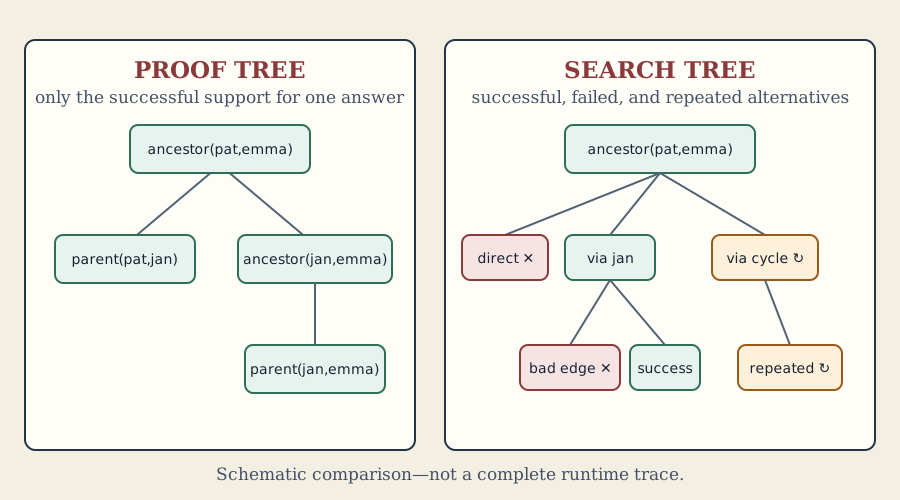
The distinction also explains why explanations are not performance profiles.
Removing a failed branch can make a program dramatically faster without
changing the final why/2 term. Conversely, introducing a well-named helper
may make a proof longer on paper while making it far clearer to a reader.
When a program is slow, sketch the first few levels of its search tree. Mark:
- the selected leftmost goal;
- the clauses or built-ins that can solve it;
- bindings produced by each choice;
- the next selected goal;
- branches that repeat a previous call.
This exercise often reveals that the model is sound but a generator is too broad, a constraint is too late, or a witness carries needless alternatives.
Checkpoint. Take one clause and write two notes beside it: its ground meaning and its intended mode. Reorder two body goals, predict whether the answer set, termination, first answer, or proof shape changes, and only then run the variant.
18. Constructing a program
A good logic program is rarely discovered by typing clauses from top to bottom. It is constructed by moving between examples, relations, and invariants.
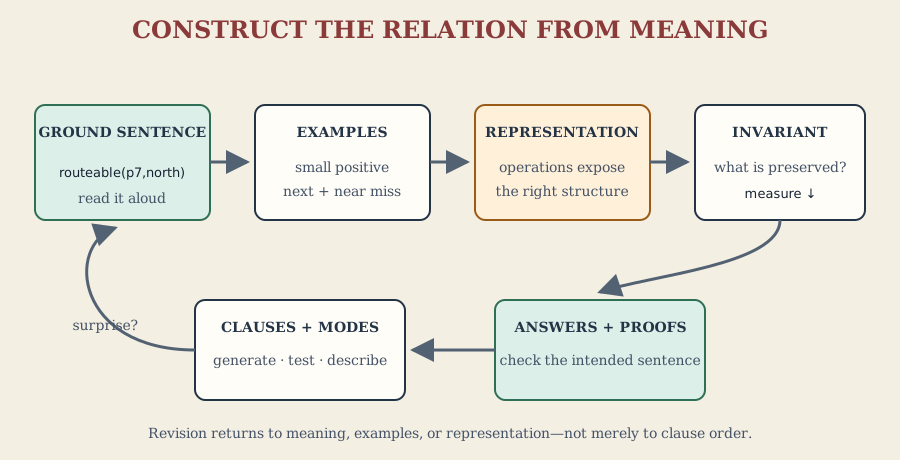
Begin with ground sentences
Suppose packages must be routed through compatible hubs. Start with sentences that contain no variables:
routeable(parcel_7, hub_north).
Decide exactly what that sentence claims. Does it mean the parcel can enter the hub, can leave it, or can complete an entire route through it? Ambiguity in a ground sentence becomes ambiguity in every rule built on it.
Now name the evidence:
routeable(Parcel, Hub) :-
  destination_zone(Parcel, Zone),
  serves(Hub, Zone),
  package_class(Parcel, Class),
  accepts(Hub, Class).
The variables express the joins already present in the English explanation. No variable should appear merely because “a value might be needed later.” Every repeated variable asserts identity; every distinct variable permits difference.
Invent examples before recursion
For a recursive relation, write the smallest positive example, the next larger positive example, and a near miss. For list prefixes:
prefix([], [a,b])          true
prefix([a], [a,b])         true
prefix([b], [a,b])         false
The empty example suggests the base clause. Comparing the second example with a smaller one suggests removing a matching head from both lists:
prefix([], _).
prefix([X | Xs], [X | Ys]) :- prefix(Xs, Ys).
This is a general construction method: find a measure that becomes smaller, preserve the invariant while reducing it, and state directly the case where no reduction is needed.
Separate generate, test, and describe
Finite combinatorial programs become easier to read when their jobs are separate:
candidate_pair(A, B) :-
  person(A),
  person(B).

compatible_pair(A, B) :-
  candidate_pair(A, B),
  (A \= B),
  \+ conflict(A, B).

answer(pair(A, B)) :- compatible_pair(A, B).
candidate_pair/2 states the domain. compatible_pair/2 states the
constraints. answer/1 controls presentation. The split is not bureaucratic:
it makes the closed domain visible, gives negation bound arguments, and makes
proofs say whether a step generated or rejected a choice.
For performance, tests may be interleaved as soon as their inputs are ready:
compatible_pair(A, B) :-
  person(A),
  person(B),
  (A \= B),
  \+ conflict(A, B).
The conceptual separation remains even when the final clause is compact.
Choose representations by the operations they support
The same domain can be represented in many ways. A graph may be edge facts, a list of edge terms, or a context. Ask which questions dominate:
- Separate
edge/2facts suit indexed relational lookup and proof provenance. - A list suits passing a private, changing graph through a recursive helper.
- A compound state term suits transitions that replace several components.
- A comma context suits inspecting a small record whose fields are themselves structured assertions.
Do not encode structure into strings and then recover it throughout the
theory. Parse once at the boundary. A term such as
address(City, PostalCode) can be unified, inspected, and explained; a string
containing the same data needs repeated procedural parsing.
Grow a theory through layers
Large rule sets benefit from a dependency direction:
source facts → normalized facts → domain concepts → decisions → answers
Negation should normally point in the same direction, from a higher layer to a complete lower layer. Cycles among positive domain concepts may be tabled; cycles through negation usually signal that the concepts have not been given a stable meaning.
At every layer, add one representative query. Do not wait for the final decision predicate to discover that normalization silently failed. Small queries are the logic-programming counterpart of inspecting intermediate values, but they retain the declarative vocabulary of the model.
Checkpoint. Before writing rules for a small domain of your own, record three positive ground examples, one near miss, the intended query mode, and a candidate finite generator. If the ground sentences are ambiguous, revise the predicate names before introducing variables.
19. Correctness and termination
Testing examples is necessary, but a reusable relation deserves a stronger argument. Two questions should be asked separately:
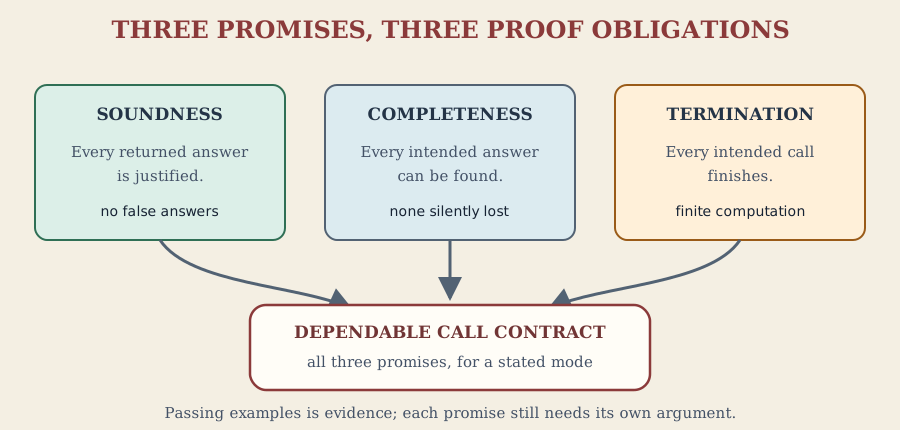
- Partial correctness: if the program returns an answer, is it justified?
- Completeness: for the intended finite calls, can it find every answer required by the specification?
For prefix/2, partial correctness follows by the clauses. The base clause
returns only the empty prefix. The recursive clause adds the same head to a
smaller valid prefix, so the result remains a prefix. Completeness follows in
the opposite direction: every nonempty prefix shares its first element with
the whole list, and removing that element yields a smaller prefix problem
covered by the recursive clause.
This informal induction is often enough. State the property, justify each base clause, assume recursive calls satisfy it, and show that each recursive clause preserves it.
Termination needs its own argument
A correct relation may still fail to return. For ordinary structural recursion, identify a well-founded measure:
- length of the remaining list;
- a nonnegative integer that decreases;
- number of unvisited states in a finite graph;
- size of a syntax tree.
The measure must decrease before the recursive call in the intended mode. For
factorial, N decreases while remaining a nonnegative integer:
factorial(0, 1).
factorial(N, F) :-
  (N > 0),
  (Previous is N - 1),
  factorial(Previous, PF),
  (F is N * PF).
Reordering the subtraction after the recursive call preserves a mathematical equation but destroys the termination argument.
Tabling changes the argument for graph recursion. A cyclic path/2 call can
terminate when the program has only finitely many distinct tabled calls and
answers. The measure is then not necessarily smaller at each edge; finiteness
comes from exhausting a finite answer space. Tabling cannot rescue a rule that
constructs s(s(s(...))) without bound.
Negation and aggregation require bounded subsearch
\+ Goal, forall/2, and aggregates ask the engine to settle a nested
search. Their meaning is usable only when that search can finish. Before
writing:
\+ disqualified(Person)
check that Person is bound and that disqualified/1 has a finite search for
that value. Before collecting routes, decide whether only simple routes, only
routes below a cost, or some other finite family is intended.
Integrity is not merely failure
Ordinary failure says that one attempted proof did not work. An explicit integrity relation can instead return the evidence for an invalid state:
invalid_limits(Name, Low, High) :-
  lower_limit(Name, Low),
  upper_limit(Name, High),
  (Low > High).
This distinction matters operationally and socially. A failed eligibility
query may be a legitimate negative result. A successful invalid_limits/3
query identifies contradictory limits; the host can then stop decisions until
the input is repaired.
Checkpoint. For one recursive relation, state three claims separately: partial correctness, completeness in one intended mode, and termination in that mode. Give the invariant supporting the first two and the decreasing measure or finite table supporting the third.
20. Improving a program
Program improvement begins with observation, not cleverness. Preserve a set of representative answers and proofs, collect solver statistics, and change one structural choice at a time.
Strengthen calls before adding machinery
The most effective improvement is often a better question. Prefer
route(brussels, Destination) to a completely open enumeration if the
application already knows its origin. Put selective, indexed relations early
enough to bind arguments for later work. Avoid constructing a large witness
when the caller needs only existence.
Compare:
connected(X, Y) :- path_with_nodes(X, Y, _).
with a direct reachability relation that tables pairs. The first may enumerate many distinct paths to establish one fact; the second records the fact itself. Keep the witness-producing relation for callers that truly need a path.
Introduce helpers that express invariants
Inlining every condition creates wide clauses with repeated work. A helper can name a stable concept:
within_thermal_limits(Battery) :-
  temperature(Battery, T),
  temperature_limit(Max),
  (T =< Max).
The gain is not just reuse. Proofs now contain a domain statement, and later
changes to the limit policy have one home. Choose helpers that add vocabulary;
avoid names such as step2/3 that merely expose an implementation sequence.
Move invariant work outward
If a recursive call repeatedly computes a value that does not change, compute it once and pass the result:
search(Request, Answer) :-
  normalized_request(Request, Normalized),
  search_normalized(Normalized, initial_state, Answer).
This resembles loop-invariant code motion in procedural programming, but the relational formulation is explicit: the helper’s arguments show exactly which values vary from step to step.
Preserve meaning while changing control
Reordering goals, adding a helper, or specializing a predicate should preserve the intended ground answers. Verify that with:
- ordinary positive examples;
- cases expected to fail;
- duplicate derivations;
- boundary numeric values;
- cyclic data;
- proof premises, not only printed conclusions.
An optimization that changes which proof is found first may affect once/1,
tie-breaking aggregates, and explanation shape even when the answer set is
unchanged. Treat those observable choices as part of the calling contract
whenever users depend on them.
Know when to stop
Not every relation should be made maximally general. A three-mode predicate can be harder to terminate, explain, and index than two simple predicates with clear contracts. Generalize when a real second use appears. The art lies in keeping the logical idea visible while giving it enough control to run well.
Checkpoint. Save representative answers, one proof, and solver statistics for a program. Make exactly one control change, rerun all three views, and classify every difference as intended, harmless but observable, or a regression.
Part IV summary
Part IV treated logic programming as a discipline of construction:
- write the relation’s sentence before choosing its control;
- record intended modes and finite uses;
- begin with ground examples and invent recursion from one proof;
- choose representations by the operations and invariants they expose;
- argue correctness, completeness, and termination separately;
- improve programs by strengthening calls and naming invariants;
- preserve answers while reviewing observable proof or ordering changes.
You should now be able to construct a theory from examples, state a termination measure, refactor a helper without losing meaning, and recognize when greater relational generality has no practical use.
Historical note: logic plus control
Kowalski’s 1979 formulation “algorithm = logic + control” gave a durable name to the dual reading developed here. The logic component specifies knowledge; control determines how it is used. The slogan did not claim that control was unimportant. It argued that control can often be improved while meaning stays steady, and that programs become easier to reason about when the two are distinguished.
The craft tradition of Prolog grew around this tension. Goal ordering, accumulators, generate-and-test, and representation change were never merely interpreter tricks. At their best they were transformations justified by invariants and modes. Sterling and Shapiro made construction and improvement central to The Art of Prolog, showing that declarative clarity and procedural competence mature together.
WebEntail removes several classic Prolog control devices, especially cut. The smaller surface changes the techniques but not the problem: authors must still turn a true relation into a productive computation and say what was preserved.
Part V — Advanced relational design
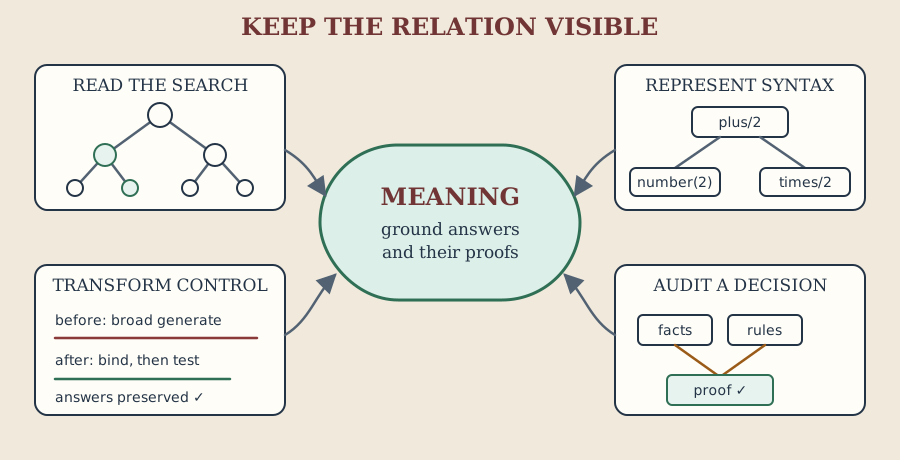
The earlier parts introduced the supported Prolog profile and the habits needed to use it safely. This part stays longer with whole computations. It asks how to inspect a search tree, represent languages and evaluators as relations, transform a correct program without losing its meaning, and organize a decision system whose conclusions remain auditable.
WebEntail now supplies the Part 1 control, dynamic-database, operator, and I/O families. It remains deliberately smaller than the wider Prolog ecosystem: modules, predicate variables in callable position, and definite-clause grammar notation are outside this profile. The examples still prefer explicit domain relations, state, and syntax trees where that makes assumptions easier to inspect.
21. Reading the computation
A query is not solved in one leap. It is reduced to goals, each goal is matched against candidate clauses, and each successful match contributes bindings and new subgoals. The computation has two kinds of branching:
- an and step, because every goal in a rule body must succeed;
- an or step, because any matching clause may establish a goal.
This and–or structure is the operational counterpart of the program’s logical structure. A conjunction asks for several supporting claims; multiple clauses offer alternative justifications.
parent(ada, byron).
parent(byron, clara).
parent(clara, diego).

ancestor(X, Y) :- parent(X, Y).
ancestor(X, Z) :- parent(X, Y), ancestor(Y, Z).

webentail --goal 'ancestor(ada, Who)' program.pl
For ancestor(ada, Who), the first clause asks
parent(ada, Who) and produces Who = byron. The second clause asks two
questions in sequence. parent(ada, Y) first binds Y = byron; the remaining
call is therefore ancestor(byron, Who). That call repeats the choice between
a direct-parent proof and a longer proof.
The three answers occupy increasing depths of one proof family:
ancestor(ada, byron)
  parent(ada, byron)

ancestor(ada, clara)
  parent(ada, byron)
  ancestor(byron, clara)
    parent(byron, clara)

ancestor(ada, diego)
  parent(ada, byron)
  ancestor(byron, diego)
    parent(byron, clara)
    ancestor(clara, diego)
      parent(clara, diego)
Drawing even a partial tree exposes errors that are hard to see in source alone: a variable that should have been shared, a recursive call that did not consume input, or a generator placed after the test that needs its output.
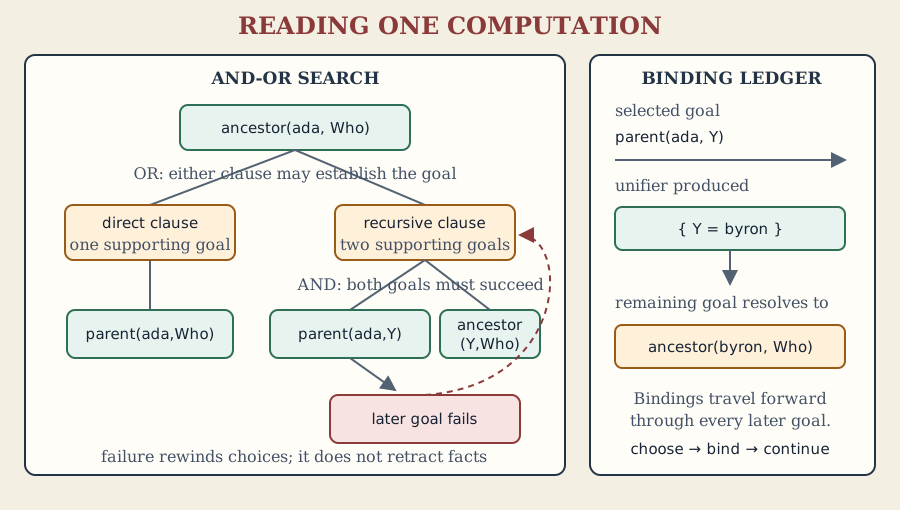
Substitutions accumulate
A substitution is a set of bindings carried through the remaining goals. Bindings are not local return values. If the first goal binds a variable, every later occurrence of that variable sees the same term:
grandparent(X, Z) :-
  parent(X, Y),
  parent(Y, Z).
Solving grandparent(ada, Z) begins with parent(ada, Y). Once that goal
binds Y to byron, the second goal is the selective
parent(byron, Z).
Repeated variables impose equality through unification:
loop_edge(Node) :- edge(Node, Node).
This does not find an arbitrary edge and compare its endpoints later. The shared variable makes equal endpoints part of the pattern being matched.
Failure rewinds choices, not facts
Suppose a later goal fails:
eligible(Person) :-
  applicant(Person),
  age(Person, Age),
  (Age >= 18),
  verified(Person).
Failure of verified(Person) rejects the current combination of bindings.
Search may return to another age/2 fact or another applicant clause. It does
not retract source facts or erase answers already printed. Backtracking is
better understood as exploring alternatives than as undoing the world.
Variants, cycles, and tables
Recursive graph search can encounter the same logical subquestion through
different paths. Calls that differ only in variable names are variants:
path(a, X) and path(a, Y) pose the same pattern. Positive recursive groups
can table such patterns, share their answers, and stop a cycle from expanding
the same question forever.
The table does not prove termination for every recursive program. If each call constructs a larger pattern, then the calls are not variants:
grows(X) :- grows(wrapper(X)).
grows(A), grows(wrapper(A)), and
grows(wrapper(wrapper(A))) are distinct calls. Remembering them does not
make their number finite.
A practical tracing discipline
When a query surprises you, write down:
- the selected goal;
- its current resolved arguments;
- the candidate clause;
- the unifier produced by the head;
- the new body goals;
- the point to which failure would return.
Compare that hand trace with --proof for a successful answer and --stats
for the amount of search. Proofs explain one successful derivation; statistics
summarize work across successful and failed branches. Neither is a complete
trace, but together they usually locate the modeling issue.
Exercises.
- Draw the and–or tree for
ancestor(byron, Who). - Add a second parent of
claraand identify where the tree branches. - Write a cyclic
edge/2graph and compare reachability answers with the table rounds reported by--stats. - Construct a recursive rule whose call grows a list on every step. Explain why variant tabling does not make its call space finite.
Checkpoint. Hand-trace one successful answer and one failed branch using
the six-item tracing discipline. Compare the successful trace with --proof
and the total work with --stats; state one fact that each view omits.
22. Trees, languages, and symbolic evaluation
Compound terms are finite trees. A functor labels an internal node and its arguments are the children. Lists are one familiar tree encoding, but syntax, plans, types, circuits, formulas, and organizational structures can all be represented directly.
tree(
  oak,
  tree(birch, empty, empty),
  tree(pine, empty, empty)
).
A structural relation follows the representation:
tree_member(X, tree(X, _, _)).
tree_member(X, tree(_, Left, _)) :- tree_member(X, Left).
tree_member(X, tree(_, _, Right)) :- tree_member(X, Right).
The clauses say where a member may occur. They also define a search order:
root, then left subtree, then right subtree. If only membership matters, that
order is an implementation choice. If a caller uses once/1, it becomes
observable.
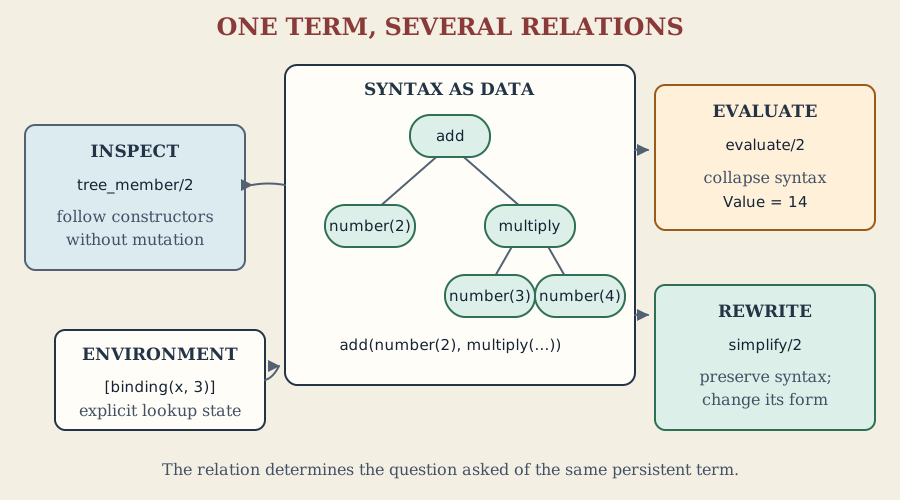
Transforming a tree
mirror(empty, empty).
mirror(
  tree(Value, Left, Right),
  tree(Value, MirroredRight, MirroredLeft)
) :-
  mirror(Left, MirroredLeft),
  mirror(Right, MirroredRight).
Read forward, mirror/2 constructs a mirror. With both trees ground, it
verifies the relationship. In some partially bound modes it can fill missing
structure. The rule does not mutate a tree; it relates two persistent terms.
The representation exposes an invariant: mirroring preserves every node value and exchanges left and right at every level. It also suggests a structural induction. The empty tree is its own mirror; if both recursive calls are correct, the constructed parent is correct.
A grammar without special syntax
A recognizer can relate an input list to its unconsumed suffix. The pair of arguments makes sequencing explicit:
sentence(Input, Rest) :-
  noun_phrase(Input, AfterNoun),
  verb_phrase(AfterNoun, Rest).

noun_phrase([the | Input], Rest) :- noun(Input, Rest).
noun_phrase([a | Input], Rest) :- noun(Input, Rest).

noun([robot | Rest], Rest).
noun([scientist | Rest], Rest).

verb_phrase(Input, Rest) :-
  verb(Input, AfterVerb),
  noun_phrase(AfterVerb, Rest).

verb([helps | Rest], Rest).
verb([observes | Rest], Rest).

complete_sentence(Words) :- sentence(Words, []).

webentail --goal 'complete_sentence([the, robot, helps, a, scientist])' program.pl
The first argument is the list before a phrase and the second is the suffix
after it. Composition is variable sharing: the suffix returned by
noun_phrase/2 becomes the input of verb_phrase/2. This is the central idea
behind difference-list grammars, expressed without dedicated notation.
The same relation can be a bounded generator when vocabulary and output length
are constrained by surrounding relations. An unconstrained
complete_sentence(Words) call can generate sentences of unbounded length if
the grammar is recursive. A grammar is also a search program, so its intended
modes need the same termination analysis as other recursive relations.
Interpreting an expression
Syntax trees separate the expression from the act of evaluating it:
evaluate(number(N), N).

evaluate(add(Left, Right), Value) :-
  evaluate(Left, L),
  evaluate(Right, R),
  (Value is L + R).

evaluate(multiply(Left, Right), Value) :-
  evaluate(Left, L),
  evaluate(Right, R),
  (Value is L * R).
webentail --goal 'evaluate(
    add(number(2), multiply(number(3), number(4))),
    Value
  )' program.pl
The value is 14. More importantly, the proof follows the syntax tree: two
literal evaluations support one multiplication and one addition.
An extension can add variables and an explicit environment:
lookup(Name, [binding(Name, Value) | _], Value).
lookup(Name, [_ | Rest], Value) :- lookup(Name, Rest, Value).

evaluate(variable(Name), Environment, Value) :-
  lookup(Name, Environment, Value).
Passing the environment as data avoids hidden global state. Shadowing is
determined by list order and should be documented as part of lookup/3.
Rewriting symbolic expressions
Evaluation collapses syntax to a value. Rewriting preserves syntax while replacing one form with an equivalent or preferred form:
simplify(add(number(0), X), X).
simplify(add(X, number(0)), X).
simplify(multiply(number(1), X), X).
simplify(multiply(X, number(1)), X).

simplify(add(A, B), add(SA, SB)) :-
  simplify(A, SA),
  simplify(B, SB).
Overlapping rules can produce several answers. That may be desirable when
exploring equivalent forms, but a normalizer needs a strategy and termination
measure. A rule that expands X to add(X, number(0)) reverses the first
simplification and permits unbounded rewriting.
Exercises.
- Define
tree_size/2andtree_height/2. - Extend the grammar with adjectives while preserving the input/suffix contract.
- Add subtraction to the evaluator and state which arguments must be ground.
- Define constant folding for
add(number(A), number(B)). - Explain why individually sensible rewrite rules may fail to terminate when repeatedly combined.
Checkpoint. For one compound term, label the object-language syntax, the WebEntail relation that inspects it, and the environment or state used to interpret it. Then identify a rewrite pair that would create a cycle if both directions were enabled.
23. Transforming programs
Program transformation changes clauses while attempting to preserve an intended relation. The useful question is not merely “does the new version run?” but “for which calls does it preserve answers, termination, answer order, and explanations?”
Four transformations recur in logic programs:
- unfolding replaces a call by the bodies of its defining clauses;
- folding names a repeated conjunction with a helper relation;
- specialization fixes known arguments and removes irrelevant choices;
- accumulation carries a partial result through recursion.
Each can improve control or reveal structure. Each can also change modes, duplicate work, or alter proof shape.
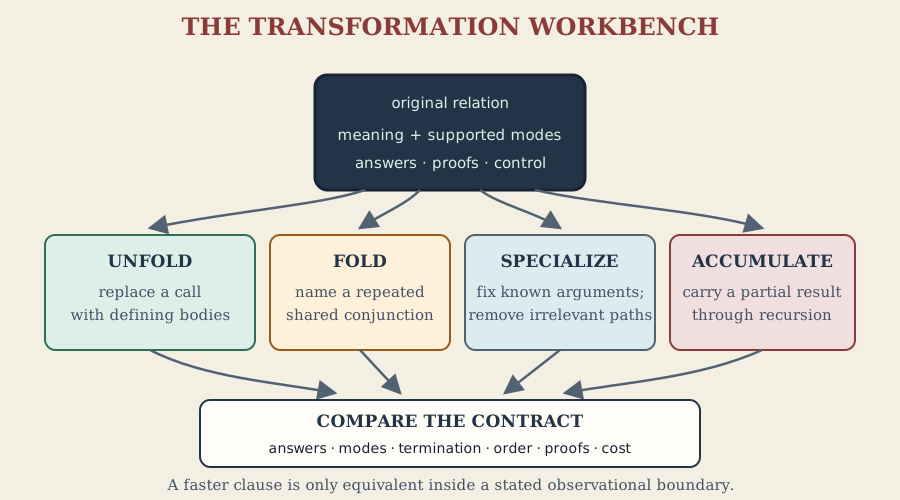
Unfolding and folding
Start with:
adult(Person) :-
  recorded_age(Person, Age),
  adult_age(Age).

adult_age(Age) :- (Age >= 18).
Unfolding adult_age/1 gives:
adult(Person) :-
  recorded_age(Person, Age),
  (Age >= 18).
For this deterministic helper, the ground answers are unchanged. The shorter
proof loses the named concept adult_age/1, however. That loss may be
undesirable in an auditable policy even if execution becomes slightly cheaper.
If a helper has several clauses, unfolding produces one caller clause for each
alternative. If it is recursive, unrestricted unfolding may never finish.
Folding moves in the other direction. Suppose decisions repeat:
can_board(Person) :-
  registered(Person),
  identity_checked(Person),
  \+ suspended(Person),
  has_ticket(Person).

can_enter_lounge(Person) :-
  registered(Person),
  identity_checked(Person),
  \+ suspended(Person),
  lounge_pass(Person).
Name the shared concept:
traveler_in_good_standing(Person) :-
  registered(Person),
  identity_checked(Person),
  \+ suspended(Person).

can_board(Person) :-
  traveler_in_good_standing(Person),
  has_ticket(Person).

can_enter_lounge(Person) :-
  traveler_in_good_standing(Person),
  lounge_pass(Person).
The helper is valuable because it has a stable meaning, not merely because
three lines became one. It creates one place to state and test the closed-world
assumption behind \+ suspended(Person).
Specializing a relation
A general transport database may use:
connection(Mode, From, To, Cost).
An application that only plans rail journeys can define:
rail_connection(From, To, Cost) :-
  connection(rail, From, To, Cost).
This wrapper establishes a stronger contract and gives indexing a bound first argument. Deeper specialization can precompute invariant classifications or remove irrelevant branches. Keep the general relation as the specification against which specialized answers are compared.
Accumulators and modes
A direct list sum performs work after recursion:
sum_numbers([], 0).
sum_numbers([X | Xs], Sum) :-
  sum_numbers(Xs, Rest),
  (Sum is X + Rest).
An accumulator makes the partial sum explicit:
sum_numbers_acc(List, Sum) :- sum_from(List, 0, Sum).

sum_from([], Accumulator, Accumulator).
sum_from([X | Xs], Accumulator, Sum) :-
  (Next is Accumulator + X),
  sum_from(Xs, Next, Sum).
For a ground numeric list, both versions return the same sum. They do not have identical relational behavior in every mode. The accumulator version requires each intermediate addition to be ready on the way down. State the intended mode instead of claiming unconditional equivalence.
A transformation checklist
Before replacing one definition with another, record:
- the intended ground relation;
- supported binding patterns;
- a termination measure for each supported pattern;
- whether duplicates and answer order matter;
- whether callers inspect proof structure;
- representative positive, negative, and boundary queries.
Then compare both versions. --stats can show fewer calls or unifications, but
performance evidence comes after semantic evidence. A faster program that
silently drops a mode is a different program.
Exercises.
- Unfold a two-clause helper and count the resulting caller clauses.
- Fold repeated validation conditions in two rules of your own.
- Specialize a generic graph relation for one edge type.
- Compare direct and accumulator-based length relations in several modes.
- Find a transformation that preserves answers but changes the first proof
selected by
once/1.
Checkpoint. Choose one original and transformed relation. Compare their answer sets in both directions over a finite domain, then separately compare termination, answer order, duplicates, proof shape, and solver statistics.
24. Designing finite search
Nondeterminism is not randomness. A nondeterministic relation defines several legitimate continuations, and search systematically explores them. The design problem is to make useful alternatives complete while keeping their number finite and their order productive.
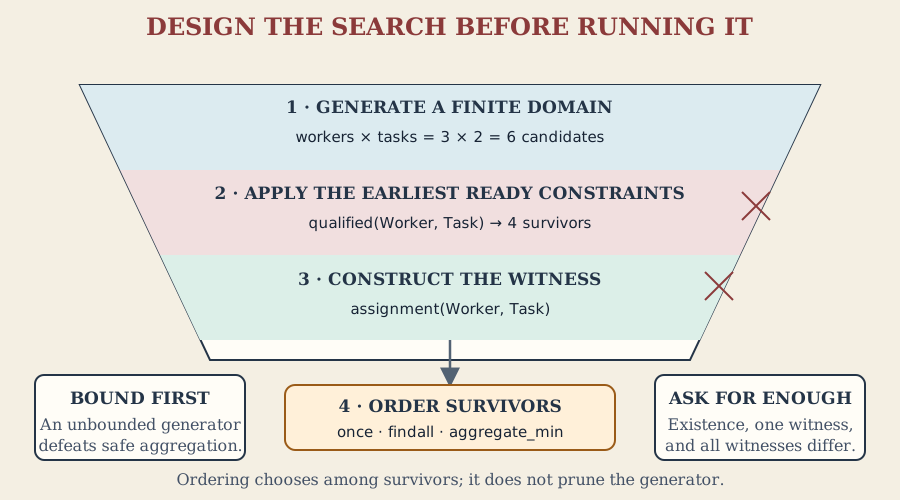
Generate, constrain, describe
A clear search program often has three layers:
- generate a candidate from a finite domain;
- constrain the candidate;
- describe or score the surviving witness.
worker(ada).
worker(byron).
worker(clara).

task(inspect).
task(repair).

qualified(ada, inspect).
qualified(byron, repair).
qualified(clara, inspect).
qualified(clara, repair).

assignment(Worker, Task) :-
  worker(Worker),
  task(Task),
  qualified(Worker, Task).

webentail --goal 'assignment(Worker, Task)' program.pl
worker/1 and task/1 make the search space explicit. qualified/2 is both a
constraint and a selective relation. If the application knows the task,
calling assignment(Worker, repair) avoids generating irrelevant task values.
Search over states
A state-space problem needs a state term, a finite move relation, a goal test, a policy for repeated states, and a witness representation. A simple graph path carries visited nodes:
simple_path(From, To, Path) :-
  walk(From, To, [From], Reversed),
  reverse(Reversed, Path).

walk(To, To, Visited, Visited).
walk(From, To, Visited, Path) :-
  edge(From, Next),
  not_member(Next, Visited),
  walk(Next, To, [Next | Visited], Path).
The visited list makes the witness finite on a finite graph. It also changes the question from arbitrary walks to simple paths. That is a modeling choice, not merely an optimization. A caller asking for repeated stops needs another bound, such as maximum steps or cost.
Existence, one witness, and all witnesses
These questions have very different costs:
reachable(From, To).
once(simple_path(From, To, Path)).
findall(Path, simple_path(From, To, Path), Paths).
Reachability needs only a pair and is a good candidate for tabling. One path may stop after the first witness. All simple paths may be exponentially numerous even though the graph is finite. Choose the weakest result that meets the caller’s need.
Optimization is search plus an order
An optimal answer requires a finite candidate relation and a comparison key:
best_plan(Request, Plan, Cost) :-
  aggregate_min(
    [CandidateCost, CandidatePlan],
    CandidatePlan,
    candidate_plan(Request, CandidatePlan, CandidateCost),
    [Cost, Plan],
    Plan
  ).
The structured key makes ties deterministic. It does not reduce the candidate
space: aggregate_min/5 must settle the nested search before knowing the
minimum. For a large problem, strengthen candidate_plan/3 or use a
domain-specific dynamic program instead of assuming aggregation performs
branch-and-bound.
Fairness and depth-first search
Depth-first clause search can become trapped in an infinite branch before reaching a later finite proof. Base cases should be reachable before recursive expansion, and recursive steps should consume a finite resource or enter a finite table. When neither is possible, the query is outside the practical contract of the relation.
Multiple clauses normally mean that any or all may yield legitimate answers.
once/1 turns the first success into a don’t-care choice: later alternatives
are intentionally discarded. Use it only when selection order is an accepted
part of the specification.
Exercises.
- Add skills and time slots to the assignment example.
- Modify
simple_path/3to return accumulated cost. - Compare reachability, one path, and all paths on a diamond-shaped graph.
- Give a finite candidate relation for which
aggregate_min/5still performs an impractically large search. - Construct a recursive first clause that starves a valid later base clause, then repair its control.
Checkpoint. Write down the size of a candidate space before running its search. Name the generator, the earliest ready constraint, the witness, and the ordering used for optimization. If the size cannot be bounded, the design is not yet ready for aggregation.
25. Case study: an auditable decision service
This case study develops a small access decision from prose to an executable, explainable theory. The purpose is the sequence of design decisions that turns informal requirements into maintainable relations.
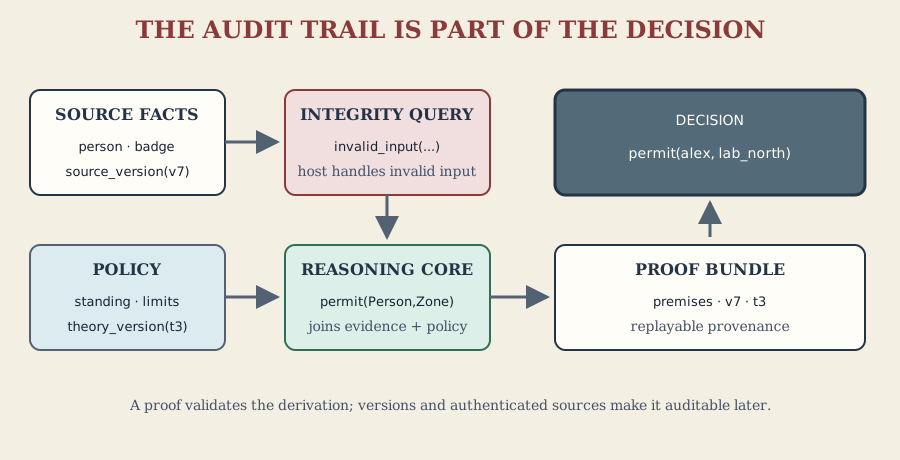
Requirements and questions
A research facility says:
- a person may enter a zone when their badge is active;
- the badge must grant the zone’s required clearance;
- required training must be current;
- an explicit suspension blocks entry;
- contradictory badge records invalidate the decision service;
- every permit should carry a reason traceable to source facts.
Before coding, identify ambiguities. Is the badge registry complete? Is missing training evidence a denial or unknown? Can a person have several active badges? Which clock determines “current”? A rule engine cannot remove these choices; it can only make the chosen answers precise.
Source and concept layers
Represent observations without embedding decisions:
person(ada).
badge(b17, ada).
badge_status(b17, active).
badge_clearance(b17, laboratory).
zone_requires(clean_room, laboratory).
training_valid(ada, clean_room).
The badge identifier remains explicit. Collapsing it into
active_badge(ada) would hide the record used as evidence and make conflicting
records harder to detect.
Build vocabulary that reads like the policy:
active_badge(Person, Badge) :-
  badge(Badge, Person),
  badge_status(Badge, active).

cleared_for(Badge, Zone) :-
  badge_clearance(Badge, Clearance),
  zone_requires(Zone, Clearance).

prepared_for(Person, Zone) :-
  training_valid(Person, Zone).
Each helper has one responsibility. A proof of cleared_for/2 names both the
badge clearance and zone requirement rather than burying their join in a wide
decision clause.
Closed-world choice
If the suspension list is authoritative and complete, absence can be used:
in_good_standing(Person) :-
  person(Person),
  \+ suspended(Person).
If it is incomplete, this rule is unsound as policy. Replace it with a positive
source claim such as standing(Person, good). The difference is an agreement
about the knowledge boundary, not a matter of syntax.
Decision, reasons, and proof
permit(Person, Zone) :-
  active_badge(Person, Badge),
  cleared_for(Badge, Zone),
  prepared_for(Person, Zone),
  in_good_standing(Person).

reason(Person, Zone, badge_and_training_verified) :-
  permit(Person, Zone).

webentail --goal 'permit(Person, Zone)' program.pl
webentail --goal 'reason(Person, Zone, Reason)' program.pl
reason/3 supplies a stable user-facing summary. With --proof, the same
answer carries its detailed derivation. These are complementary: the reason is
domain vocabulary, while the proof records actual clauses and bindings.
Integrity before decisions
Contradictory badge states are exposed by an explicit validation relation:
incompatible_status(active, revoked).
incompatible_status(revoked, active).

invalid_badge_status(Badge, Status, Other) :-
  badge_status(Badge, Status),
  incompatible_status(Status, Other),
  badge_status(Badge, Other).
This result does not say that one permit failed. It identifies input that is
unfit for a trusted decision. The host can query invalid_badge_status/3 before
permit goals, alongside checks for a badge assigned to two people or a zone
with incompatible clearance definitions.
Tests are policy examples
A useful test set includes an ordinary permit, missing training, suspension, insufficient clearance, duplicate derivations, contradictory status, and a proof showing the exact badge and training facts.
Boundary examples reveal requirements. If a person has two valid badges,
should there be one permit with two derivations or two permit terms containing
the badge? permit(Person, Zone) chooses one ground decision with potentially
several proofs. If badge identity belongs in the answer, define
permit(Person, Zone, Badge).
Embedding and audit
Authenticate source systems in the host, convert records to WebEntail facts, run the theory, and store the answer with its proof and input version. The solver can explain logical support; it cannot attest that a badge database was current or a training provider trustworthy.
authenticated source snapshot
  -> normalized WebEntail facts
  -> checked theory
  -> permit and reason
  -> proof referencing clauses and facts
When policy changes, preserve old inputs, theory versions, and proofs so a past decision can be reconstructed under the rules that actually governed it.
Exercises.
- Add time-bounded training using explicit dates and
difference/3. - Model
denial/3without assuming every failed permit has the same reason. - Add a two-person escort rule and identify duplicate-proof cases.
- Write an integrity relation for badges assigned to multiple people.
- Design a source socket for badge facts and state what the host must validate.
- Run the case with
--proofand decide which helpers improve the explanation.
Checkpoint. Reconstruct one permit decision from a preserved source snapshot, theory version, answer, and proof. Mark which step authenticates the source, which checks integrity, which derives the decision, and which merely stores evidence for later audit.
Part V summary
Part V followed whole computations rather than isolated features:
- and–or trees expose conjunction, alternatives, failure, and repeated calls;
- explicit syntax trees support grammars, evaluators, and symbolic rewriting;
- unfolding, folding, specialization, and accumulators transform control under stated invariants;
- finite search needs a declared space, pruning argument, witness, and fairness expectation;
- an auditable service layers sources, concepts, integrity, decisions, reasons, embedding, and proof retention.
You should now be able to trace substitutions through several goals, represent an object language without confusing it with the surrounding Prolog syntax, justify a bounded program transformation, and design a reconstructable decision theory.
Historical note: interpreters, transformation, and the art tradition
Logic programming became a laboratory for symbolic programming because its principal data—terms, clauses, substitutions, and proof trees—could be represented with the same structures used for ordinary domains. Meta-interpreters made resolution itself a program topic; grammar rules made language recognition relational; partial evaluation showed how a general relation could be specialized when part of its input was known.
Futamura’s work in the 1970s gave partial evaluation a striking interpretation: specializing an interpreter with respect to a source program can produce a compiled form. Logic-program transformation developed related practices of unfolding, folding, and specialization. The inheritance for WebEntail is not a promise that every classic transformation is built in. It is the demand that a transformation name its invariant and preserve a stated answer contract.
The Art of Prolog joined computation, construction, nondeterminism, grammars, interpreters, transformation, and applications into a sustained account of craft. Part V pays tribute to that breadth through WebEntail’s explicit subset: syntax is data, state is an argument, and audit evidence remains visible.
Part VI — Mathematics made executable
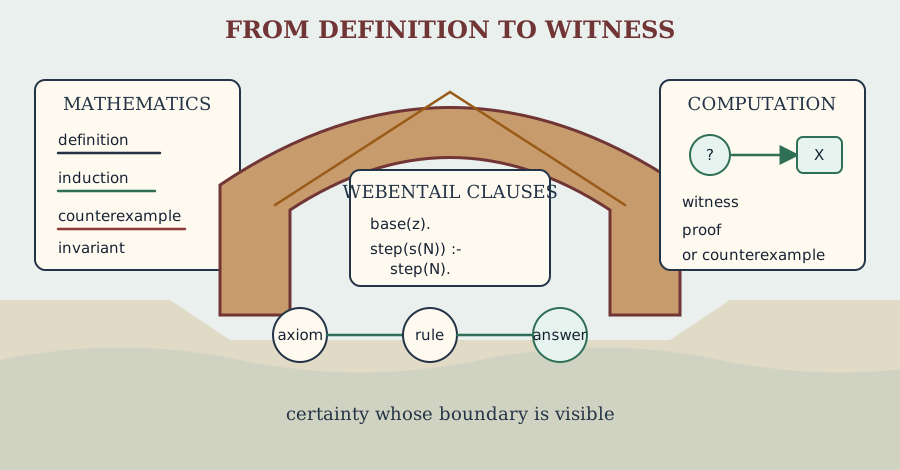
This Part is a route, not a prerequisite for the reasoning laboratory. For a short practical path, read Chapters 26, 27, and 29, then continue at Chapter
- Read Chapters 28 and 30 as well when representation, formal scope, and the limits of computation are central to your purpose.
Mathematics appears throughout this book as subject matter: arithmetic, combinatorics, graphs, geometry, algebra, statistics, and physical models. But its deeper presence is structural. A logic program is possible because parts of mathematical reasoning can be represented as finite symbols, transformed by explicit rules, and checked step by step.
In that qualified sense, the history of logic programming belongs inside the history of mathematics. It inherits the mathematician’s old practices of definition, proof, construction, abstraction, and counterexample. It also inherits the twentieth century’s harder questions. What counts as a formal proof? What is an effective procedure? Which truths follow from a finite set of axioms? Which questions cannot be decided by any uniform mechanical method?
WebEntail is a very small descendant of those questions. It is not a foundation for all mathematics, a computer algebra system, or an interactive theorem prover. Its definite clauses cover only a disciplined fragment of logic. Precisely because the fragment is small, however, one can see the ancient mathematical acts inside the running machine:
| Mathematical act | WebEntail form | Operational consequence |
|---|---|---|
| Define a class | facts and clauses | enumerate its instances |
| Introduce an unknown | a variable | seek a substitution |
| Use a lemma | call a helper relation | open a subgoal |
| Split into cases | multiple clauses | create alternatives |
| Perform induction | base and recursive clauses | reduce to smaller calls |
| Construct a witness | bind an output term | return evidence, not only truth |
| Refute a universal guess | search for a counterexample | one answer is enough |
| Check consistency | an explicit integrity query | let the host reject or report invalid input |
| Explain a conclusion | a proof term | expose the successful derivation |
The table is a correspondence, not an identity. A mathematical proof and an WebEntail execution answer different questions unless the encoding between them is itself justified. This Part develops both the power and the limit of the correspondence.
26. A proof can be a computation
For most of mathematical history, an algorithm and a proof could live close together without being regarded as the same kind of object. Euclid’s algorithm computes a greatest common divisor, while Euclid’s propositions justify why the procedure works. A geometrical construction produces an object, while an argument establishes that it has the required properties. The distinction remains useful, but modern logic revealed increasingly exact connections among a proposition, its proof, and the construction carried by that proof.
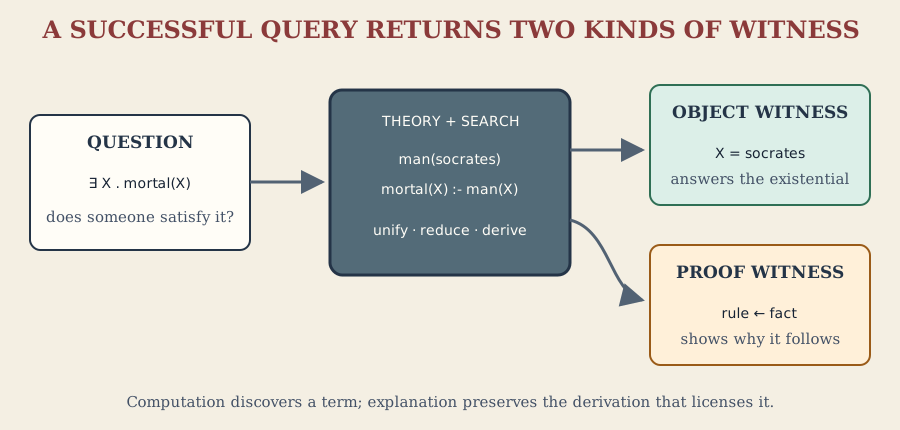
Logic programming enters through one particular connection. A definite clause
mortal(X) :- human(X).
is at once an implication-like statement and an instruction for reducing the
question mortal(socrates) to the subquestion human(socrates). A successful
derivation does not merely return true; it records a sequence of justified
reductions and the substitutions that made them fit.
From axioms to effective procedure
The route was neither straight nor inevitable. A compact historical spine is:
- Axiomatization. Nineteenth- and early-twentieth-century mathematics sharpened the demand that assumptions and inference rules be stated explicitly. Hilbert’s program made formal proof and consistency central mathematical subjects.
- Limits of formal systems. Gödel showed that sufficiently expressive, effectively axiomatized consistent systems cannot capture every arithmetical truth within themselves. Formalization acquired proven limits, not merely engineering difficulties.
- Effective calculability. Church and Turing gave exact, extensionally equivalent accounts of effective computation and established that some decision problems have no general algorithm.
- Ground instances. Herbrand connected quantified first-order statements to finite combinations of ground instances. The terms used to instantiate variables became central proof objects.
- Machine-oriented inference. Robinson’s resolution principle combined clauses and unification into a small general proof mechanism.
- Logic as a programming language. Prolog specialized these ideas into an executable discipline, and the least-model and fixed-point semantics of van Emden and Kowalski explained how definite programs denote their ground consequences.
Each step narrowed one ambiguity while uncovering another. Formal syntax made proofs mechanically inspectable, but Gödel marked the boundary of formal completeness. Models of computation made “algorithm” exact, but Church and Turing marked the boundary of decidability. Resolution made inference uniform, but a proof procedure still needed control: selection order, clause order, termination discipline, and eventually tabling.
Logic programming is therefore not the historical triumph of machinery over mathematics. It is one result of mathematics becoming reflective about its own methods.
Answers are existential witnesses
Consider a relation for a Pythagorean triple:
triple(A, B, C) :-
  between(1, 20, A),
  between(A, 20, B),
  between(B, 20, C),
  (AA is A * A),
  (BB is B * B),
  (Sum is AA + BB),
  (Sum is C * C).

webentail --goal 'triple(A, B, C)' program.pl
The open query asks an existential question over a finite domain: find values for which the equation holds. Each printed ground answer is a witness. The substitution is not an incidental side effect; it is the computational content of the existential claim.
A verifier and a generator are logically close but operationally different.
If A, B, and C are already known, the arithmetic goals check a candidate.
If they are unknown, the bounded between/3 calls create candidates first.
The equation alone does not tell a mode-sensitive evaluator where numbers
should come from.
This is an important distinction between mathematical existence and executable witness production. A classical proof may establish that something exists without furnishing an efficient construction. An WebEntail query produces a witness only when its clauses and control actually reach one.
Proof objects and proof checking
The normal answer
triple(3, 4, 5).
states the result. Proof output adds the successful chain of facts, rule uses, built-ins, and bindings. That evidence supports three different activities:
- rechecking: verify that every step follows from the supplied theory and built-in contract;
- auditing: identify which premises were actually used;
- explanation: translate a derivation into domain reasons a person can inspect.
These activities must not be conflated. A derivation can be mechanically valid but pedagogically obscure. It can be clear but depend on an untrustworthy source fact. It can be valid in the implemented arithmetic but fail to express the intended physical quantity. Proof output makes scrutiny possible; it does not perform all scrutiny on the reader’s behalf.
The least model as mathematical closure
For a definite program, begin with its ground facts. Repeatedly add every ground rule head whose ground body is already satisfied. The least fixed point of this operation is the least Herbrand model.
For
edge(a, b).
edge(b, c).

path(X, Y) :- edge(X, Y).
path(X, Z) :- edge(X, Y), path(Y, Z).
the closure first contains the two edges, then the corresponding direct paths,
then path(a, c). No unsupported path is added. Bottom-up closure and
goal-directed proof search approach the same declarative meaning from opposite
directions: one asks what follows globally, the other asks what is needed for
this goal.
Automatic tabling makes the connection visible. A table for a recursive component grows monotonically with newly discovered answers until no rule adds another. The implementation is performing a local, demand-driven fixed-point calculation.
Exercises.
- Run the triple program with one, two, and three arguments bound. Compare the logical question, answer set, and search size.
- Add a primitive-triple test by rejecting triples whose three values share a divisor. State exactly which finite generators make the negation safe.
- Inspect
examples/fundamental-theorem-arithmetic.pl. Separate the witness it constructs from the property it verifies. - Draw the fixed-point stages for a four-edge graph containing one cycle.
- Find a proof whose machine form is correct but whose helper names make it a poor human explanation.
Checkpoint. For one printed mathematical answer, state the existential claim witnessed by its bindings, the finite domain that made search effective, and the separate argument—if any—that justifies a universal theorem.
27. Recursion is induction in motion
Recursion and mathematical induction are not identical, but they are natural partners. Induction justifies a statement for every object generated by a finite construction. Recursion defines a result by following that same construction toward smaller objects.
For natural numbers represented as z, s(z), s(s(z)), and so on:
natural(z).
natural(s(N)) :- natural(N).

plus(z, Y, Y).
plus(s(X), Y, s(Z)) :- plus(X, Y, Z).
The clauses for plus/3 say:
- adding zero to
YproducesY; - adding the successor of
XtoYproduces the successor of the result of addingXtoY.
Operationally, the first argument decreases by one constructor until it reaches
z. Mathematically, the clauses mirror a recursive definition. To prove a
property of plus/3 for all Peano naturals, induction on that first argument is
the obvious proof shape.
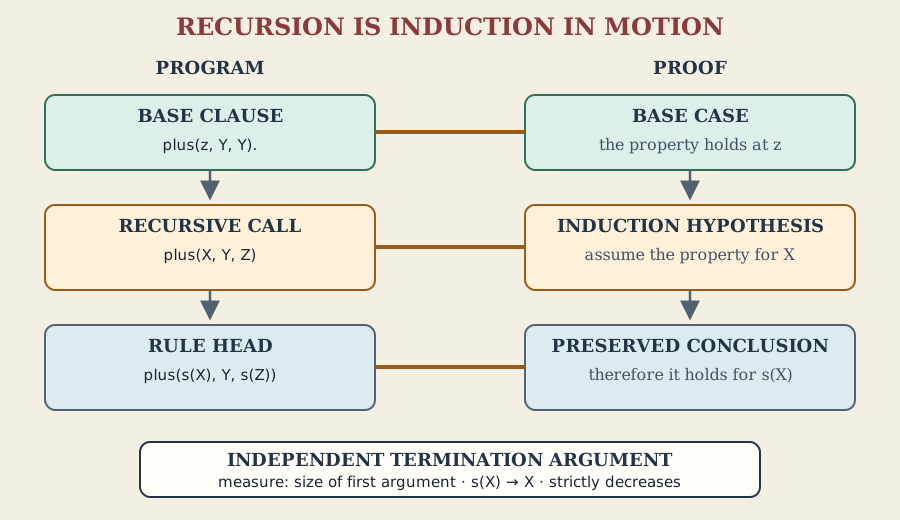
Three obligations, not one
A recursive mathematical program invites three separate arguments:
- Partial correctness: if the relation returns an answer, does the answer satisfy the intended specification?
- Completeness for the intended mode: if an answer satisfies the specification, will this program find it?
- Termination: will search finish for calls in the intended mode?
They are logically independent. A program can terminate and return the wrong answer. It can return only correct answers while missing some. It can describe the correct relation and still diverge before producing it.
For plus(+,+,-), a termination measure is the number of s/1 constructors in
the first argument. Every recursive call strictly decreases that natural
number. The measure is well-founded: there is no infinite descending sequence
of natural numbers.
That last sentence is the mathematical heart of a termination proof. “It seems to get smaller” is not enough. Name a set with no infinite descent, give a measure into that set, and show strict decrease on every recursive branch.
Structural induction and data design
Lists carry their induction principle in their syntax:
- base object:
[]; - constructor:
[Head | Tail].
A relation following that structure is easy to reason about:
list_length([], 0).
list_length([_ | Tail], N) :-
  list_length(Tail, M),
  (N is M + 1).
To prove that list_length(List, N) returns the number of cells in a finite
proper list, prove the empty case, then assume the claim for Tail and prove
it for [Head | Tail]. The recursive program and inductive proof share a
skeleton because both respect the same constructors.
Representation can either expose or obscure this skeleton. A syntax tree built
from number/1, plus/2, and times/2 supports structural recursion directly.
A flat token string requires parsing before the same argument becomes visible.
Good representations do not merely save code; they make invariants and proof
principles available.
Accumulators and strengthened invariants
An accumulator often improves control but makes the induction hypothesis more subtle:
reverse_acc(List, Reversed) :-
  reverse_go(List, [], Reversed).

reverse_go([], Acc, Acc).
reverse_go([X | Xs], Acc, Reversed) :-
  reverse_go(Xs, [X | Acc], Reversed).
The useful invariant is not merely “Reversed is the reverse of Xs.” It is:
reverse_go(Xs, Acc, Reversed)holds whenReversedis the reverse ofXsplaced beforeAcc.
Strengthening the statement makes the recursive step provable. This is a classic mathematical move: a theorem that is too weak to support induction is generalized until the induction hypothesis contains what the next step needs. Program transformation and proof discovery meet at the invariant.
Tabling changes the termination argument
Ordinary structural recursion terminates by decreasing a term. Graph reachability on a cyclic finite graph has no such simple decrease: following an edge can return to an earlier vertex. Tabling supplies a different well-founded argument.
If the graph has finitely many vertices, then there are finitely many possible
ground path/2 answers. A table only grows; each productive iteration adds a
previously unseen answer; therefore only finitely many productive iterations
are possible. Termination follows from finiteness of the answer space rather
than structural descent of each call.
The proof also states its boundary. If rules construct terms of unbounded depth, the set of possible calls or answers may be infinite, and tabling no longer supplies a finite bound.
Exercises.
- State partial correctness, completeness, and termination claims for
plus(+,+,-)separately. - Define multiplication over Peano naturals and give its decreasing measure.
- Prove the strengthened
reverse_go/3invariant on paper. - Compare the termination arguments for list membership and cyclic graph reachability.
- Study
examples/peano-calculus.pland identify where the data constructors determine the available induction.
Checkpoint. Align one recursive program with an inductive argument: base clause with base case, recursive call with induction hypothesis, and rule head with the preserved conclusion. Then give the independent termination measure.
28. Algebra, symmetry, and representation
Algebra studies operations by the laws they satisfy rather than by the material of the objects being operated on. Logic programming has a similar appetite for structure. Unification ignores the private identity of a variable name and asks whether two terms have a common instance. A relational program often works over lists, trees, graphs, substitutions, or group elements because the clauses depend only on their constructors and laws.
Unification is structural equation solving
The goal
(pair(X, f(Y)) = pair(g(a), f(b))).
decomposes into structural equations. The outer functors and arities agree,
so corresponding arguments must agree; the resulting substitution is
X = g(a) and Y = b.
This resembles algebraic equation solving, but unification is more specific.
It operates in the free term algebra: different constructors are distinct,
and two constructed terms agree only when their outer symbols and corresponding
arguments agree. It does not know, unless clauses or built-ins say so, that
X is 2 + 3 and X is 3 + 2 express a commutative operation.
The distinction prevents a common conceptual error:
- syntactic equality comes from identical term structure or unification;
- domain equality may require mathematical laws, normalization, or a decision procedure.
For polynomials, matrices, groups, or sets, choosing a canonical representation can turn some domain equalities into syntactic equalities. But the normalization algorithm then carries a proof obligation: equivalent objects must normalize alike, and normalization must not identify inequivalent ones.
Symmetry reduces search
Suppose a triangle is represented by three side lengths. Searching all permutations repeats the same geometric object six times. Ordering the sides removes the symmetry:
triangle(A, B, C) :-
  between(1, 20, A),
  between(A, 20, B),
  between(B, 20, C),
  (Sum is A + B),
  (Sum > C).
The constraints A =< B =< C select one representative from each permutation
class. This is more than a performance trick. It is a quotient-like move:
identify descriptions related by a symmetry, then search canonical
representatives.
Mathematics repeatedly advances by finding the right equivalence relation. Fractions are identified when cross-products agree; graphs may be identified up to renaming; group presentations may denote isomorphic structures; logical formulas may be identified up to variable renaming. Logic programs must decide which distinctions belong to the problem and which are artifacts of notation.
Relations reveal inverse problems
A function privileges one direction. An equation or relation contains several:
rectangle(W, H, Area) :- (Area is W * H).
In a supported arithmetic mode, this relation may verify an area or calculate it from width and height. With a finite generator it can also search for factorizations:
integer_rectangle(Area, W, H) :-
  between(1, Area, W),
  between(W, Area, H),
  (Area is W * H).

webentail --goal 'integer_rectangle(24, W, H)' program.pl
The relational view makes inverse questions conceptually ordinary, even when the implementation still needs an explicit finite direction. Mathematics has long moved between direct and inverse problems: multiply versus factor, evaluate versus interpolate, evolve a system versus infer its initial state. A relational vocabulary lets both questions share a specification where their common structure genuinely permits it.
Composition, homomorphism, and reusable laws
Well-designed relations compose because variables carry outputs from one statement into another. Mathematical structure tells us what composition should preserve.
If a mapping is claimed to preserve an operation, write the preservation law
as a testable relation. For a symbolic mapping image/2 and operation
combine/3:
preserves_combine(X, Y) :-
  combine(X, Y, XY),
  image(X, IX),
  image(Y, IY),
  image(XY, IXY),
  combine(IX, IY, CombinedImages),
  (IXY = CombinedImages).
Over a finite carrier, forall/2 can test the law for every generated pair.
Over an infinite carrier, finite testing is evidence, not proof. The algebraic
law must instead follow from definitions or a stronger proof system.
The examples d3-group.pl, matrix-noncommutativity.pl,
group-inverse-uniqueness.pl, and
composition-of-injective-functions-is-injective.pl show different roles:
computing a finite operation table, finding a counterexample to commutativity,
proving uniqueness from axioms, and composing preserved properties.
Representation is a mathematical commitment
Representing a rational number as fraction(N, D) raises immediate questions:
may D be zero, must signs be normalized, and are fraction(1, 2) and
fraction(2, 4) identical or merely equivalent? These are not serialization
details. They determine the equality relation, the search space, and the
meaning of every later proof.
Before selecting a representation, state:
- its valid inhabitants;
- its equivalence relation;
- whether it has a canonical form;
- the operations that must be efficient;
- the induction or decomposition principle it exposes.
That checklist joins abstract algebra, data modeling, and program design.
Exercises.
- Modify the triangle generator to enumerate only primitive Pythagorean triples and explain every removed symmetry.
- Give two representations of an undirected edge. Compare their equality and indexing behavior.
- Design a normalized rational representation and write integrity relations for invalid denominators and noncanonical zero.
- Use
examples/d3-group.plto test identity, inverses, and associativity. Which checks are exhaustive, and why? - Find a matrix counterexample showing that multiplication is not commutative. Explain why one witness refutes a universal law.
Checkpoint. Pick a domain value with two possible representations. State whether WebEntail regards them as structurally equal, whether the domain regards them as equivalent, and which normalization or explicit relation connects the two notions.
29. Search as experimental mathematics
Mathematicians do not prove only by moving forward from axioms. They calculate small cases, draw figures, search for patterns, try extreme examples, and hunt for counterexamples. Computation greatly enlarges this experimental practice. Logic programming contributes a particularly transparent form: generate a finite mathematical world, state the property relationally, and ask for witnesses or failures.
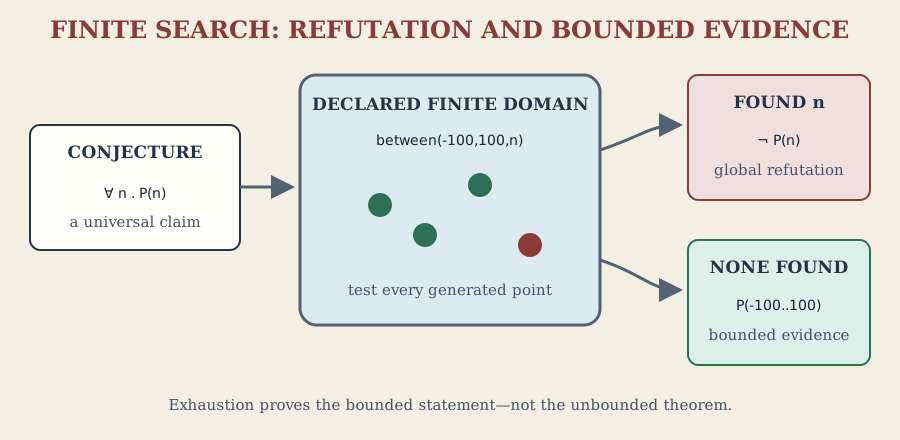
Examples suggest; proofs compel
The first values of a sequence can suggest a recurrence. Exhaustive search up to a bound can destroy a false conjecture. Neither establishes a universal theorem over an unbounded domain.
This boundary can be written directly:
counterexample_to_odd_square(N) :-
  between(1, 100, N),
  (1 is N mod 2),
  (Square is N * N),
  (Remainder is Square mod 2),
  (Remainder \= 1).

webentail --goal 'counterexample_to_odd_square(N)' program.pl
No answer means only that no counterexample was found in the generated range
under the implemented arithmetic. The theorem that every odd integer has an
odd square needs an algebraic argument valid for an arbitrary integer:
(2k+1)^2 = 2(2k^2+2k)+1.
By contrast, if the claim concerns exactly the integers from 1 through 10,000, the finite exhaustive search can be a proof—provided the generator is complete, the predicate expresses the property correctly, and the arithmetic implementation is trusted.
One counterexample has asymmetric power
A universal statement falls to one valid counterexample. This makes finite search especially valuable for criticism. Testing associativity over random inputs offers evidence; finding one triple where associativity fails settles the negative question.
noncommuting_pair(A, B) :-
  matrix(A),
  matrix(B),
  matrix_multiply(A, B, AB),
  matrix_multiply(B, A, BA),
  (AB \= BA).
The example need not explain every failure of commutativity. Its existence is enough to refute the universal claim. This asymmetry between confirmation and refutation is one reason constraint solving, model finding, and property-based testing are so productive.
Finite model exploration
A finite structure consists of a finite carrier and interpretations of its operations and relations. WebEntail can enumerate candidates, apply axioms as filters, and return models or countermodels. The method is mathematically serious because the scope is explicit.
For a carrier of three named elements, a binary operation table has nine entries. Searching all possible tables is finite but large. Algebraic laws can prune partial or complete candidates:
- closure restricts every output to the carrier;
- an identity fixes an entire row and column;
- commutativity identifies mirrored entries;
- associativity checks triples;
- inverse requirements constrain remaining cells.
The order of these constraints is operational mathematics. A strong law applied early may collapse the search space; the same law applied after full generation merely rejects enormous numbers of candidates.
Combinatorics is the anatomy of search
Search complexity is often a counting problem before it is a programming
problem. If a choice has n alternatives at each of k positions, naive
generation contains n^k leaves. If order does not matter, permutations may
be redundant. If partial choices already violate a constraint, pruning saves
an entire subtree.
This is why combinatorial examples are not toys. n-queens-8.pl retains one
witness, while n-queens.pl exposes the complete 92-solution search. Together
with send-more-money.pl, integer-partitions.pl, stirling-bell-numbers.pl,
and weighted-interval-scheduling.pl, they show different geometries of
choice: permutations, digit assignments, recursive decompositions, set
partitions, and ordered optimization.
For each search program, ask a mathematical question before a performance question:
What objects are being counted, and when do two execution branches denote the same mathematical object?
Only after answering that should one add indexing, reorder goals, or introduce an accumulator. Otherwise the program may optimize accidental multiplicity.
Numerical models and epistemic humility
The scientific examples combine logical rules with floating-point
calculations. beam-deflection.pl, orbital-transfer-design.pl,
competitive-enzyme-kinetics.pl, and least-squares-regression.pl encode
mathematical models of physical or statistical relationships.
A correct derivation inside such a model establishes a conditional:
given these measurements, equations, units, approximations, and thresholds, this conclusion follows under the implementation’s numeric semantics.
It does not establish that the sensor was calibrated, the model applies in this regime, omitted variables are negligible, or a floating-point result is an exact real number. The proof boundary should name these conditions rather than conceal them.
Exercises.
- Turn a familiar universal conjecture into a bounded counterexample search. State what a failure to find an answer does and does not prove.
- Estimate the naive search space of
send-more-money.pl, then identify each constraint that removes branches. - Use
examples/stirling-bell-numbers.plto connect a recurrence with the combinatorial objects it counts. - Design a finite carrier and search for a noncommutative operation with an identity.
- Choose one scientific example and list every premise outside pure logic: measurements, units, empirical law, approximation, and numeric behavior.
Checkpoint. Label a computation as one of: witness construction, counterexample, exhaustive finite-model check, bounded evidence, or numerical model evaluation. Write one sentence stating exactly what its success proves and what its failure leaves open.
30. What mathematics promises
Mathematics earns unusual trust because it makes its conditions inspectable. Once definitions, axioms, and inference rules are fixed, a valid proof does not negotiate with status, rhetoric, fashion, or desire. The conclusion either follows by the accepted rules or it does not.
That is perhaps the precise sense in which mathematics does not cheat us. It does not promise that our premises describe the world. It promises that we can ask whether the conclusion follows from them.
Conditional certainty
Every theorem is conditional, even when the conditions have become culturally invisible:
axioms + definitions + inference rules
  -> theorem
Every trustworthy WebEntail conclusion has the same broad shape:
source facts + clauses + built-in semantics + execution assumptions
  -> ground answer + proof
The arrows are where rigor lives. A proof disciplines the transition from premises to conclusion. It cannot authenticate the premises merely by using them.
This yields four layers of trust:
- Source trust: are facts authentic, current, complete enough, and represented with the correct units and identity?
- Model trust: do the predicates and rules express the intended domain?
- Engine trust: do parsing, unification, built-ins, tabling, and proof generation implement the stated standards profile?
- Derivation trust: does this answer have a valid proof from this exact theory?
Explicit integrity relations expose contradictions and invalid states inside the supplied theory. Conformance tests address the implementation. Proof output addresses the derivation. Provenance, signatures, calibration, peer review, and domain validation address other layers. No single mechanism replaces the rest.
The dignity of a counterexample
Mathematics corrects itself through definitions and counterexamples. A false conjecture is not rescued by the beauty of its statement. One legitimate counterexample has standing against a thousand confirming cases.
Logic programming should preserve this culture. Write negative tests before the theory becomes emotionally expensive. Search boundary cases. Ask for forbidden states. Turn domain invariants into queryable integrity relations. Keep the failed model that forced a redesign.
A knowledge system becomes trustworthy not when it never changes, but when it can say:
- what it assumed;
- what followed;
- which evidence was used;
- which counterexample broke the former rule;
- when the theory changed; and
- which past conclusions belonged to which version.
This is mathematical honesty translated into engineering practice.
The limits are part of the truth
Gödel, Church, and Turing did not diminish mathematics by proving limits. They made informal hopes precise enough to refute. There is no complete effective method that settles every sufficiently expressive mathematical question. No amount of faster hardware turns an undecidable general problem into a decidable one.
WebEntail has smaller, immediate limits:
- some relations have infinitely many answers;
- depth-first search may pursue an unproductive branch;
- mode-sensitive built-ins are not omnidirectional equations;
- negation as failure is not classical negation;
- floating-point arithmetic is not exact real arithmetic;
- tabling terminates only when the relevant call and answer spaces stabilize;
- proof output explains successful derivations, not every failed search path;
- the language cannot prove arbitrary metatheorems about its own programs.
Naming these limits is not an apology. A trustworthy formal tool states the edge of its guarantee.
Mathematics as a style of care
The deepest lesson is methodological. Mathematics asks us to separate:
- a name from its definition;
- an example from a proof;
- existence from construction;
- a theorem from its converse;
- syntax from semantics;
- equality from resemblance;
- local evidence from a universal claim;
- correctness from termination;
- the model from the world.
Those separations are exactly what good logic programming requires. A predicate must have a sentence. A recursive clause must have an invariant and a termination argument. A finite search must declare its domain. An aggregate must have a bounded subsearch. A decision must retain its premises. A proof must remain attached to the theory version that licensed it.
The result is not certainty about everything. It is something more useful: certainty whose boundary is visible.
A final program-reading ritual
Before trusting an WebEntail conclusion, ask:
- What does the ground answer say in the domain?
- Which facts and rules support it?
- Which facts came from outside the theory?
- Which built-ins contribute extra semantics?
- Was the search domain finite, and why?
- Could goal or clause order hide an answer?
- Does negation mean absence of proof or an explicit opposite?
- What invariant justifies each recursive relation?
- What counterexample would overturn the model?
- Can the result be reconstructed under the same source and theory version?
That ritual is the book in miniature. State a small theory. Ask a precise question. Let the machine search. Inspect the witness. Challenge the premises. Preserve the proof.
Exercises.
- Take one policy example and classify every dependency under the four layers of trust.
- Write a conclusion that is logically valid from false premises. Explain why proof checking alone cannot repair it.
- Add version and provenance facts to a scientific example and make them visible in its explanation.
- Find one claim in your own program for which tests provide evidence but not proof. State the missing universal argument.
- Write a one-page “trust contract” for an embedded WebEntail service: accepted sources, model scope, numeric assumptions, resource bounds, proof retention, and known limits.
Checkpoint. Take one strong conclusion and prefix it with every condition on which it depends: source authenticity, model scope, built-in semantics, finite search, theory version, and derivation validity. If the qualified claim still matters, the model has earned its confidence honestly.
Part VI summary
Part VI placed logic programming inside the longer history of mathematics:
- a ground answer can carry the witness of an existential claim;
- definite-program closure connects proof search with least-model semantics;
- recursive definitions and inductive proofs often share a constructor skeleton;
- correctness, completeness, and termination are independent obligations;
- unification solves equations in a free term algebra, not every domain;
- symmetry and canonical form remove representational duplicates;
- finite search is experimental mathematics whose scope must be stated;
- formal certainty is conditional on sources, models, engines, and rules.
You should now be able to distinguish computation from proof, bounded evidence from a universal theorem, syntactic equality from mathematical equivalence, and valid derivation from trustworthy premises.
Historical note: mathematics examines its own methods
This arc begins before electronic computing. Hilbert’s program made formal proof and consistency mathematical objects. Gödel established limits for sufficiently expressive effective axiomatic systems. Church and Turing made effective calculability precise enough to prove that some general decision problems have no algorithm. Herbrand and Robinson supplied ideas that became central to automated first-order deduction.
Logic programming belongs to this history because it operationalizes a restricted proof discipline. It does not erase the limit results or turn every existence proof into an efficient witness generator. It gives a small region where propositions, substitutions, proof steps, and computations can be inspected together.
The deeper inheritance is a style of honesty. Mathematics advanced by proving not only more statements but also where methods fail, separating truth, provability, decidability, and computation. WebEntail’s finite bounds, mode restrictions, search risks, and trust boundaries belong inside its account for the same reason: limits are part of the result, not fine print.
Part VII — The reasoning laboratory
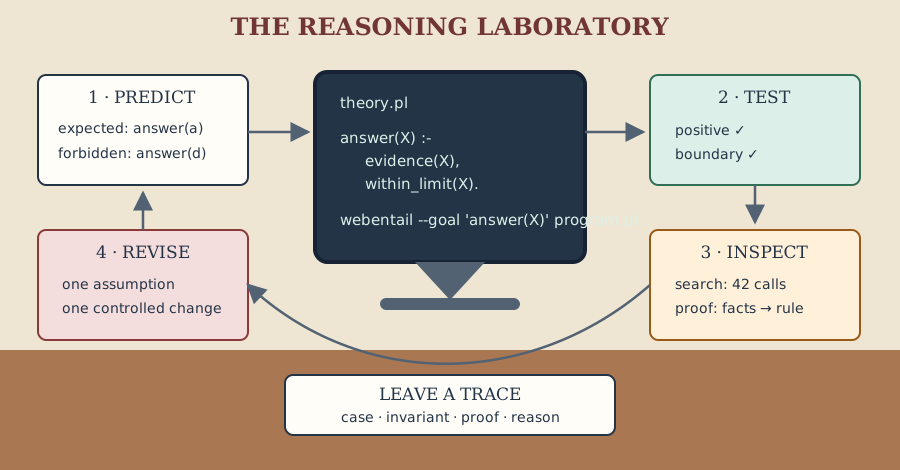
The final craft is experimental without being careless. A logic programmer works like a mathematician at a blackboard and an engineer at a test bench: state a claim precisely, derive consequences, seek counterexamples, measure the computation, and preserve enough evidence for another person to repeat the work.
This Part turns the book’s ideas into a daily discipline. It does not add a new language feature. It shows how to make theories survive change.
31. Testing a theory
A conventional unit test often presents an input to a function and compares one returned value with an expected value. A relational program needs a wider test vocabulary. One call may have several answers, no answer, duplicate proofs, or different useful modes. Correctness includes the answer set, the absence of forbidden answers, the shape of witnesses, and the finiteness of the intended search.
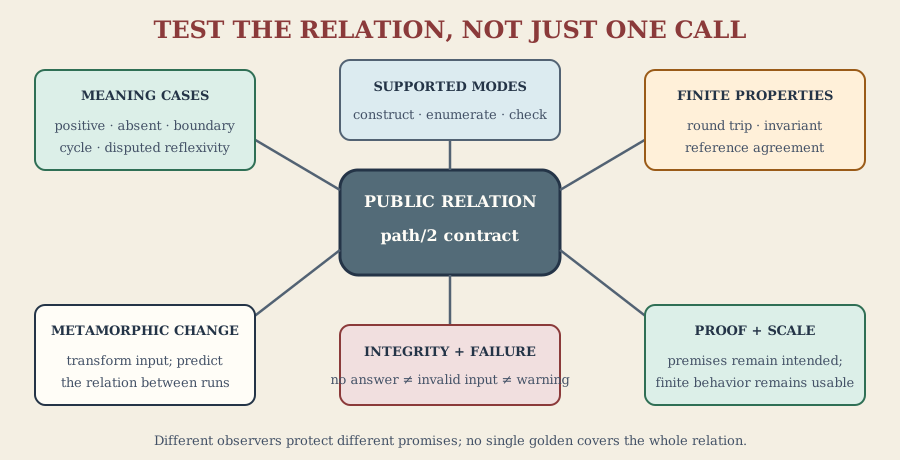
Begin with a semantic test table
Before writing test code, make a table in domain language:
| Case | Given | Question | Expected | Why this case matters |
|---|---|---|---|---|
| direct | edge(a,b) |
path from a to b? |
yes | base clause |
| composed | a→b→c |
path from a to c? |
yes | recursive clause |
| absent | disconnected d |
path from a to d? |
no | false positive |
| cycle | c→a |
all destinations from a? |
finite set | tabling or visited state |
| reflexive | no explicit loop | path from a to a? |
design choice | relation boundary |
The last row is especially valuable. Many bugs are not implementation mistakes but unresolved meanings. Does a path require at least one edge, or may it be empty? No test framework can choose the definition for you.
Positive and negative observers
Queries naturally record positive expectations:
edge(a, b).
edge(b, c).

path(X, Y) :- edge(X, Y).
path(X, Z) :- edge(X, Y), path(Y, Z).

webentail --goal 'path(a, b)' program.pl
webentail --goal 'path(a, c)' program.pl
To make an expected absence visible, define a finite observer:
unexpected_path :-
  path(a, d).

expected_absence :-
  \+ unexpected_path.

webentail --goal 'expected_absence' program.pl
This is a test over a ground, terminating goal. It does not turn negation as failure into classical negation; it records that this finite theory derives no such path.
For a reusable package, prefer a dedicated test program that loads or repeats the relevant theory and declares only test queries. For a small example, the golden answer file is an executable specification of the expected answer set.
Test the relation from more than one mode
Suppose append/3 is intended both to concatenate and to split:
webentail --goal 'append([a, b], [c], Whole)' program.pl
webentail --goal 'append(Prefix, Suffix, [a, b])' program.pl
The first call should construct one list. The second should enumerate three splits. Testing only the first mode would miss a regression in relational generality; testing the completely open mode would request an infinite relation and prove little beyond the absence of a useful bound.
For every public predicate, record:
- the principal mode;
- any secondary supported modes;
- modes that are meaningful but intentionally unsupported;
- calls expected to be finite;
- calls whose answer order is part of the observable contract.
Keep this design close to the clauses in comments or tests, and exercise each supported call pattern directly.
Properties over finite domains
Examples test selected points. A finite generated property tests every point in a declared scope:
double(N, D) :- (D is N + N).

double_is_even(N) :-
  double(N, D),
  (0 is D mod 2).

bounded_double_law :-
  \+ bounded_double_counterexample.

bounded_double_counterexample :-
  between(-100, 100, N),
  \+ double_is_even(N).

webentail --goal 'bounded_double_law' program.pl
This is exhaustive for the 201 generated integers, not for all integers.
Naming the predicate bounded_double_law/0 keeps the scope honest.
Useful finite properties include:
- round trips: parse then render, or encode then decode;
- preservation: normalization keeps the represented value;
- idempotence: normalizing twice equals normalizing once;
- symmetry: an undirected adjacency relation works in both directions;
- invariants: every generated plan state is safe;
- agreement: a simple reference relation and an optimized relation return the same bounded answer set.
Metamorphic tests
Sometimes the correct answer is hard to list, but a controlled change has a predictable effect. These are metamorphic tests.
If an isolated graph vertex is added, existing reachability answers should not change. If every edge cost is multiplied by a positive constant, the cheapest route should retain the same vertices. If the order of source facts changes, the set of logical answers should remain unchanged even if their discovery order changes.
A metamorphic test states a relation between runs. It is particularly useful for optimizations because it checks a preserved invariant rather than one frozen implementation trace.
Proof regression and answer regression
An answer golden asks, “Did the public conclusions change?” A proof golden asks, “Did their supporting derivations change?”
Proof changes may be desirable after introducing a clearer helper. They may also reveal that a decision now depends on an unintended fact. Treat proof goldens as reviewed evidence, not snapshots updated automatically whenever a test fails.
Use answer regression broadly. Use proof regression selectively where provenance, explanation, or policy accountability is part of the product.
Test failures, integrity results, and warnings
Three outcomes carry different meanings:
- an ordinary query has no answer: the relation did not establish that goal;
- an integrity query succeeds: the supplied input violates a forbidden condition;
--warningsreports unstratified negation: execution may proceed, but the program crosses a portability and semantic boundary.
A mature suite covers all three. Include malformed source in parser tests, inconsistent source in integrity-query tests, and semantically dubious dependency cycles in warning tests.
A release-quality test matrix
Before releasing a theory or embedded service, cover:
| Dimension | Minimum evidence |
|---|---|
| Meaning | one positive, one absent, and one boundary case per public relation |
| Modes | every documented mode; explicit rejection or warning for unsafe uses |
| Recursion | base case, multi-step case, cycle, and termination argument |
| Search | smallest witness, competing witnesses, ties, and empty domain |
| Negation | ground success, ground failure, and stratification check |
| Aggregation | empty, singleton, duplicates, and deterministic tie handling |
| Integrity | each invalid state is detected and valid input is not misclassified |
| Proof | representative derivation with source premises visible |
| Scale | a case large enough to expose indexing or table behavior |
| Reproducibility | fixed time, source version, stable fixtures, and clean output |
Exercises.
- Build the semantic test table for
ancestor/2, including a cycle and a disputed reflexive case. - Write bounded commutativity and associativity tests for a finite operation table. Explain why one is cheaper.
- Create a metamorphic test for a route planner.
- Choose one proof golden and identify changes that should be accepted versus changes that should block a release.
- Design a test that distinguishes “no answer” from “invalid input theory.”
Checkpoint. Assemble a minimum release matrix for one public relation: positive, absent, boundary, alternate mode, recursive or cyclic, integrity, proof, and scale cases. State which expected outputs should be exact goldens.
32. Debugging by meaning, search, and proof
Debugging a logic program is difficult when every symptom is described as “the query failed.” Failure can mean the fact is absent, a variable was bound too early, a built-in ran outside its mode, a negative goal saw an unintended answer, recursion did not reach its base case, or the original relation was misstated.
Use four views in a fixed order:
- meaning: what should a ground instance say?
- bindings: what is known before each goal?
- search: which alternatives are explored, repeated, or pruned?
- proof: which successful premises support the observed answer?
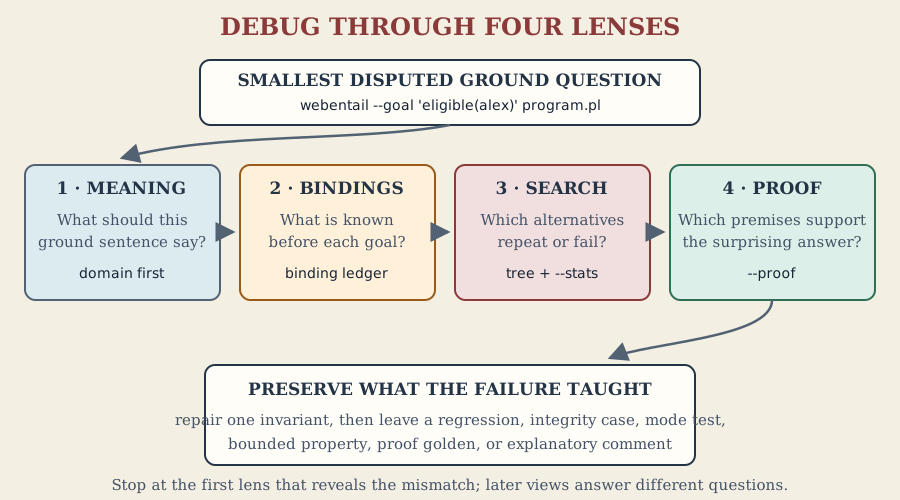
Reduce to the smallest disputed ground question
Do not begin with an open query that prints hundreds of answers. Name one conclusion that is missing or surprising:
webentail --goal 'eligible(alex)' program.pl
Then expand only the clause intended to prove it. Replace broad generators with the relevant ground facts. A small ground question removes accidental branching and makes every failed subgoal discussable.
If the ground question is itself ambiguous, stop debugging the implementation. Rewrite the domain sentence first.
Follow bindings from left to right
Consider:
eligible(Person) :-
  (Age >= 18),
  age(Person, Age).
The intended mathematics is easy to recognize, but >=/2 sees an unbound
Age. Write a binding ledger:
| Before goal | Goal | Bindings produced |
|---|---|---|
| none | Age >= 18 |
none; not ready |
| — | age(Person,Age) |
never productively reached |
Reordering the goals repairs the operational mode:
eligible(Person) :-
  age(Person, Age),
  (Age >= 18).
For a clause with five goals, the ledger is often more revealing than staring at the source. Record structures as well as scalar bindings: a variable may be bound to an improper list or a compound term whose inner variables remain open.
Use a symptom atlas
No answers
- Confirm the queried predicate name and arity.
- Ground one expected answer and locate a clause whose head unifies with it.
- Walk the body with a binding ledger.
- Check readiness of arithmetic, string, list, and term built-ins.
- Inspect whether a negative goal is too early.
- Verify that a base clause is reachable.
Too many answers
- State which answer violates the domain sentence.
- Find its proof and identify the first overbroad premise.
- Look for missing joins: the same conceptual entity may use two variables where one shared variable was intended.
- Check whether a closed-world assumption was omitted.
- Decide whether duplicate answers or duplicate proofs are the real issue.
Right answers, wrong order
- Inspect clause order and generator order.
- Identify
once/1or aggregate tie-breaking that makes order observable. - Do not confuse order-sensitive behavior with declarative completeness.
Nontermination or explosive search
- Name the intended finite domain.
- Identify the recursive call and its decreasing measure, or the finite tabled call/answer space.
- Move selective generators and ready filters earlier.
- Check for terms that grow on every recursive call.
- Run with
--statsand compare one controlled revision at a time.
A surprising proof
- Verify that the answer itself is intended.
- Find the earliest source premise that should not have participated.
- Distinguish a misleading helper name from a semantically wrong clause.
- Check whether two source versions or contexts were accidentally combined.
Create diagnostic relations
Temporary helpers can expose intermediate concepts:
candidate_debug(Person, Age) :-
  age(Person, Age).

adult_debug(Person, Age) :-
  candidate_debug(Person, Age),
  (Age >= 18).

webentail --goal 'candidate_debug(Person, Age)' program.pl
webentail --goal 'adult_debug(Person, Age)' program.pl
Once the fault is understood, either remove the helper or rename it as a
permanent domain concept. Do not leave debug2/3 archaeology in a theory whose
proofs people must read.
Compare specification and implementation
For a bounded domain, write a deliberately simple reference relation and compare it with the optimized one. The reference may be slow; its purpose is clarity.
reference_square(N, S) :-
  between(0, 20, N),
  (S is N * N).

optimized_square(N, S) :-
  between(0, 20, N),
  (S is N * N).

disagreement(N, S) :-
  reference_square(N, S),
  \+ optimized_square(N, S).

webentail --goal 'disagreement(N, S)' program.pl
A complete equivalence check needs both directions and must account for duplicates if proof multiplicity matters. Within a finite domain, differential testing is a powerful guard during program transformation.
Read statistics as questions
--stats reports work, not meaning. A high solution count may be necessary or
may indicate a generator that should be constrained. Many table hits may show
effective reuse; many distinct table entries may reveal an argument that
prevents calls from sharing.
Compare statistics only between runs with the same query, data, and observable answer contract. A faster program that silently loses answers is not an optimization.
Preserve the failure that taught you
Every repaired defect should leave behind one of:
- a new positive or negative case;
- an integrity regression;
- a documented mode and tests for that call pattern;
- a bounded property;
- a proof golden;
- a comment stating a non-obvious invariant.
Otherwise the repository remembers the repair but forgets the reason.
Exercises.
- Deliberately misorder a numeric filter and diagnose it with a binding ledger.
- Introduce a missing-variable join into a two-relation rule. Use the proof of one false positive to locate it.
- Create a recursive term-growing rule, then state why tabling cannot make its answer space finite.
- Compare statistics before and after moving an invariant calculation out of recursion.
- Write a bidirectional bounded equivalence check for two list relations.
Checkpoint. Preserve one defect as a regression. Record the smallest disputed ground question, expected answer, first incorrect binding or search choice, repaired invariant, and test that would fail if the defect returned.
33. A pattern catalog for reasoning
A pattern is not a copied code fragment. It is a recurring arrangement of meaning, representation, and control that solves a named design problem. The following patterns summarize the strongest constructions in this book.
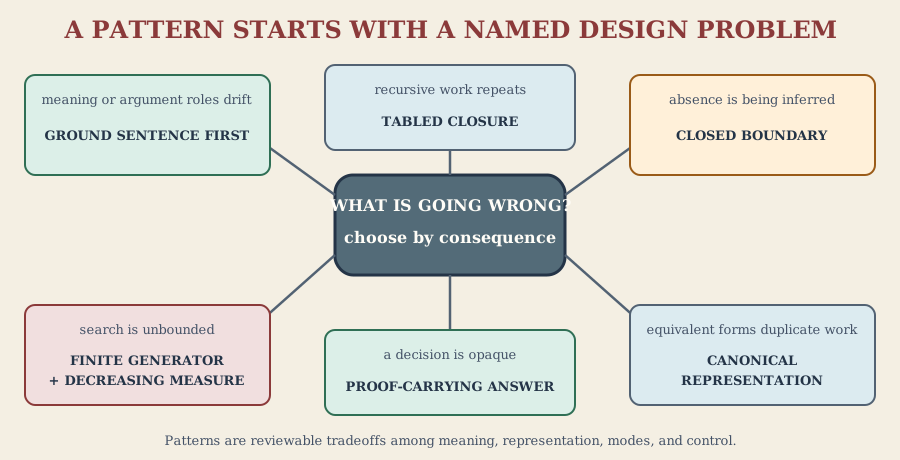
Pattern 1: Ground sentence first
Problem: a predicate’s argument order and meaning drift while rules are being written.
Form: write one representative ground fact and read it aloud before adding variables.
assigned_badge(alex, badge_17).
Consequence: argument roles become reviewable; modes and indexes can be discussed against a stable sentence.
Pattern 2: Normalize at the boundary
Problem: spelling, aliases, units, or source-specific terms leak into every domain rule.
Form: retain source facts, derive one canonical vocabulary, and make core rules depend only on the normalized layer.
source_role(person_7, "Doctor").

canonical_role(Person, clinician) :-
  source_role(Person, Text),
  lowercase(Text, "doctor").
Consequence: adapters change independently from policy; proofs still trace back to source data.
Pattern 3: Generate, constrain, describe
Problem: a search relation mixes candidate production, pruning, and explanation until none can be reasoned about separately.
Form: generate a finite candidate, apply the cheapest selective constraints in dependency order, then construct a witness or reason.
chosen_pair(pair(X, Y), reason(sum_is_ten)) :-
  between(0, 10, X),
  between(X, 10, Y),
  (10 is X + Y).
Consequence: the search domain and each pruning step are visible.
Pattern 4: Carry the witness
Problem: a Boolean-like conclusion proves existence but loses the object needed for explanation or later computation.
Form: add a structured output containing the path, assignment, schedule, or evidence summary.
path(X, Y, [X, Y]) :- edge(X, Y).
path(X, Z, [X | Rest]) :-
  edge(X, Y),
  path(Y, Z, Rest).
Consequence: answers become constructive; witness size and duplicate paths become explicit design concerns.
Pattern 5: Bound absence
Problem: the domain needs a negative conclusion, but absence is meaningful only after a complete finite search.
Form: bind the subject and finite scope before \+/1; isolate the
closed-world step behind a clearly named predicate.
unregistered(Person) :-
  person(Person),
  \+ registered(Person).
Consequence: the closed-world assumption has one reviewable home. It must not be mistaken for an explicit fact that the person is not registered.
Pattern 6: Explicit state transition
Problem: planning or interpretation appears to require mutable state.
Form: represent the old and new states as terms related by an action.
step(state(Room, outside), enter(Room), state(Room, inside)).
Consequence: histories are ordinary lists, transitions can be queried, and the state representation exposes invariants.
Pattern 7: Fixed-point closure
Problem: reachability, inheritance, or dataflow revisits the same finite subquestions.
Form: state the positive recursive relation directly and let eligible components be tabled.
depends(X, Y) :- direct_dependency(X, Y).
depends(X, Z) :- direct_dependency(X, Y), depends(Y, Z).
Consequence: termination rests on a finite call and answer space, not on pretending the graph is acyclic.
Pattern 8: Proof façade
Problem: low-level helper clauses produce technically correct but unreadable explanations.
Form: introduce stable domain concepts and a small public decision relation whose premises are meaningful reasons.
within_limit(Device) :-
  reading(Device, Value),
  maximum(Max),
  (Value =< Max).

status(Device, safe) :-
  within_limit(Device).
Consequence: internal calculations remain available, while the successful proof reads in domain vocabulary.
Pattern 9: Integrity before inference
Problem: contradictory or impossible input would make ordinary conclusions misleading.
Form: encode forbidden combinations as ordinary relations with diagnostic arguments.
invalid_badge_assignment(Badge, PersonA, PersonB) :-
  assigned_badge(PersonA, Badge),
  assigned_badge(PersonB, Badge),
  (PersonA \= PersonB).
Consequence: callers can collect every defect, and a host that requires validated input can query this relation before it requests trusted decisions. The rejection policy remains explicit rather than being hidden in clause-head syntax.
Pattern 10: Version the evidence boundary
Problem: an answer can be reproduced only if its facts, rules, and external semantics are known.
Form: retain source snapshot, theory version, adapter version, and relevant clock or numeric assumptions beside the proof.
theory_version("2026-07-24").
source_snapshot("telemetry-0042").
numeric_model(ieee_754_double).
Consequence: an old decision can be reconstructed under the system that actually made it rather than silently rerun under today’s theory.
Anti-patterns
The unbounded open generator. A relation is queried with every argument free even though its mathematical extension is infinite.
The premature test. A mode-sensitive built-in or negative goal appears before the goals that bind its inputs.
The accidental Cartesian product. Two goals use different variables for what should be the same entity.
The opaque mega-clause. One rule performs normalization, search, policy, and explanation with no named intermediate concepts.
The Boolean witness eraser. A relation returns only yes after doing the
work needed to construct a useful path or reason.
The silent closed world. Failure to derive a fact is used as its opposite without documenting finite scope and completeness assumptions.
The proof-hostile helper. Names such as step3/2 or tmp/4 expose an
implementation sequence instead of a domain idea.
The optimization by answer loss. once/1, early aggregation, or reordered
search makes a benchmark faster by changing the public answer contract.
The floating theorem. A numerical result is described as mathematically exact without naming units, approximation, or host floating-point behavior.
The timeless decision. Sources and rules change, but conclusions retain no snapshot or theory version.
Selecting patterns
Patterns compose. A robust decision service often uses:
normalize at the boundary
  -> generate, constrain, describe
  -> carry the witness
  -> proof façade
  -> integrity before inference
  -> version the evidence boundary
Do not apply every pattern mechanically. A three-fact teaching example does not need six architectural layers. Introduce a pattern when its named problem is present, and keep the smallest theory that makes meaning and control clear.
Exercises.
- Find three patterns and two anti-patterns in an existing large example.
- Refactor an opaque rule into boundary, concept, and decision layers; compare proofs before and after.
- Add witness carrying to a Boolean reachability relation and analyze the new duplicate-answer behavior.
- Replace a silent closed-world decision with a named bounded-absence helper.
- Write a versioned evidence envelope for the Chapter 25 decision service.
Checkpoint. Select the smallest set of patterns that solves a real problem in one theory. For every selected pattern, name the pressure that justifies it; remove any layer that exists only because the catalog made it available.
Part VII summary
Part VII made theory development repeatable:
- semantic test tables settle meanings before test mechanics;
- positive, absent, boundary, cycle, and scale cases cover different risks;
- bounded properties and metamorphic relations test more than selected points;
- answer and proof goldens protect different contracts;
- binding ledgers diagnose readiness and accidental joins;
- debugging moves from meaning to bindings, search, and proof;
- named patterns connect recurring problems to reusable relational forms;
- every repaired defect should leave a case, invariant, integrity check, or explanation.
You should now be able to design a release-quality test matrix, reduce a surprising result to one ground question, compare a reference relation with an optimized relation, and recognize productive patterns and anti-patterns.
Historical note: executable specifications learn to remember
Logic programs have long stood between specification and implementation. That made testing both easier and subtler: a ground clause could serve as an example, yet a relation might have several modes and an answer set rather than one returned value. Testing practice absorbed ideas from theorem proving, database validation, software regression, and property-oriented testing.
The repository form of this practice is historically significant in its quiet way. A theory, exact answer file, proof file, conformance corpus, and version tag preserve not only a program but expectations about its meaning. Regression tests make old decisions reviewable; property tests seek counterexamples; metamorphic tests state what remains invariant across controlled change.
Patterns complete the cycle by naming recurring design knowledge. Sterling and Shapiro’s craft-oriented presentation helped establish that expertise lives in constructions and transformations, not syntax alone. The reasoning laboratory extends that attitude into maintenance: prediction, execution, evidence, and revision form one method, and the failure that taught a lesson becomes executable memory.
Part VIII — Standard Prolog in practice
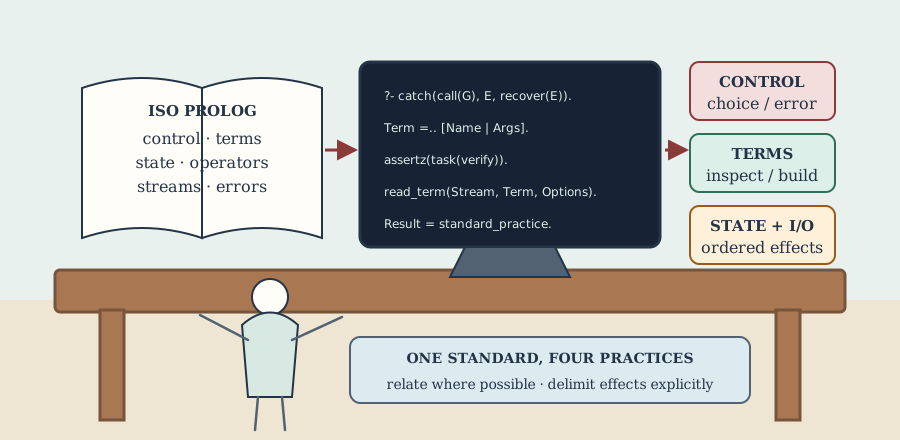
The supported ISO Prolog profile includes processor-facing facilities that
become important in reusable libraries, language tools, long-running
applications, and file boundaries. Earlier chapters use its relational core;
this part makes control, reflection, state, operators, and streams explicit.
Isolated mode and error cases live in test/conformance/cases/iso/. The
examples here compose those operations into programs worth changing and
rerunning.
These facilities do not all have the same declarative character. Term inspection and atomic conversion are relations. Cut commits to an operational choice. Dynamic updates and stream operations change solver-owned state. Use the pure relation when it expresses the problem; introduce control or effects at a named boundary.
34. Control, exceptions, and grouped solutions
The control predicates accept goals as arguments. call/1 invokes a callable
term, once/1 keeps its first solution, and !/0 commits within the clause
that contains it. If-then-else commits to the first successful condition:
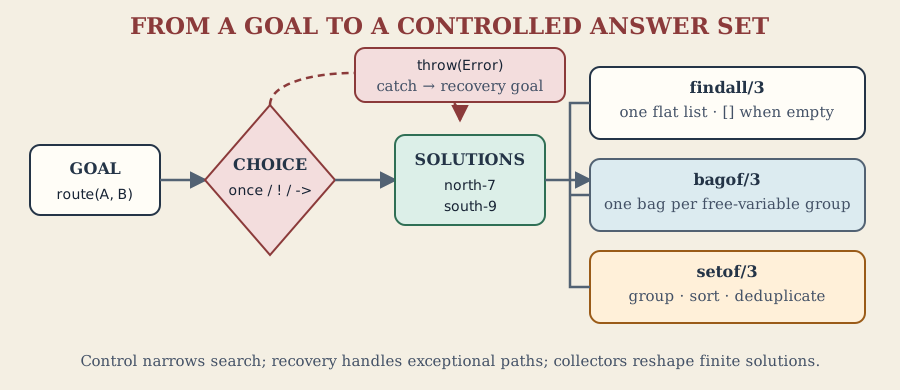
travel_status(From, To, Status) :-
  (route(From, To) -> Status = connected ; Status = disconnected).
once(Goal) is a local request for one solution. Cut is lower level: it
discards alternatives created since entry into the current predicate call.
The two can produce the same first answer without expressing the same control
boundary. Keep cut close to the choice it documents and test the complete
answer set before and after introducing it.
Exceptions separate an exceptional call from ordinary logical failure:
require_route(From, To) :-
  (route(From, To) -> true ; throw(no_route(From, To))).

checked_route(From, To, Result) :-
  catch(
    (require_route(From, To), Result = accepted),
    no_route(From, To),
    Result = rejected
  ).
The catcher is unified with the thrown term. A matching recovery goal runs in
the environment at the catch/3 boundary; unrelated exceptions continue
outward. Prefer failure for an expected negative answer, such as a route that
does not exist. Throw when a caller cannot safely interpret the computation,
for example malformed input or an unavailable required resource. ISO
instantiation, type, domain, permission, representation, and evaluation errors
follow this same exception path.
Collection also makes search boundaries explicit. findall/3 returns one list
and existentially closes variables that occur only in its goal. bagof/3
instead creates a group for each binding of a free variable and fails when
there are no solutions. setof/3 has the same grouping rule, then sorts and
deduplicates each group. The ^/2 notation marks a goal variable existential:
regional_total(Region, Total) :-
  bagof(Amount, Seller^sale(Region, Seller, Amount), Amounts),
  sum_amounts(Amounts, Total).
Here Region deliberately remains free and produces one answer per region;
Seller is hidden from grouping. This distinction matters whenever a
collection unexpectedly arrives as several answers.
Integer arithmetic has similarly precise choices. In WebEntail’s supported
profile, div and // both truncate the quotient toward zero. With a positive
divisor, mod returns a nonnegative modulo while rem keeps the dividend’s
sign. For -7 and 3, the quotient is -2, but the two remainders are 2
and -1. Bitwise conjunction, disjunction, complement, and shifts require
integers.
Run the focused examples:
iso-control-and-errors.plcoverscall/1,once/1, cut, if-then-else, and recovery;iso-grouped-solutions.plcontrasts the three collectors and inspects a source clause; andiso-integer-arithmetic.plmakes division and bit-operation results visible.
Checkpoint. Explain why bagof(Amount, sale(Region, Seller, Amount), X)
groups on both Region and Seller, then write the existential qualification
that groups only on Region. Name one expected absence that should fail and
one broken precondition that should throw.
35. Reflective terms and atomic conversion
Ordinary pattern matching should remain the first choice when term shape is known. Reflective predicates are valuable when the shape itself is input: generic walkers, schema checkers, interpreters, and source transformations.
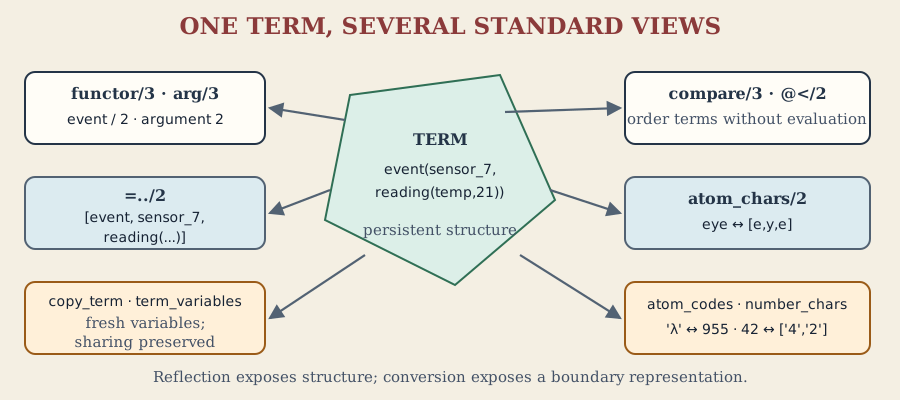
functor/3 relates a term to its name and arity. arg/3 selects a one-based
argument. =../2—traditionally called univ—relates a term to a list whose
head is the functor and whose tail contains the arguments:
term_shape(Term, shape(Name, Arity, Arguments)) :-
  functor(Term, Name, Arity),
  (Term =.. [Name | Arguments]).
In a construction mode, functor/3 creates a term with fresh arguments and
=../2 rebuilds a term from a proper list. Their ISO errors are useful
guardrails: an unknown functor name, negative arity, partial univ list, or
uninstantiated required argument is not silently treated as failure.
copy_term/2 preserves sharing inside a term while replacing its variables
with fresh ones. term_variables/2 returns each distinct variable in
first-occurrence order. Identity predicates make the distinction observable:
==/2 tests whether two resolved terms are identical without binding them;
\==/2 is its negation. =/2 still performs unification, while
unify_with_occurs_check/2 explicitly rejects cyclic bindings.
The standard term-order family—compare/3, @</2, @=</2, @>/2, and
@>=/2—compares terms without evaluating arithmetic. Do not replace
3 + 4 < 8 with 3 + 4 @< 8: the former evaluates numbers and the latter
orders syntax.
Atomic conversion predicates expose reversible representations:
atom_concat/3joins an atom or solves a sufficiently instantiated split;sub_atom/5relates a source to before, length, after, and fragment;atom_chars/2andatom_codes/2use character atoms or Unicode codes;char_code/2converts one character; andnumber_chars/2andnumber_codes/2parse or render ISO numbers.
These are atom relations, not the WebEntail library’s string convenience
predicates. Quoted atoms such as 'λ' remain atoms; double-quoted values remain
WebEntail strings.
iso-reflective-terms.pl
walks through shape, rebuilding, fresh copying, variables, and order.
iso-atomic-conversion.pl
demonstrates both conversion directions and every three-character sub-atom of
webentail.
Checkpoint. Given pair(X, X), predict the variable list before and after
copy_term/2. Then explain why atom_codes/2 belongs at a text boundary
rather than throughout a domain theory.
36. Dynamic predicates, directives, and operators
A dynamic predicate is a mutable clause store owned by one solver run. Declare it before updates:
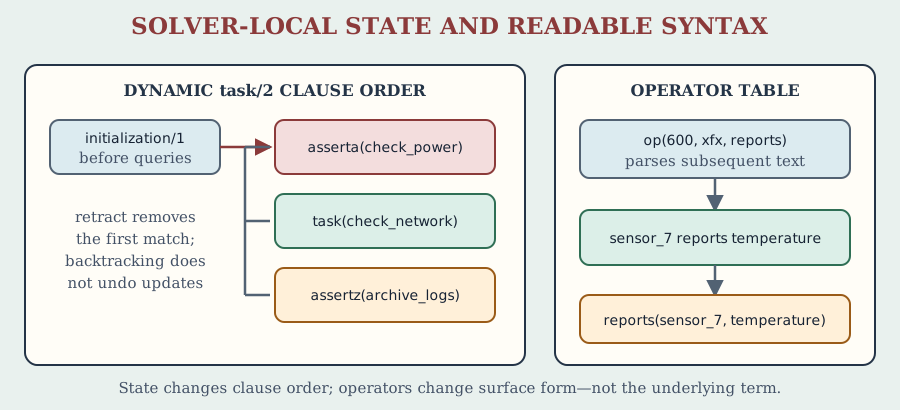
:- dynamic(task/2).

prepare_queue :-
  asserta(task(check_power, urgent)),
  assertz(task(check_network, normal)).
asserta/1 inserts at the beginning and assertz/1 at the end. retract/1
removes the first unifying clause and can be retried for later matches.
abolish/1 removes a dynamic procedure. clause/2 inspects accessible
clauses, while current_predicate/1 enumerates or tests predicate indicators.
Static and private built-in procedures are protected by permission errors.
Updates are ordered effects, not pure logical conclusions, and they are not
undone by ordinary backtracking: later goals observe a changed database. Each
update invalidates cached tabled and ground-chain answers, and rule changes
refresh recursion and negation analysis before later goals continue. Keep them
in a narrow lifecycle layer.
The queue example performs setup in initialization/1, so query order does not
determine its state:
:- initialization(prepare_queue).
Initialization runs after preparation and before host queries. include/1
expands a source file in place; ensure_loaded/1 loads the same designation at
most once. multifile/1 and discontiguous/1 document permitted clause
layout. Prolog flags and character conversions are also solver-scoped and
should be set deliberately near the boundary that relies on them.
Operators offer readable syntax without adding a new data model:
:- op(600, xfx, reports).

sensor_7 reports temperature.
The fact is exactly reports(sensor_7, temperature). Priority determines
binding strength, and fx, fy, xf, yf, xfx, xfy, and yfx
determine position and associativity. current_op/3 inspects the table;
op(0, Specifier, Name) removes a definition. Because declarations affect
parsing of subsequent text, place them before their first use.
Run iso-dynamic-database.pl
for an explicitly stateful queue and
iso-operators.pl
to see custom notation decomposed back into an ordinary term.
Checkpoint. State the final clause order after one asserta/1 and two
assertz/1 calls. Then rewrite one custom-operator fact in canonical
functor notation and verify it with =../2.
37. Streams and term I/O
Streams are handles to ordered input or output. open/4 adds options to the
basic open/3: text or binary type, alias, repositioning, and end-of-file
action. Always close a nonstandard stream, including exceptional paths in
application code.
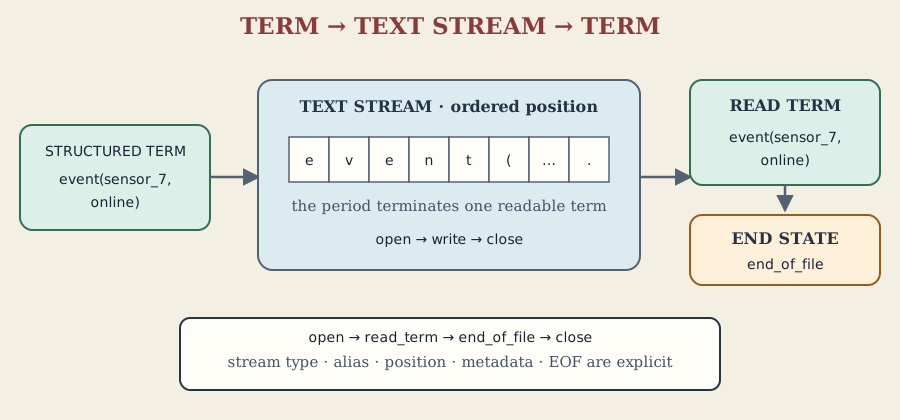
write_event(Path, Event) :-
  open(Path, write, Stream, [type(text)]),
  write_canonical(Stream, Event),
  put_char(Stream, '.'),
  nl(Stream),
  close(Stream).
The period is essential when another Prolog processor will read the result as
a term. write/1-2 uses readable conventional syntax, writeq/1-2 quotes
where needed, and write_canonical/1-2 exposes canonical structure.
write_term/2-3 accepts formatting options.
Character operations are get_char, peek_char, put_char, get_code,
peek_code, and put_code; byte streams use the corresponding byte
predicates. Peeking does not advance the position. Mixing byte operations with
a text stream, or text operations with a binary stream, raises a permission
error rather than guessing an encoding.
read/1-2 reads the next term. read_term/2-3 can also return all variables,
source variable names, and singletons. The metadata contains variables, so a
program normally validates or transforms it before placing it in a ground
query answer. stream_property/2 exposes mode, type, alias, position, and
end state. current_input/1, current_output/1, set_input/1, and
set_output/1 manage defaults shared by nested goals.
End of file is a state transition, not merely a character. With
eof_action(eof_code), term input yields end_of_file, character input yields
end_of_file, and code or byte input yields -1; at_end_of_stream/1
tests the position. Repeated input after the end follows the selected
eof_action.
iso-term-io.pl
writes a temporary fixture, reads its terms in order, checks variable metadata,
and observes end of stream. The file lives under /tmp; running the example
does not modify the checkout.
Checkpoint. Write a term round trip and name where quoting, the terminating period, stream type, and close operation matter. Explain why a stream side effect belongs outside the central relation that decides what the term means.
Part VIII summary
The supported ISO facilities make WebEntail suitable for more than closed rule files:
- control predicates delimit choices and exception recovery;
- collectors distinguish flat, grouped, and canonicalized answer sets;
- reflective predicates treat term structure as data;
- atomic conversions provide standard lexical boundaries;
- dynamic predicates and directives manage explicit solver-local state;
- operators change notation while preserving ordinary term structure; and
- streams connect terms to ordered text or binary I/O.
Chapters 38–40 state the supported profile, list every registered predicate, and document the command line; the conformance corpus fixes success, failure, mode, and error behavior. Use this part for working practice and those chapters for exact reference.
Part IX — Reference as practice
Reference is useful only when the route into it is clear. Begin with the task in hand: Chapter 38 answers what source means, Chapter 39 helps select a predicate, and Chapter 40 turns a file into observable evidence. Chapters 41–43 then support study design, boundary decisions, and precise vocabulary. The long catalogs are meant to be entered locally, not memorized linearly.
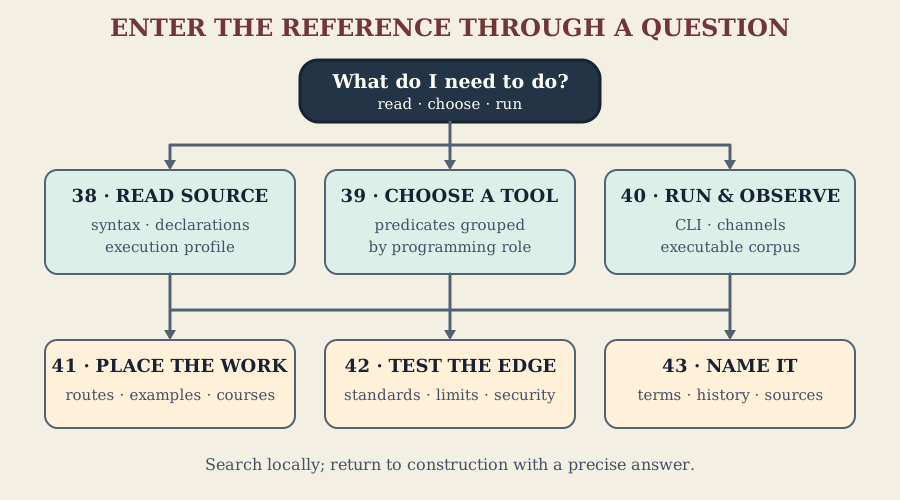
38. Language and ISO profile
The standards baseline is ISO/IEC 13211-1:1995, as corrected by Technical Corrigenda 1:2007, 2:2012, and 3:2017. WebEntail implements the compatibility profile documented here; it does not claim certification as a complete conforming processor.
Prolog source accepted by WebEntail is UTF-8. % starts a line comment and
/* ... */ delimits a block comment. Plain atoms begin with a
lowercase ASCII letter. Variables begin with uppercase or underscore. The bare
_ is fresh each time. Single quotes delimit quoted atoms; double quotes
delimit strings. Integers, decimals, scientific notation, binary/octal/
hexadecimal integers, and character-code constants are accepted.
Unquoted names deliberately use ASCII spelling. Unicode belongs inside quoted atoms and strings:
city('München').
message("café").
Inside a quoted atom, a single quote is doubled: 'don''t'. Strings support
the common escapes \n, \t, \", and \\. Whitespace is insignificant
between tokens, and a % comment continues to the end of its line. Doubling
the active delimiter is also accepted inside either quoted form, so ""
inside a string denotes one literal double quote.
Graphic atoms may contain #$&*+-/<=>@^~\;. Colon names and unquoted
angle-bracket IRIs are not syntax; quote names containing such punctuation.
In the grammar below, { x } means zero or more repetitions of x, [ x ]
means that x is optional, and parentheses group alternatives. These marks
describe the grammar; they are not characters written in WebEntail source.
program             ::= { clause }
clause              ::= head "."
                      | head ":-" goal-list "."
head                ::= term
goal-list           ::= term { "," term }
term                ::= variable | atom-constant | string | number
                      | compound | list | curly-term | parenthesized-term
compound            ::= atom-constant "(" term { "," term } ")"
list                ::= "[" "]"
                      | "[" term { "," term } [ "|" term ] "]"
curly-term          ::= "{}" | "{" term "}"
parenthesized-term  ::= "(" term [ "," term { "," term } ] ")"
variable            ::= "_"
                      | variable-start { name-continue }
atom-constant       ::= plain-atom | quoted-atom | graphic-atom
plain-atom          ::= lowercase-letter { name-continue }
number              ::= [ "-" ] digits [ "." digits ] [ exponent ]
exponent            ::= ( "e" | "E" ) [ "+" | "-" ] digits
variable-start      ::= uppercase-letter | "_"
name-continue       ::= uppercase-letter | lowercase-letter | digit | "_"
Zero-arity compounds such as ready() are unsupported; use ready. Every
clause ends in a period. The grammar above gives the canonical term shapes.
The initial operator table contains the following ISO-style operators, all
lowered to ordinary compound terms:
- prefix:
\+, unary+, unary-, and\; - control:
,,;, and->; - unification and comparison:
=,\=,==,\==,@<,@=<,@>,@>=,is,=:=,=\=,<,=<,>, and>=; - arithmetic:
+,-,*,/,//,div,mod,rem,/\,\/,<<,>>,**, and^.
op/3 directives and runtime calls define or remove prefix, infix, and postfix
operators using the ISO fx, fy, xf, yf, xfx, xfy, and yfx
specifier classes. Variables cannot occur in functor or predicate position.
Parentheses around one term
denote that term; parentheses around two or more comma-separated terms
construct a right-associated ','/2 term. In goal position it is conjunction;
in data position it remains inspectable data.
The pure definite-clause fragment has a Herbrand reading: ground terms denote themselves, predicates denote sets of ground atomic formulas, variables have clause scope, and unification is structural. The implementation performs first-order finite-tree unification with an occurs check. An attempt to bind a variable to a term containing that same variable fails.
An atom constant such as pat is a term. An atomic formula such as
parent(pat, jan) is a proposition that may be a fact, rule head, or goal.
The surface form pair(pat, jan) may also be compound data when nested inside
another term; its role comes from context. Predicate identity includes arity,
so edge/2 and edge/3 are different predicates.
Execution is goal-directed rather than complete bottom-up saturation. Goals in
a body normally run from left to right; the solver may select a ready
deterministic built-in early as a pure filter. Ordinary user-defined calls use
depth-first resolution, while eligible positive recursive groups are tabled
automatically. \+/1 is stratified negation as failure, not classical
negation.
WebEntail supports cut, operator declarations, dynamic database updates, grouped solutions, exceptions, flags, initialization and inclusion directives, and standard stream and term I/O. Modules and DCG notation remain outside this Part 1 profile.
Directives and protected built-ins
false/0 is the ISO always-failing built-in. It is protected as a static
procedure, so source clauses headed by false are rejected instead of being
interpreted as directives or integrity constraints.
Standard directives include dynamic/1, multifile/1, discontiguous/1,
op/3, char_conversion/2, initialization/1, include/1,
ensure_loaded/1, and set_prolog_flag/2. Initialization goals run once
after program preparation and before host queries. Included text is expanded
in place; repeated ensure_loaded/1 designations are loaded once.
Normal output contains only ground query answers, one term and period at a time. Source facts are not echoed as new conclusions, and duplicate answers are suppressed. Answers are not asserted back into the running program. Supported output syntax is designed to be readable as Prolog input accepted by WebEntail.
Automatic hybrid reasoning
The program loader detects predicate-dependency cycles, including dependencies
inside conjunction, \+/1, once/1, forall/2, and aggregate goals.
Positive recursive components—including directly queried recursive
relations—are tabled to an answer fixed point before answers are replayed.
Components with a negative dependency retain guarded ordinary resolution,
because positive least-fixed-point tabling does not define unstratified
negation. Nonrecursive groups use indexed, depth-first resolution.
For calls with ground structural input, tabled answers can be reused within a solver run. The engine infers common structurally decreasing inputs from recursive heads. Fully open calls and calls whose inferred structural input is not ground may remain under ordinary resolution rather than forcing a possibly infinite relation into a table. This changes control, not declarative meaning.
Query execution
The host-supplied goal must be callable and may contain constants or variables.
An unbound goal raises instantiation_error; a non-callable goal raises
type_error(callable). A program without a supplied goal prints no normal
answers. The host:
- parses all inputs into one program;
- collects source facts and host-supplied goals;
- runs initialization goals;
- solves each supplied goal;
- retains only ground answers;
- removes answers identical to source facts and suppresses duplicates;
- prints each answer and, only when requested, its
why/2explanation.
Goal selection affects host execution rather than the program’s logical meaning. One goal’s answers are not asserted for later goals, although internal tables may be reused during the solver run. For stable output, queries for known predicates are grouped by the source order in which their predicate groups first appear; goals within one group retain their supplied order. Queries for predicates with no group follow the known groups.
39. Built-in predicates by programming role
WebEntail’s default registry contains the built-ins in its ISO compatibility
profile. Where a predicate is defined by ISO/IEC 13211-1:1995, WebEntail uses its
standard predicate indicator; the registry also includes a few later or common
compatibility predicates identified below. Arithmetic is expressed through
is/2 rather than output arguments on arithmetic predicates. The registry
contains 115 name/arity entries across 94 names.
| Family | Registered predicate indicators |
|---|---|
| Control and exceptions | true/0, fail/0, false/0, !/0, call/1, \+/1, once/1, repeat/0, ;/2, ->/2, catch/3, throw/1, halt/0, halt/1 |
| Unification and identity | =/2, unify_with_occurs_check/2, \=/2, ==/2, \==/2 |
| Type tests | var/1, nonvar/1, atom/1, integer/1, float/1, number/1, atomic/1, compound/1, callable/1, ground/1 |
| Profile term order | compare/3, @</2, @=</2, @>/2, @>=/2 |
| Term inspection | functor/3, arg/3, =../2, copy_term/2, term_variables/2 |
| Collection | findall/3, bagof/3, setof/3 |
| Database and information | clause/2, asserta/1, assertz/1, retract/1, abolish/1, current_predicate/1 |
| Operators, conversion, and flags | op/3, current_op/3, char_conversion/2, current_char_conversion/2, current_prolog_flag/2, set_prolog_flag/2 |
| Atomic terms | atom_length/2, atom_concat/3, sub_atom/5, atom_chars/2, atom_codes/2, char_code/2, number_chars/2, number_codes/2 |
| Stream control | open/3, open/4, close/1, close/2, current_input/1, current_output/1, set_input/1, set_output/1, flush_output/0, flush_output/1, stream_property/2, set_stream_position/2, at_end_of_stream/0, at_end_of_stream/1 |
| Character input | get_char/1, get_char/2, peek_char/1, peek_char/2, get_code/1, get_code/2, peek_code/1, peek_code/2 |
| Character output | put_char/1, put_char/2, put_code/1, put_code/2, nl/0, nl/1 |
| Byte input/output | get_byte/1, get_byte/2, peek_byte/1, peek_byte/2, put_byte/1, put_byte/2 |
| Term input | read/1, read/2, read_term/2, read_term/3 |
| Term output | write/1, write/2, writeq/1, writeq/2, write_canonical/1, write_canonical/2, write_term/2, write_term/3 |
| Arithmetic | is/2, =:=/2, =\=/2, </2, =</2, >/2, >=/2 |
false/0 and fail/0 both fail as goals. false/0 is a protected static
procedure and cannot be defined by source clauses or declared dynamic.
Arithmetic expressions
Result is Expression evaluates an ISO arithmetic expression and unifies the
numeric result with Result. Supported expressions include integer and
floating-point literals, unary + and -, +, -, *, /, //, div,
mod, rem, bit operations, exponentiation, abs, rounding functions,
sin, cos, atan, exp, log, and sqrt.
Arithmetic comparisons evaluate both operands. Standard term-order predicates
(@<, @=<, @>, @>=) compare terms without arithmetic evaluation.
WebEntail’s documented profile order is not the complete ISO term order: strings
are a distinct scalar category, and numeric terms share one exact numeric
ordering category.
Errors
ISO built-ins distinguish logical failure from exceptional calls. Insufficient
instantiation raises instantiation_error; wrong argument categories raise
type_error; invalid values raise domain_error; and arithmetic faults raise
evaluation_error. JavaScript embedders receive these as PrologError
instances whose message contains the corresponding Prolog error term.
Streams belong to one solver run and are shared by nested calls, exceptions,
and solution collectors. user_input and user_output are always present.
open/4 supports type/1, alias/1, reposition/1, and eof_action/1;
read_term/3 supports variables/1, variable_names/1, and singletons/1.
The JavaScript ioOptions.input and ioOptions.write hooks connect standard
streams to an embedder. File-backed streams use synchronous lifecycle semantics
so side effects occur in Prolog execution order.
The WebEntail library
The runtime registry combines the supported ISO Prolog profile with the WebEntail library, implemented entirely in JavaScript. It is
loaded automatically by the CLI, run(), Solver, proof replay, and the browser
playground. Ordinary programs therefore use the same built-ins throughout.
All of these relations live in src/library.js; there is no second portable
source module and no runtime Prolog-library parse or program overlay.
src/playground-worker.js constructs the same registry directly. The isolated
ISO-only registry remains available through createDefaultRegistry() and
getDefaultRegistry() for conformance work and advanced embedders.
The complete registry contains 169 predicate indicators: 115 in the isolated
ISO profile and 54 WebEntail library indicators implemented in src/library.js. Every
WebEntail library definition is tagged with webEntailLibrary: true, so tests and
embedders can audit the boundary directly.
| WebEntail library predicates |
|---|
append/3, member/2, select/3, head/2, rest/2, last/2 |
nth0/3, nth1/3, set_nth0/4, take/3, drop/3, slice/4 |
reverse/2, length/2, sum_list/2 |
min_list/2, max_list/2 |
not_member/2, list_to_set/2, sort/2 |
str_concat/3, contains/2, matches/2 |
join/3, substring/4 |
countall/2, sumall/3 |
aggregate_min/5, aggregate_max/5 |
between/3, min/3, max/3, smallest_divisor_from/3 |
maplist/3 |
acos/2, asin/2, atan2/3, tan/2 |
lt/2, le/2, gt/2, ge/2 |
local_time/1, difference/3 |
matches/3 |
call/3 |
split/3, replace/4 |
lowercase/2, uppercase/2, trim/2 |
number_string/2, atom_string/2, term_string/2 |
On the command line, the WebEntail library is already present:
webentail program.pl
webentail -p program.pl        # add proof output
JavaScript uses the same registry by default:
import { run } from 'webentail';

const result = run(source);
The mode notation below is descriptive:
+means the argument must already have the required input shape;-means the predicate produces that argument;?means a bound value can be checked or an unbound value generated.
Most WebEntail library predicates are projections or filters. When an input is unbound, malformed, outside its domain, or incompatible with the requested output, they normally fail rather than raising the ISO errors described in the errors section above. They do not invent open-ended domains. Bind arithmetic operands, source text, proper lists, indexes, dates, and aggregate generators before calling the corresponding predicate.
Native numeric, comparison, and date predicates
| Predicates and principal modes | Behavior |
|---|---|
tan/2, asin/2, acos/2, atan2/3 |
Floating-point functions not supplied as evaluable functions by ISO/IEC 13211-1. |
lt(+A,+B), le(+A,+B), gt(+A,+B), ge(+A,+B) |
Compare integers exactly, finite numeric text numerically, PnYnMnD duration text component-wise, and other lexical values by string order. These differ from ISO arithmetic comparison and standard term order. |
local_time(-Date) |
Produces the host-local calendar date as "YYYY-MM-DD". Tests and reproducible hosts may set WEBENTAIL_LOCAL_TIME. |
difference(+End,+Start,-Duration) |
Computes a nonnegative calendar difference between ISO date prefixes and returns "PnYnMnD". Invalid dates or an end before the start fail. |
answer(square, S) :- (S is 12 * 12).
answer(day_count, N) :- between(3, 5, N).
answer(age, D) :- difference("2026-07-28", "2020-05-20", D).
webentail --goal 'answer(Kind, Value)' program.pl
The library deliberately does not register named arithmetic wrappers such as
add/3, mul/3, abs/2, or sqrt/2, because ISO arithmetic already
expresses them: for example, R is A + B, R is abs(A), and
R is sqrt(A). The same applies to subtraction, multiplication, division,
modulo, powers, sine, cosine, exponential, logarithm, and the ISO rounding
functions.
The bundled WebEntail library layer defines between/3, min/3, max/3, and
smallest_divisor_from/3 using ISO arithmetic and comparisons. They are
available in the default runtime, but they are part of the WebEntail library.
between/3 and smallest_divisor_from/3 retain measured native accelerators.
List relations
These relations are JavaScript implementations provided by the WebEntail library. Their relational modes and error behavior are regression-checked against equivalent clause definitions. Every list-consuming relation below expects a proper list unless explicitly stated otherwise. Indexes and counts are zero-based, nonnegative safe integers.
| Predicate and principal mode | Behavior |
|---|---|
append(+Prefix,+Suffix,-Whole) |
Appends a proper prefix to any suffix, including an improper tail. |
append(-Prefix,-Suffix,+Whole) |
Enumerates every split of a proper Whole, from empty prefix to empty suffix. |
member(?Item,+List) |
Produces one answer per matching position, so duplicates remain observable. |
select(?Item,+List,-Rest) |
Removes one occurrence at a time and preserves the order of all other elements. Duplicate occurrences may produce duplicate answers. |
not_member(+Item,+List) |
Succeeds only when Item does not unify with any member. Use it after binding the item and list. |
nth0(?Index,+List,?Item) |
Checks a bound zero-based index or enumerates indexes and their items. |
nth1(+Index,+List,?Item) |
Checks a bound one-based index. |
maplist(+Closure,+List1,?List2) |
Applies a two-argument closure pairwise; call/3 supplies the closure arguments and supports partially applied compound closures. |
set_nth0(+Index,+List,+Item,-NewList) |
Replaces one existing position without mutating the input list. |
head(+List,?Head), rest(+List,?Tail) |
Decompose a nonempty list. rest/2 may expose an improper tail. |
last(+List,?Last) |
Returns the final element of a nonempty proper list. |
take(+Count,+List,-Prefix), drop(+Count,+List,-Suffix) |
Select the first Count elements or remove them. Counts beyond the list length fail. |
slice(+Start,+Count,+List,-Slice) |
Selects exactly Count elements beginning at Start; an out-of-range slice fails. |
reverse(+List,-Reversed) |
Reverses a proper list. |
length(?List,?Length) |
Reports or checks the length of a proper list, or generates a list skeleton when Length is a bound nonnegative integer. |
sum_list(+List,-Sum) |
Sums numeric elements with ISO is/2. The empty sum is 0; invalid arithmetic raises the corresponding ISO error. |
min_list(+List,-Min), max_list(+List,-Max) |
Select by WebEntail term order, not numeric coercion. Empty lists fail. |
list_to_set(+List,-Set) |
Removes later structural duplicates while preserving first-occurrence order. |
sort(+List,-Set) |
Sorts by standard term order and removes structural duplicates. |
answer(split, pair(Prefix, Suffix)) :-
  append(Prefix, Suffix, [a, b]).

answer(second, Item) :-
  nth0(1, [a, b, c], Item).

webentail --goal 'answer(Kind, Value)' program.pl
Native strings, lexical values, and regular expressions
A lexical value is the textual spelling of a ground atom, string, or number. Most string predicates accept any of those inputs but produce WebEntail string terms unless their name says otherwise.
| Predicate and principal mode | Behavior |
|---|---|
str_concat(+Left,+Right,-Text) |
Concatenates two scalar lexical values. |
contains(+Text,+Needle) |
Tests literal containment. |
matches(+Text,+Pattern) |
Tests |-separated literal alternatives. |
matches(+Text,+Regex,-Context) |
Runs a JavaScript regular expression and returns named captures as comma-context data such as (year("2026"), month("07")). It fails for an invalid expression, no match, or a match with no named captures. |
split(+Text,+Separator,-Parts) |
Literal split into a proper list of strings. |
join(+Parts,+Separator,-Text) |
Joins scalar lexical values. The empty list produces "". |
substring(+Text,+Start,+Count,-Part) |
Extracts Unicode characters using zero-based integer indexes. |
replace(+Text,+Search,+Replacement,-Result) |
Replaces every literal occurrence. An empty search leaves the text unchanged. |
lowercase(+Text,-Lower), uppercase(+Text,-Upper), trim(+Text,-Trimmed) |
Apply JavaScript Unicode case conversion or surrounding-whitespace trimming. |
number_string(?Number,?Text) |
Converts a number to a string or parses numeric string/atom text. At least one conversion direction must be ready. |
atom_string(?Atom,?Text) |
Converts an atom to a string or a ground string, atom, or number to an atom. |
term_string(+Term,-Text) |
Renders a nonvariable term using WebEntail readback syntax. It does not parse text back into a term. |
contains/2 and matches/2 retain measured native accelerators for bound
lexical inputs. Calls outside that mode fall through to the native builtins,
so user-defined relational clauses with the same indicators remain visible.
answer(words, Words) :-
  trim("  Logic Made Visible  ", Clean),
  lowercase(Clean, Lower),
  split(Lower, " ", Words).

answer(captures, Context) :-
  matches("2026-07", "^(?<year>[0-9]{4})-(?<month>[0-9]{2})$", Context).

webentail --goal 'answer(Kind, Value)' program.pl
Native aggregation and bounded control
These native relations follow the documented collection, arithmetic, term-order, and scoping contracts. The caller is responsible for making that search finite. Bind outer variables before the nested goal when they are intended to restrict its domain.
| Predicate and principal mode | Behavior |
|---|---|
countall(+Goal,-Count) |
Counts all solutions, including solutions that produce the same visible template. The empty count is 0. |
sumall(+Template,+Goal,-Sum) |
Sums the numeric value of Template in every solution. The empty sum is 0; invalid arithmetic raises the corresponding ISO error. |
aggregate_min(+KeyTemplate,+ValueTemplate,+Goal,-BestKey,-BestValue) |
Retains the solution with the smallest resolved key under standard term order. |
aggregate_max(+KeyTemplate,+ValueTemplate,+Goal,-BestKey,-BestValue) |
Retains the solution with the largest resolved key. Both best-value predicates fail on an empty solution set and retain the first solution on an equal key. |
ISO findall/3 is present in both registries. The WebEntail library aggregates follow
the same scoping principle: variables created inside the nested search do not
leak except through the declared templates and outputs.
There are no not/1 or forall/2 semantic host conveniences. Use ISO \+/1;
define a named counterexample relation for universal checks. once/1 is
supplied directly by the ISO registry.
cost(a, 8).
cost(b, 3).
cost(c, 3).

answer(count, N) :- countall(cost(_, _), N).
answer(best(Name), Cost) :-
  aggregate_min(CandidateCost, CandidateName,
                cost(CandidateName, CandidateCost),
                Cost, Name).

webentail --goal 'answer(Kind, Value)' program.pl
Contexts with ordinary terms
A comma-context needs no special native predicate. A small program relation can
walk its members, and ISO =../2 can expose any member’s name and argument list.
message(event_17,
        (severity(high), source(sensor_3), reading(temp, 91))).

context_member((Left, _right), Member) :- context_member(Left, Member).
context_member((_left, Right), Member) :- context_member(Right, Member).
context_member(Member, Member) :- Member \= (_left, _right).

context_parts(Context, Name, Args) :-
  context_member(Context, Member),
  (Member =.. [Name | Args]),
  atom(Name).

answer(field(Name, Args)) :-
  message(event_17, Context),
  context_parts(Context, Name, Args).

webentail --goal 'answer(X)' program.pl
The ISO profile includes functor/3, arg/3, and =../2. Use =../2 for whole-argument-list
decomposition and construction, =/2 for unification, and \=/2 for
non-unifiability; redundant aliases are not registered.
40. Running WebEntail: command line and corpus
The command line is an observation boundary around a theory. Keep the program fixed while selecting the evidence you need: ordinary output for answers, proof output for support, warnings for portability risks, and statistics for search behavior.
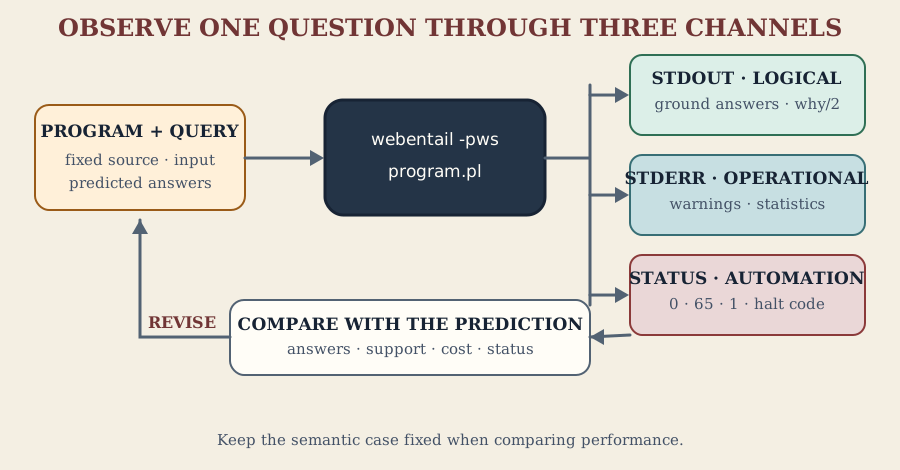
webentail [options] [file-or-url.pl|- ...]
Selecting goals
A Prolog source file states facts, rules, and ISO directives; the command line
selects what to solve. Supply --goal followed by a callable Prolog goal:
webentail --goal 'ancestor(ada, Who)' examples/ancestor.pl
Repeat --goal to request several result relations in one run. WebEntail prints
their ground answers in the order the goals were supplied. This separation
keeps program text portable and makes the observed question explicit in a
script, shell history, or API call.
| Option | Meaning |
|---|---|
-h, --help |
Show usage |
-p, --proof |
Print why/2 explanations |
-s, --stats |
Print solver counters to stderr |
-v, --version |
Print the package version |
-w, --warnings |
Print non-fatal portability warnings |
--goal Goal |
Solve a callable goal; may be repeated |
-- |
Treat following arguments as inputs |
Short flags may be combined, so -pw is equivalent to -p -w.
Inputs may be local files, HTTP(S) URLs, or one - for stdin. The bare command
webentail prints help. When options are present but no input is named, stdin is
used; writing - explicitly is clearer in scripts. Multiple sources are
parsed as one program, so facts, rules, and directives can be separated across
files. A relative include/1 inside a local file resolves from that file’s
directory.
A reproducible run
Work in a fixed sequence:
- predict the ground answers before running the program;
- run without observation flags and compare stdout with that prediction;
- add
--proofwhen the support for an answer is the question; - add
--warningswhen portability or negative dependencies are the question; - add
--statsonly when comparing two executions of the same semantic case.
For example:
webentail --goal 'ancestor(X, Y)' examples/ancestor.pl
webentail --proof --goal 'type(X, Y)' examples/socrates.pl
webentail --warnings --goal 'answer(X)' test/conformance/warnings/negation/unstratified_mutual.pl
webentail --stats --goal 'path(a, X)' examples/path-discovery.pl > answers.pl 2> run.stats
Normal answers and why/2 terms go to stdout, which makes them suitable for a
golden file or another WebEntail input. Warnings and statistics go to stderr so
they do not corrupt that logical stream. A successful run normally exits with
status zero; loading, syntax, option, and other uncaught errors use status 1. halt/0-1 can deliberately choose the
process status from inside a program.
Statistics are comparative evidence, not a score in isolation. Preserve the program, input, runtime version, selected query, answers, and counters together. An optimization is acceptable only when the intended answers remain unchanged and the chosen resource measure improves on the relevant scale case.
The corpus as executable documentation
The files under examples/ pair readable programs with checked output under
examples/output/. The conformance cases under test/conformance/ focus on
language behavior, including success, failure, errors, warnings, and file
loading. Use an example to learn a modeling pattern and a conformance case to
settle an exact processor question. npm test checks both along with the book’s
extracted programs; npm run generate refreshes those extracted examples after
changing executable book blocks.
Checkpoint. Run one example with --proof --stats. Identify which bytes
belong to the reusable logical result, which describe this execution, and which
process status an automated caller observes. Then change one fact and predict
all three channels before rerunning it.
41. Study paths, review, and further examples
For a first week, run socrates.pl and ancestor.pl, rewrite them from memory,
inspect their proofs, learn member/2, append/3, and select/3, solve one
finite puzzle, and add one explicit integrity query.
Course-length schedules
These schedules name a spine rather than a reading quota. Every meeting should include prediction, execution, one changed input, and a short explanation.
| Meeting | Six-meeting introduction | Ten-meeting course | Fourteen-meeting course |
|---|---|---|---|
| 1 | Chapters 1–2; Socrates and family facts | Chapters 1–2; Laboratory 1 begins | Chapters 1–2; predicates, terms, and unification |
| 2 | Chapters 3–5; recursion and lists | Chapters 3–5; Laboratories 1–2 | Chapters 3–4; rules, semantics, and recursion |
| 3 | Chapters 6–10; one finite puzzle | Chapters 6–8; finite generation and absence | Chapters 5–6; lists and arithmetic |
| 4 | Chapters 11–14 and 17–20; proof, integrity, construction | Chapters 9–12; contexts, models, proofs, and integrity checks | Chapters 7–8; negation and aggregation |
| 5 | Choose Chapters 21–25 or 26–30 | Chapters 13–16; performance and boundaries | Chapters 9–10; structured data and finite models |
| 6 | Chapters 31–33; release matrix and reflection | Chapters 17–20; construction and improvement | Chapters 11–12; answers, proofs, and integrity |
| 7 | — | Chapters 21–25; one advanced case | Chapters 13–14; termination and knowledge engineering |
| 8 | — | Choose Chapters 26–30 | Choose Chapters 15–16 or an alternate domain route |
| 9 | — | Chapters 31–32; test and debug | Chapters 17–20; construction, correctness, improvement |
| 10 | — | Chapter 33; project review | Chapters 21–25; advanced relational design |
| 11 | — | — | Chapters 26–27; witnesses and induction |
| 12 | — | — | Chapters 28–30; representation, experiment, limits |
| 13 | — | — | Chapters 31–33; test, debug, patterns |
| 14 | — | — | Laboratory demonstrations and rubric review |
For a classroom, use checkpoints as exit questions and laboratories as multi-meeting projects. A six-meeting introduction should prefer one small, finished theory over hurried coverage of every feature.
Domain routes
Modelers should study access-control-policy.pl,
clinical-trial-screening.pl, gdpr-compliance.pl, and
trust-flow-provenance-threshold.pl. Identify facts, derived concepts,
decisions, closed-world assumptions, and proof premises.
Algorithm students should study graph-reachability.pl,
dijkstra-risk-path.pl, stable-marriage.pl, sat-solver-dpll.pl, and
type-inference.pl. For each, identify the finite domain, branching relation,
pruning goals, witness, and termination argument.
Mathematics students should read Chapters 3, 19, and 26–30 together, then study
peano-calculus.pl, fundamental-theorem-arithmetic.pl,
stirling-bell-numbers.pl, d3-group.pl, and
matrix-noncommutativity.pl. For each program, distinguish definition from
theorem, computation from justification, finite evidence from universal proof,
and syntactic equality from the domain’s mathematical equality.
Review questions
Review questions:
- What distinguishes an atom constant from an atomic formula?
- Why can one append relation construct lists and split them?
- When does goal order affect performance but not declarative meaning?
- Why should variables usually be bound before
\+/1? - What does automatic tabling solve, and what does it not solve?
- Why is proof output useful when the answer is already known?
- When should a host query an
invalid/1relation before domain decisions? - What does an explicit RDF adapter preserve about the core language?
- In what sense is a ground query answer an existential witness?
- Why are partial correctness, completeness, and termination three different claims?
- When can exhaustive computation constitute a proof, and when is it only evidence?
- Which parts of an answer’s trust come from its proof, and which remain outside the formal theory?
Further examples
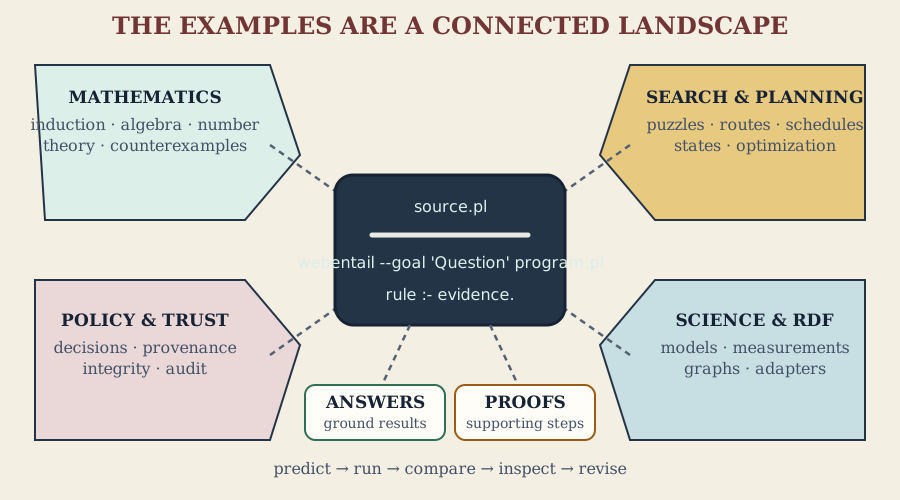
The examples directory is the book’s executable companion. The top-level directory contains 200 self-contained runnable programs. Every source program has an exact answer file under examples/output, and 55 selected programs have a checked explanation under examples/proof. The selected pointers below open the program itself rather than merely naming it.
The generated examples/book/ tree serves a different
purpose: it mirrors the complete inline WebEntail displays chapter by chapter.
Those files are checked for syntax, and displays containing queries are
executed, but some teaching fragments deliberately depend on neighboring
facts or helpers. Use the top-level catalog below when you want a self-contained
program with a golden answer; use examples/book/ when you want the exact
display being discussed on a page.
For any named example, the three useful views are:
- source: the facts, rules, comments, and declared queries in the top-level examples directory;
- answers: the exact normal output in its
examples/output/counterpart; - proof: when present, the exact
--proofoutput in the correspondingexamples/proof/file.
Run one program directly:
node bin/webentail.js examples/ancestor.pl
node bin/webentail.js --proof examples/ancestor.pl
Then compare the result with its linked golden file. A productive reading sequence is:
- read the query declarations and predict their ground answers;
- identify facts, base clauses, recursive clauses, and mode-sensitive built-ins;
- state one intended mode and its finiteness argument;
- run the program and compare with the answer golden;
- inspect the proof, when supplied, and mark which source clauses support the conclusion;
- change one fact or bound and predict the changed answer before rerunning.
Standard Prolog profile
These examples compose ISO facilities that isolated conformance cases test one mode at a time.
| Program | Standard facility | Checked answer |
|---|---|---|
| Control and errors | call/1, once/1, cut, if-then-else, throw/1, and catch/3. |
answers |
| Grouped solutions | findall/3, bagof/3, setof/3, existential qualification, and clause/2. |
answers |
| Integer arithmetic | Integer quotient/remainder choices plus bit operations. | answers |
| Reflective terms | Term shape, construction, copying, variables, identity, and standard order. | answers |
| Atomic conversion | Atom splitting, character atoms, Unicode codes, and numeric parsing. | answers |
| Dynamic database | Initialization and ordered updates to a declared dynamic procedure. | answers |
| Operators | Custom syntax, standard term order, and operator-table inspection. | answers |
| Term I/O | Text-stream lifecycle, canonical writing, reading, metadata, and end state. | answers |
Read these beside Part VIII. Then use the ISO conformance cases when a program depends on the exact failure or error behavior of a particular mode.
First encounters
These programs isolate one idea at a time. Read them before the larger case studies.
| Program | What to notice | Checked companions |
|---|---|---|
| Socrates | A fact and one rule turn the classical syllogism into a ground derivation. | answers · proof |
| Age | Arithmetic comparison acts as a filter after a fact supplies the age. | answers · proof |
| Ancestor | The canonical base-plus-recursive definition computes a transitive family relation. | answers · proof |
| Animal | Several clauses form a small classification theory with inspectable reasons. | answers · proof |
| Dog | A compact inheritance chain shows how intermediate concepts appear in a proof. | answers · proof |
| Good cobbler | Multiple premises combine into a conclusion without hidden mutation or control state. | answers · proof |
| Derived rule | A conclusion depends on another derived predicate rather than directly on a source fact. | answers · proof |
| Existential rule | Structured Herbrand terms carry explicit generated witnesses. | answers · proof |
| Herbrand witnesses | Functional witness terms make existential structure and syntactic identity visible in both answers and derivations. | answers · proof |
| Annotation | Terms attach descriptive data while the logical relation remains ordinary. | answers · proof |
| Reusable built-ins | Arithmetic, strings, lists, and term inspection compose through ordinary variables. | answers · proof |
Suggested path: Socrates → Age → Ancestor → Derived rule → Reusable built-ins. At each step, say aloud what one ground instance of every predicate means.
Recursion, lists, and graph closure
These examples make termination arguments visible. Compare structural descent, visited-state search, and fixed-point tabling rather than treating all recursion as one technique.
| Program | What to notice | Checked companions |
|---|---|---|
| List collection | findall/3, list construction, and aggregation turn a solution stream into data. |
answers · proof |
| Graph reachability | A visited list bounds cyclic traversal and makes explicit negative test cases finite. | answers · proof |
| Cyclic path | A deliberately cyclic graph exposes repeated calls and the need for disciplined recursion. | answers |
| Path discovery | Witness paths, not only endpoint pairs, are constructed during a larger graph search. | answers |
| Deep taxonomy: 10 | A small generated hierarchy is readable by hand and establishes the benchmark shape. | answers |
| Deep taxonomy: 1,000 | The same logical theory tests indexing and recursive closure at a realistic depth. | answers |
| Deep taxonomy: 100,000 | A stress case separates semantic simplicity from implementation scale. | answers |
| Family cousins | Several relational joins derive kinship beyond a simple transitive closure. | answers |
| Chart parser | A finite chart represents shared parsing subproblems and recursive grammatical structure. | answers · proof |
Read the three taxonomy programs as one experiment: the mathematical relation does not change as the data scale changes. Any difference in runtime belongs to control, indexing, memory, and table management.
Finite search, puzzles, and optimization
The central question for every program in this group is: what exactly is the finite search space, and which constraint removes which branches?
| Program | Search design | Checked answer |
|---|---|---|
| Eight queens | A permutation supplies one queen per row; diagonal tests prune candidates; once/1 retains one witness. |
answers |
| N-Queens enumeration | select/3 chooses each row and diagonal checks prune partial placements; the query enumerates all 92 eight-queen solutions in the default runtime. |
answers |
| Zebra puzzle | House records, adjacency relations, and clue constraints jointly determine the famous solution. | answers |
| SEND + MORE = MONEY | Digit assignments are generated under distinctness, leading-zero, and column constraints. | answers |
| DONALD + GERALD = ROBERT | The 200th example assigns all ten decimal digits to ten distinct letters. Right-to-left carry propagation cuts a naive 10! search space to one solution. | answers |
| Four-color map | A finite color assignment is filtered by adjacency constraints. | answers |
| Sudoku 4×4 | Small domains make row, column, and block constraints completely inspectable. | answers |
| Hamiltonian path | A witness must visit every vertex exactly once; path construction and global coverage meet. | answers |
| Eulerian path | The state tracks remaining edges rather than merely visited vertices. | answers |
| Knapsack optimization | Candidate subsets become feasible solutions, then aggregation selects a best value. | answers |
| Weighted interval scheduling | Compatibility constraints and an ordered objective select a maximum-value schedule. | answers |
| Job-shop scheduling | Resource and precedence constraints interact in a larger finite schedule space. | answers |
| Stable marriage | Preference data, matching generation, and the absence of blocking pairs define stability. | answers |
| Register allocation | Interference constraints turn compiler allocation into graph coloring. | answers |
A useful comparative exercise is to draw the first three levels of the search tree for Eight queens, SEND + MORE = MONEY, DONALD + GERALD = ROBERT, and Knapsack. Mark whether each branching decision chooses a permutation element, assigns a digit, derives a carry-constrained digit, or includes an item. The syntax is similar; the combinatorial objects and pruning strength are different.
Planning and state transition
Planning programs represent a world state as a term, define legal transitions, and search for a sequence whose final state satisfies a goal.
| Program | State-space idea | Checked answer |
|---|---|---|
| Route planning | Weighted edges construct candidate routes and expose the chosen path as a witness. | answers |
| Lee routing | Breadth-first wave expansion reaches a destination on a grid, then reconstructs a path around rectangular obstacles using the standard list relations. | answers |
| Blocks world | Symbolic actions transform a compact arrangement of blocks. | answers |
| Wolf, goat, and cabbage | Safety invariants reject river-bank states before they enter a valid plan. | answers |
| Missionaries and cannibals | Numeric state constraints must hold on both banks after every crossing. | answers |
| Monkey and bananas | Actions change location, support, and possession facts until the goal becomes true. | answers |
| Hanoi | A recursive plan mirrors the inductive structure of moving a tower. | answers · proof |
| Critical-path schedule | Dependency closure and duration arithmetic derive project timing. | answers |
| Drone corridor planner | Route feasibility combines graph structure with domain restrictions. | answers |
| Microgrid dispatch | Candidate operating decisions are checked against supply, demand, and engineering limits. | answers |
Compare the witness shape: Hanoi returns an inductively constructed move list; route planning returns a graph path; Lee routing reconstructs a path from breadth-first wave layers; Blocks world and the river puzzles expose a sequence of whole states. Representation determines which plan properties are easy to check.
Mathematics as relations
These examples accompany Part VI. They range from executable definitions to finite counterexample searches. Do not call every computed result a theorem: state which domain was exhausted and which general property was proved only by the clauses.
| Program | Mathematical content | Checked answer |
|---|---|---|
| Peano calculus | Addition, multiplication, and factorial follow the constructors z and s/1. |
answers |
| Peano arithmetic | Explicit natural-number terms support arithmetic relations and structural recursion. | answers |
| Fundamental theorem of arithmetic | Two factorization strategies construct normalized prime-factor witnesses and check reconstruction. | answers |
| Prime range | Bounded integer generation and divisor tests enumerate primes over an explicit finite interval. | answers |
| Goldbach | Bounded search checks Goldbach decompositions for powers of two; the default native smallest_divisor_from/3 accelerator makes the range through 2^35 practical. |
answers |
| Pi | The Nilakantha series is a deterministic numeric recurrence; WebEntail recognizes its accumulator shape and executes 10,000 terms without tabling or heap growth. | answers |
| Sieve | List filtering presents a different operational route to finite prime generation. | answers |
| Fibonacci | A recurrence becomes an executable relation with a visibly decreasing argument. | answers |
| Fast exponentiation | Algebraic decomposition by parity changes a linear recurrence into logarithmic-depth recursion. | answers |
| Modular exponentiation | Intermediate reduction preserves the residue while controlling numeric growth. | answers |
| Integer partitions | Recursive generation constructs unordered additive decompositions without permutation duplicates. | answers |
| Stirling and Bell numbers | Inclusion–exclusion and recurrence count set partitions in two related ways. | answers |
| Catalan convolution | A classic convolution identity is evaluated over a bounded range. | answers |
| Binomial Vandermonde | Two finite sums compute the sides of Vandermonde’s identity. | answers |
| D3 group | A finite Cayley table, inverses, and subgroup closure make group laws executable. | answers |
| Matrix noncommutativity | Two concrete products provide a counterexample to universal commutativity. | answers |
| Group inverse uniqueness | A short derivation exposes the algebraic premises needed for uniqueness. | answers · proof |
| Greatest lower bound uniqueness | Order-theoretic definitions support a uniqueness argument. | answers · proof |
| Pell equation | Bounded generation searches for integer witnesses to a Diophantine equation. | answers |
| Totient summatory function | Divisibility, coprimality, counting, and summation compose over finite domains. | answers |
For a focused seminar, read Peano calculus, Fast exponentiation, D3 group, Matrix noncommutativity, and Fundamental theorem of arithmetic. They exhibit, respectively, structural induction, program improvement by algebra, finite model checking, refutation by one witness, and witness-producing number theory.
Symbolic mathematics, languages, and metaprogramming
Here terms denote syntax, formulas, expressions, or programs. The crucial discipline is to keep object language and WebEntail metalanguage distinct.
| Program | What the terms represent | Checked answer |
|---|---|---|
| Expression evaluator | Arithmetic expression trees are interpreted under an explicit environment. | answers · proof |
| Fast Fourier Transform | Recursive evaluation builds a shared expression tree and treats graphic operators such as + and * as data atoms. |
answers |
| Symbolic derivative | Differentiation rules transform expression trees without evaluating them numerically; the proof golden exposes the recursive construction. | answers · proof |
| Polynomial | Structured coefficients and powers support symbolic polynomial operations. | answers |
| Partial evaluator | Known inputs specialize an expression or program while unknown parts remain symbolic. | answers |
| Equality saturation | Repeated rewrite closure explores equivalent symbolic forms to a fixed point. | answers |
| Knuth–Bendix completion | Oriented equations and critical interactions seek a more canonical rewrite system. | answers |
| Language | A small grammar recognizes a finite relational language. | answers |
| Chart parser | Shared chart items prevent grammatical subproblems from being rediscovered independently. | answers · proof |
| Turing machine | Machine configuration terms and transition rules expose a classical computation model. | answers |
| SAT solver: DPLL | Formula representation, assignment, simplification, and branching form a compact solver. | answers |
| SAT solver: CDCL | The example extends the SAT vocabulary toward conflicts and learned information. | answers |
Inspect the outermost functor of every data term. In the derivative example it names an expression constructor; in the SAT examples it names logical syntax; in the Turing example it helps describe a machine configuration. None of those nested terms is automatically asserted as an WebEntail goal.
Program analysis and verification
These programs make programs or system configurations the subject of reasoning.
| Program | Analysis idea | Checked answer |
|---|---|---|
| Abstract interpretation | A finite sign domain conservatively approximates many concrete executions. | answers |
| Pointer analysis | Allocation and assignment constraints derive a points-to relation by closure. | answers |
| Type inference | Structural unification solves type constraints for a tiny expression language. | answers |
| Register allocation | Liveness interference becomes a finite coloring problem. | answers |
| Cache performance | Configuration and workload facts derive performance classifications and reasons. | answers · proof |
| Canary release | Observations and thresholds support a deployment decision with auditable evidence. | answers · proof |
| Security incident correlation | Distributed observations combine into incident conclusions. | answers · proof |
| Observability log correlation | Structured log events join across identifiers and time-related facts. | answers |
| Truth-maintenance system | Justifications remain explicit when conclusions depend on defeasible information. | answers |
Abstract interpretation deserves special care: an abstract warning is not the claim that every concrete execution fails. It says the abstraction cannot rule the failure out. The direction of approximation is part of the theorem.
Policies, provenance, and auditable decisions
These examples are best read in layers: source facts, normalized concepts, decisions, reasons, integrity conditions, and proof.
| Program | Decision domain | Checked companions |
|---|---|---|
| Access control policy | Attribute and policy facts derive permit status and reasons. | answers · proof |
| GDPR compliance | Purpose, basis, and processing facts support compliance conclusions. | answers · proof |
| Clinical-trial screening | Inclusion and exclusion criteria produce an evidence-backed eligibility result. | answers · proof |
| Workplace compliance | Training, role, and workplace conditions feed a compact compliance theory. | answers |
| ODRL–DPV risk ranking | Policy and privacy vocabulary is normalized before candidates are ranked. | answers |
| Healthcare ODRL–DPV risk | The same architecture is specialized to a richer healthcare scenario. | answers |
| Purpose mapping | Explicit mapping relations connect two policy vocabularies. | answers · proof |
| Trust-flow provenance threshold | Provenance and trust values remain premises of the derived threshold decision, including its arithmetic and comparison steps. | answers · proof |
| Data negotiation | Offered and required data conditions derive an agreement or mismatch. | answers · proof |
| Integrity check | An explicit invalid-state relation reports contradictory input and a diagnostic status. | answers |
When studying a policy proof, circle every premise imported from outside the theory. The derivation validates the transition from those premises to the decision; it does not authenticate the source by itself.
Science, engineering, and numerical models
These examples make mathematical assumptions operational. Their values are illustrative models, not professional engineering or medical advice.
| Program | Model | Checked companions |
|---|---|---|
| Spacecraft battery diagnosis | Telemetry, P = I²R, limits, and redundant sensing support diagnosis and action. |
answers · proof |
| Beam deflection | A mechanics equation combines load, geometry, and material parameters. | answers · proof |
| Electrical RC filter | Component values derive circuit behavior under an explicit formula. | answers · proof |
| Competitive enzyme kinetics | A biochemical rate law becomes a numeric relational model. | answers |
| Orbital transfer design | Candidate orbital parameters are evaluated against transfer equations. | answers |
| Buck converter design | Electrical design candidates are checked against component and performance constraints. | answers |
| Control system | System parameters derive stability- and response-related quantities. | answers |
| Least-squares regression | Finite observations are summarized into a fitted linear model. | answers |
| Statistics summary | Aggregates compute descriptive statistics over a finite list. | answers |
| Epidemic policy | Observations and thresholds connect a simple epidemic model to policy conclusions. | answers · proof |
| Dairy energy balance | Intake and expenditure quantities are combined in an agricultural model. | answers |
| Field nitrogen balance | Inputs, removal, and losses form a conservation-style accounting relation. | answers |
For each scientific example, write a five-column audit: quantity, unit, source, equation, and approximation. A machine-checked derivation is only as interpretable as that modeling boundary.
RDF 1.2 and knowledge boundaries
These programs are generated from RDF inputs by the repository tools. Follow the source data, generated WebEntail facts, rules, answers, and serialized RDF as one adapter pipeline.
| Program | RDF feature | Checked answer |
|---|---|---|
| Triple term | An RDF 1.2 triple term is represented as nested WebEntail data and projected by a rule. | answers |
| Nested triple term | Triple terms occur recursively without becoming asserted facts merely by nesting. | answers |
| TriG named graph | The fourth rdf/4 argument preserves graph identity. |
answers |
| TriG triple term | RDF 1.2 triple terms and dataset graph structure appear together. | answers |
| TriG graph join | Rules join facts while retaining their graph-sensitive representation. | answers |
| Directional language | Language direction remains explicit in the lossless literal encoding. | answers |
| Web names | Quoted web identifiers remain atom constants in ordinary Prolog terms. | answers |
| Aliases and namespaces | Explicit name relations avoid adding hidden namespace semantics to the core. | answers · proof |
The original RDF fixtures and adapter rules are available in examples/input. Chapter 15 explains why the conversion is an explicit boundary instead of extra syntax inside the reasoning core.
Large integrated cases
After the focused examples, these programs are useful for whole-program reading. Begin by drawing their predicate dependency layers.
| Program | Why it is a capstone | Checked answer |
|---|---|---|
| AuroraCare | A large healthcare-oriented knowledge theory combines many domain concepts and decisions. | answers |
| Basic monadic | A large generated symbolic theory stresses parsing, terms, and relational execution. | answers |
| Flandor | A broad rule set provides practice navigating a less tutorial-shaped theory. | answers |
| LLDM | A larger logical model demonstrates layered derivation over substantial source data. | answers |
| Knowledge-engineering alignment flow | Source concepts, mappings, validation, and derived alignment are kept in explicit layers. | answers |
| Manufacturing quality control | Measurements, limits, classifications, and actions form an auditable industrial decision. | answers |
Do not read a capstone from the first line to the last as if it were prose. Start at the supplied goal, find its predicate heads, follow their dependencies downward, and only then inspect the source facts. This is backward slicing by hand.
Running and extending the corpus
Run all 200 normal answer goldens and the 55 selected proof goldens with:
npm run test:examples
Run the complete conformance, regression, RDF-tool, example, and proof corpus with:
npm test
When adding an example:
- choose a filename that names the mathematical or domain idea;
- begin with comments stating the intended lesson and model boundary;
- keep queries finite and outputs small enough to inspect;
- add the exact normal output under
examples/output/; - add a proof golden under
examples/proof/when explanation is central; - include both a positive case and a meaningful boundary or failure case;
- run the full corpus before treating the example as documentation.
The full set of runnable source programs is checked against exact output. This chapter is curated rather than exhaustive: use the complete directory listing for the remaining demonstrations, then apply the same reading discipline—sentence, mode, finite domain, answer, proof, and revision.
42. Standards, limits, and implementation boundaries
This book is the single reference for the WebEntail implementation. Chapters 38–40 describe its supported ISO Prolog syntax, directives, execution model, built-in predicates, and command-line interface. The earlier chapters explain the reasoner, automatic tabling, proof terms, warnings, answer formatting, embedding, and external data adapters.
The executable corpus under test/conformance/ tests the JavaScript
implementation. Positive programs and exact output cover arithmetic, strings,
lists, terms, atoms, variables, negation, queries, rules, and
syntax. Separate corpora cover expected errors, warnings, and proofs:
npm run test:conformance
node test/run-conformance-report.mjs
The complete suite must pass before release. The file-based conformance corpus
contains 686 cases, including 279 focused ISO
cases derived from the success, failure, mode, and error behavior in
ISO/IEC 13211-1 clauses 7 and 8. Separate exact-output suites check 200 normal
examples, 55 proof examples, and extracted book displays. The seven-case
playground contract suite imports the production worker, sends real reasoning
requests through its message protocol, and crawls the served module graph for
missing assets, bad MIME types, and static Node-only imports. The generated
conformance-report.md is the authoritative source for current conformance
category totals.
Run the browser contract independently with:
npm run test:playground
Supported ISO Prolog profile
WebEntail executes a documented and tested ISO compatibility profile based on
ISO/IEC 13211-1:1995 and its three technical corrigenda. The exact supported
predicate indicators—not a claim about the standard’s complete processor
environment—are listed in Chapter 39. The profile includes control and
exceptions, term operations, arithmetic, grouped solutions, dynamic clauses,
operators, atomic-term processing, flags, character conversion, streams,
character/byte and term I/O, initialization, source inclusion, and
termination. compare/3, callable/1, ground/1, and term_variables/2 are
additional compatibility conveniences.
This breadth is not a formal certification of every processor requirement. The executable examples are WebEntail-profile programs using host-supplied goals, strings, explicit integrity relations, automatic tabling, and the WebEntail library. The remaining qualifications are:
- zero-arity compound syntax such as
ready()is represented by the atomready; - modules and DCG notation are outside this Part 1 profile;
- variables cannot occupy functor or predicate position;
- double-quoted text is a distinct WebEntail string scalar rather than switching
representation with the
double_quotesflag; - operator-aware
write_term/3formatting and some option/error precedence combinations remain implementation-profile behavior; - unification consistently performs an occurs check, rejecting rational-tree bindings accepted as extensions by some systems.
Write terms explicitly, keep variables uppercase or underscore-prefixed, and quote atom names that are neither lowercase plain names nor graphic tokens. These boundaries distinguish implemented ISO functionality from certification. The WebEntail corpus verifies this documented profile; it is not an independent certification that every conforming Prolog text will run unchanged.
Security and resource use
WebEntail has no general host-call primitive, yet an untrusted theory is still executable input. It can request enormous finite searches or construct unbounded terms. URL inputs also cross a network and trust boundary. Applications should restrict accepted sources and impose suitable input-size, time, depth, memory, and solution limits. Proof output can be larger than answer output and needs its own budget.
Sockets do not grant authority by themselves. They describe expected knowledge; the embedding host remains responsible for authenticating a provider and validating what it supplies.
43. Glossary and notes for continued study
Notes and references
The book is self-contained as an WebEntail guide. These sources provide historical and technical background for the ideas that WebEntail adapts. They describe larger languages and theories, so they should not be read as additional WebEntail specifications.
-
ISO/IEC, ISO/IEC 13211-1:1995 — Programming languages — Prolog — Part 1: General core, with Technical Corrigendum 1:2007, Technical Corrigendum 2:2012, and Technical Corrigendum 3:2017. Chapter 38 defines the precise WebEntail compatibility profile against this standards baseline; Chapter 39 lists the implemented predicate indicators.
-
Michael Genesereth, Introduction to Logic, Stanford University. This free online text provides a broader introduction to logical syntax and semantics, proof systems, and resolution, complementing the focused treatment of executable Horn clauses in this book.
-
David Hilbert, “Mathematical Problems”, address to the International Congress of Mathematicians, Paris, 1900; English translation published in 1902. The address exemplifies the axiomatic, problem-directed mathematical culture from which the later formal study of proof grew. Part VI places logic programming within that longer development without reducing the history of mathematics to formalism.
-
Kurt Gödel, “Über formal unentscheidbare Sätze der Principia Mathematica und verwandter Systeme I”, Monatshefte für Mathematik und Physik 38, 1931, pp. 173–198. The incompleteness theorems establish intrinsic limits for sufficiently expressive effectively axiomatized formal systems. Chapter 30 treats such limits as part of mathematical rigor, not as a failure of it.
-
Alonzo Church, “An Unsolvable Problem of Elementary Number Theory”, American Journal of Mathematics 58(2), 1936, pp. 345–363. Church’s lambda-definability account of effective calculability and his negative solution concerning general decision procedures helped make the boundary of algorithmic method mathematically exact.
-
Alan M. Turing, “On Computable Numbers, with an Application to the Entscheidungsproblem”, Proceedings of the London Mathematical Society 42, 1936–1937, pp. 230–265. Turing’s machine model gave an independent analysis of effective computation and another route to the undecidability of the general decision problem. It supplies historical context for the distinction in Part VI between a mathematical relation and a procedure guaranteed to decide it.
-
Jacques Herbrand, Recherches sur la théorie de la démonstration, doctoral thesis, University of Paris, 1930. Herbrand’s fundamental theorem and treatment of ground instances form a major proof-theoretic foundation for automated deduction. Chapter 3 explains how the later Herbrand universe, base, interpretations, and least-model vocabulary connect that foundation to logic programming.
-
J. A. Robinson, “A Machine-Oriented Logic Based on the Resolution Principle”, Journal of the ACM 12(1), 1965, pp. 23–41. The foundational account of resolution and machine-oriented unification behind later logic-programming proof procedures.
-
Alain Colmerauer and Philippe Roussel, “The Birth of Prolog”, in History of Programming Languages II, 1996, pp. 331–367. A first-person history of how theorem proving, natural-language processing, and programming-language design converged in early Prolog.
-
Maarten H. van Emden and Robert A. Kowalski, “The Semantics of Predicate Logic as a Programming Language”, Journal of the ACM 23(4), 1976, pp. 733–742. The classic fixed-point and model-theoretic account behind the least-Herbrand-model discussion in Chapter 3.
-
Robert A. Kowalski, “Algorithm = Logic + Control”, Communications of the ACM 22(7), 1979, pp. 424–436. The source of the distinction developed throughout Chapters 3 and 17–20.
-
Keith L. Clark, “Negation as Failure”, in Logic and Data Bases, 1978, pp. 293–322. Clark relates finite failure in a logic database to a completed-database reading. The historical note after Part II uses this work to distinguish operational negation from unrestricted classical negation.
-
Yoshihiko Futamura, “Partial Evaluation of Computation Process—An Approach to a Compiler-Compiler”, originally published in 1971 and republished in English translation. Futamura showed how specializing an interpreter with respect to a source program connects partial evaluation with compilation. Part V invokes this as historical context for specialization, not as an WebEntail implementation claim.
-
Krzysztof R. Apt, Howard A. Blair, and Adrian Walker, “Towards a Theory of Declarative Knowledge”, in Foundations of Deductive Databases and Logic Programming, 1988, pp. 89–148. Background for stratified negation and for treating negative dependencies as layers rather than unrestricted cycles.
-
Weidong Chen and David S. Warren, “Tabled Evaluation with Delaying for General Logic Programs”, Journal of the ACM 43(1), 1996, pp. 20–74. A foundational treatment of tabled logic-program evaluation. WebEntail’s automatic positive tabling is smaller in scope, but the shared-call and fixed-point intuitions are closely related.
-
W3C, RDF 1.2 Concepts and Abstract Data Model and RDF 1.2 N-Quads. These specifications define the RDF terms, datasets, triple terms, directional language strings, and output syntax represented by the adapters in Chapter 15.
-
Dörthe Arndt and Stephan Mennicke, “Notation3 as an Existential Rule Language”, 2023. Context for the N3 and EYE side of WebEntail’s name and for the relationship between Semantic Web rule languages and existential-rule reasoning. WebEntail deliberately implements a different, compact Horn-clause language.
-
Leon Sterling and Ehud Shapiro, The Art of Prolog, second edition, MIT Press, 1994. Its sustained treatment of computation, program construction, nondeterminism, transformation, interpreters, grammars, search, and applications is an important pedagogical benchmark for Part V. WebEntail differs substantially from full Prolog, so the material here develops those themes only through WebEntail’s explicit, supported relations.
The aim of WebEntail is not to make every difficult problem easy. It is to keep the theory visible while the machine searches it: facts you can inspect, rules you can discuss, answers you can test, and proofs you can carry forward as data.
Glossary
This glossary fixes the book’s vocabulary. Definitions describe WebEntail unless a broader mathematical meaning is explicitly stated.
Aggregate. A relation that evaluates a finite nested solution space and
combines its solutions, as findall/3, countall/2, sumall/3,
aggregate_min/5, or aggregate_max/5 does.
Answer. A ground instance of a declared query goal produced by successful search. WebEntail suppresses duplicate printed answers and source facts already identical to queried conclusions.
Answer set. The distinct ground answers for a query, considered without their discovery order or number of proofs.
Arity. The number of arguments of a predicate or compound term. Predicate
identity includes arity: edge/2 and edge/3 are different.
Atom constant. A symbolic scalar such as alice, ready, or
'a quoted atom'. An atom constant is data; an atomic formula uses a predicate
name, possibly with arguments, as a proposition.
Atomic formula. A callable proposition such as ready or
parent(ada, byron).
Base case. A nonrecursive clause that gives recursion a directly solvable case.
Binding. An association between a variable and a term accumulated during unification and search.
Binding pattern. Which arguments of a call are known, unknown, or partly structured at call time. See also mode.
Body. The comma-separated goals to the right of :- in a rule. Every body
goal must succeed for that rule use to succeed.
Built-in. A predicate whose relation is supplied by the host implementation rather than by source clauses. Built-ins may have restricted operational modes.
Call. A goal selected for solving, together with its current bindings.
Canonical form. A chosen representative for all values considered equivalent in a domain. Canonicalization can make some domain equality decidable by structural equality.
Clause. A fact or rule terminated by a period.
Closed-world assumption. The decision to treat failure to derive a
sufficiently scoped claim as evidence for its absence. WebEntail’s \+/1 performs
negation as failure; the modeler is responsible for justifying the scope.
Compound term. Structured data with a functor and one or more arguments,
such as point(3, 4) or reason(limit, exceeded).
Conformance corpus. The executable cases defining the supported ISO Prolog
profile and implementation extensions under test/conformance/.
Conjunction. Several goals joined by commas. Operationally they normally run left to right while carrying bindings forward.
Constraint. In this book, a goal that rejects candidates not satisfying a property. WebEntail does not provide a general persistent constraint store.
Declarative reading. What ground instances of clauses mean independently of the particular order in which a solver searches.
Definite clause. A clause with exactly one positive head and a conjunction of positive body goals. The pure definite fragment has a least-Herbrand-model semantics.
Dependency graph. A graph whose vertices are predicate indicators and whose edges record calls between predicates. Recursive components are cycles in this graph.
Environment. The current collection of variable bindings during a branch of search.
Fact. A clause with no body, such as parent(ada, byron).
Failure. The absence of a solution for the selected goal along the current branch. Failure causes search to reconsider alternatives; it is not an exception and not automatically an explicit negative fact.
Finite domain. An explicitly bounded set of candidates a search can exhaust. Finiteness is a property of a call and its generators, not merely of a predicate name.
Fixed point. A stage of repeated consequence generation at which no new answers are added.
Functor. The name at the root of a compound term. In point(3,4), the
functor is point and the arity is two.
Generator. A goal that produces candidate bindings, usually from facts, finite lists, or bounded numeric ranges.
Goal. An atomic formula the solver is asked to establish.
Golden file. Checked expected output stored in the repository. Normal example goldens record answers; proof goldens record explanations.
Ground. Containing no variables. WebEntail prints only ground query answers.
Head. The atomic formula to the left of :-, or the entire formula in a
fact. A successful rule use derives an instance of its head.
Herbrand base. The set of all ground atomic formulas constructible from a language’s predicate symbols and Herbrand universe.
Herbrand interpretation. A selection of ground atomic formulas treated as true over the Herbrand universe.
Herbrand universe. The set of ground terms constructible from the constants and function symbols of a program.
Indexing. Implementation machinery that narrows candidate clauses using bound arguments without changing the intended answer set.
Integrity check. An ordinary predicate whose answers identify invalid input. The host decides whether to reject, report, or inspect those answers.
Least Herbrand model. The smallest Herbrand interpretation satisfying a definite program; equivalently, the fixed point obtained by repeatedly adding supported ground consequences.
List. Either [] or a cons cell written [Head | Tail]. A proper list
eventually ends in [].
Mode. An intended direction of use described by which arguments are supplied and which are produced.
Negation as failure. The operational meaning of \+ Goal: succeed when a
terminating nested search finds no solution for Goal.
Operational reading. How a clause directs computation: which subgoal is selected, which bindings it needs and produces, and which alternatives it creates.
Occurs check. A unification check that prevents binding a variable to a
term containing that variable. WebEntail performs it consistently for ordinary
unification as well as unify_with_occurs_check/2.
Predicate indicator. A predicate name paired with its arity, conventionally
written name/arity.
Proof. A successful derivation showing which clauses, facts, and built-ins support a ground answer. A proof records success, not every failed search branch.
Proof tree. The tree of successful subgoals supporting one derivation. Unlike a search tree, it omits failed alternatives.
Proper list. A finite list whose final tail is [].
Host goal. A callable Prolog goal supplied by the CLI or embedding API to select the relation whose answers are observed.
Readiness. The binding condition under which a mode-sensitive built-in can run safely and productively.
Recursion. A predicate depending on itself directly or through other predicates.
Relation. A set of tuples described by the ground instances for which a predicate holds.
Resolution. The proof-search step that matches a goal with a clause head and replaces it with the instantiated clause body.
Rule. A clause with a head and body, written Head :- Body.
Search branch. One sequence of clause and solution choices considered by the solver.
Search tree. The tree of successful, failed, and repeated alternatives explored while seeking answers.
Socket. A named declaration of an expected knowledge boundary to be satisfied by an embedding host or provider.
Source fact. A fact explicitly present in loaded input, as opposed to a derived conclusion.
Stratified negation. Negative dependencies arranged in layers so no predicate depends negatively on itself through a dependency cycle.
Substitution. A mapping from variables to terms. Applying a substitution replaces those variables consistently throughout a term or clause.
Tabling. Evaluation that shares recursive calls and accumulates their answers toward a fixed point.
Term. An atom constant, string, number, variable, compound term, list, or parenthesized comma term.
Termination measure. A value in a well-founded order that strictly decreases along every recursive branch in a stated mode.
Theory. The collection of source facts and rules loaded together and interpreted as claims about a domain.
Unification. Structural equation solving that finds a substitution making two terms identical, when one exists.
Variable. A clause-local placeholder beginning with uppercase or
underscore. Bare _ is fresh at every occurrence.
Variant call. A call identical to another up to consistent renaming of variables. Variant recognition is important for tabling and cycle analysis.
Witness. A constructed ground term demonstrating an existential result, such as a path, assignment, factorization, schedule, or proof-relevant object.
Part X — Laboratories
44. Twelve laboratories
These laboratories turn the book into a course. Each has a deliverable, an acceptance test, and a reflection question. Complete them in order or choose a route suited to a study group.
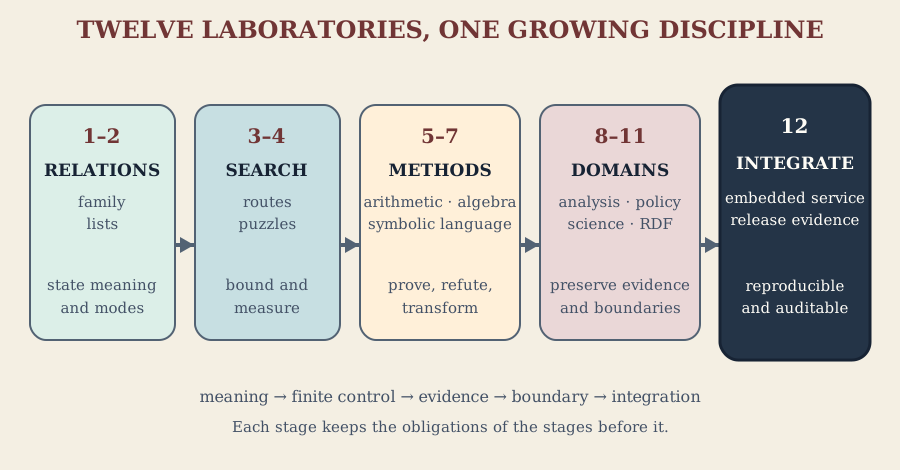
The estimates below assume familiarity with the listed chapters and include design, implementation, tests, and reflection. They are planning ranges, not deadlines.
| Laboratories | Preparation | Typical scope |
|---|---|---|
| Laboratories 1–2 | Chapters 1–5 | 2–4 hours each |
| Laboratories 3–4 | Chapters 6–10 and 13 | 4–8 hours each |
| Laboratories 5–7 | Chapters 19 and 26–29 | 4–8 hours each |
| Laboratories 8–10 | Chapters 14, 25, and 31–33 | 6–12 hours each |
| Laboratory 11 | Chapter 15 and tools/README.md |
4–8 hours |
| Laboratory 12 | Chapters 16, 25, and 31–33 | multi-session capstone |
Laboratory 1. A family theory
Build: facts for at least six people and relations for parent, sibling, grandparent, and cousin.
Requirements:
- state the ground reading and principal modes of every predicate;
- expose a person being their own parent through an integrity relation;
- include one family branch that produces multiple cousins;
- query both forward and inverse modes.
Acceptance: normal output contains the predicted ground relations; one proof for a cousin conclusion passes through named intermediate concepts.
Reflect: which conclusions depend on absence, and are those closed-world assumptions justified?
Laboratory 2. A relational list toolkit
Build: user-defined relations for membership, concatenation, reversal, and prefix.
Requirements:
- use only facts, rules, unification, and list syntax for the core relations;
- document every finite mode;
- test empty, singleton, proper, and improper lists;
- compare one relation with its built-in counterpart over a finite corpus.
Acceptance: bounded differential queries find no disagreement in either direction.
Reflect: which logically meaningful modes are operationally infinite?
Laboratory 3. A cyclic transport network
Build: a network with at least ten stations, cycles, weighted edges, and two disconnected components.
Requirements:
- derive reachability;
- construct simple path witnesses;
- choose a least-cost path with deterministic tie-breaking;
- test a cycle, absence, and equal-cost routes;
- compare
--statsbefore and after one justified control improvement.
Acceptance: every returned witness begins and ends at the queried stations, uses known edges, and contains no repeated station.
Reflect: why can endpoint reachability table finitely while the set of arbitrary walks is infinite?
Laboratory 4. A finite puzzle
Build: encode a small Latin square, scheduling puzzle, or house puzzle.
Requirements:
- write the complete finite-domain calculation;
- separate generation from constraints;
- identify and remove at least one symmetry;
- retain a structured witness;
- predict the naive and symmetry-reduced search spaces.
Acceptance: the solver returns every intended solution and no permutation duplicate representing the same mathematical object.
Reflect: which source line contributes the greatest pruning power?
Laboratory 5. Arithmetic by construction
Build: Peano addition and multiplication, then one relation of your choice: exponentiation, comparison, division with remainder, or factorial.
Requirements:
- state a termination measure for each intended mode;
- prove one property by structural induction on paper;
- add a bounded executable property test;
- distinguish the inductive proof from the bounded test.
Acceptance: the proof and program share a clearly identified base and recursive structure.
Reflect: did the representation make the induction easier or merely the computation slower?
Laboratory 6. Counterexample laboratory
Build: finite operation tables over carriers of two or three elements.
Requirements:
- test closure, identity, commutativity, and associativity;
- search for a counterexample before testing the full universal property;
- return the offending tuple as a witness;
- explain which checks exhaust the model and which claims remain external.
Acceptance: one deliberately nonassociative table is rejected with a specific triple; one valid group table passes every finite law.
Reflect: why does one counterexample settle the negative question while a thousand random confirmations do not settle the positive one?
Laboratory 7. A symbolic language
Build: a small expression language with literals, variables, addition, conditionals, and local bindings.
Requirements:
- represent syntax as explicit terms;
- evaluate under an explicit environment;
- define a structural size relation;
- transform constant subexpressions;
- show that evaluation agrees before and after transformation on a finite set of environments.
Acceptance: the transformation is idempotent over the chosen corpus and does not change evaluated results.
Reflect: where is the boundary between Prolog syntax and the object language represented by Prolog terms?
Laboratory 8. A static analyzer
Build: a sign, nullness, taint, or permission analysis for a tiny statement language.
Requirements:
- define a finite abstract domain and join;
- propagate facts to a fixed point;
- emit both safe conclusions and conservative warnings;
- include a concrete execution illustrating one abstract result;
- explain the approximation direction.
Acceptance: every tested concrete behavior is covered by its abstract result; the analyzer may overapproximate but must not miss the chosen unsafe case.
Reflect: why is a warning not necessarily evidence that a concrete failure occurs?
Laboratory 9. An auditable policy
Build: an access, consent, eligibility, or compliance theory.
Requirements:
- separate source, normalized concept, decision, and reason layers;
- state every closed-world assumption;
- add at least three explicit integrity relations;
- retain source and theory version facts;
- produce proof goldens for one permit and one denial-like conclusion.
Acceptance: changing one source fact changes exactly the predicted decision and its supporting proof.
Reflect: which trust claims are established by derivation, and which require authentication outside the theory?
Laboratory 10. A scientific model
Build: encode a compact model from mechanics, circuits, chemistry, epidemiology, or statistics.
Requirements:
- document every quantity and unit;
- expose derived intermediate quantities;
- include valid, boundary, and invalid scenarios;
- use an integrity relation for an impossible input state;
- state floating-point and approximation assumptions.
Acceptance: a proof for the final classification includes measurements, equations represented by built-ins, and thresholds in an intelligible order.
Reflect: what has been proved conditionally, and what empirical claim remains outside formal logic?
Laboratory 11. An RDF knowledge boundary
Build: start with a small Turtle or TriG fixture, convert it to rdf/4
facts, derive one new relation, and serialize the result.
Requirements:
- preserve IRIs, literals, graph identity, and one RDF 1.2 feature;
- keep adapter rules separate from domain rules;
- query the generated Prolog program with WebEntail directly;
- compare the final N-Quads with a checked golden;
- document what the host authenticates.
Acceptance: the round trip retains the selected RDF term distinctions, and nested triple data is not accidentally asserted as a global fact.
Reflect: what simplicity does the explicit adapter preserve in the WebEntail core?
Laboratory 12. A release-quality reasoning service
Build: combine the preceding techniques into a small embedded service.
Requirements:
- define a JavaScript boundary that supplies or loads facts;
- validate inputs before constructing the theory;
- test the principal modes and expected solution counts of public predicates;
- include semantic cases, bounded properties, metamorphic tests, integrity queries, warnings, proof goldens, and one scale case;
- retain source snapshot, theory version, and proof with every audited result;
- state time, memory, solution, and proof-size budgets;
- write a one-page trust contract and a one-page known-limitations statement.
Acceptance: another person can clone the repository, run one command, and reproduce answers and proofs from the preserved inputs without oral instructions.
Reflect: if the service gives a wrong real-world decision, which of the four trust layers—source, model, engine, or derivation—would reveal the fault?
Laboratory review rubric
Evaluate each project on five independent axes:
| Axis | Excellent work demonstrates |
|---|---|
| Meaning | every public ground relation has one stable domain sentence |
| Logic | clauses derive the intended answers and reject counterexamples |
| Control | supported modes terminate for a stated mathematical reason |
| Evidence | tests, witnesses, and proofs expose why results hold |
| Boundary | sources, assumptions, versions, limits, and host duties are named |
A beautiful program is not merely short. It makes the reason for its correctness, the shape of its search, and the boundary of its trust available to the next reader.
Part XI — Review
45. Checkpoint notes and selected answers
Checkpoints are for retrieval and diagnosis, not grading by hidden wording. Attempt one before reading these notes. When a checkpoint asks about a program of your own, compare the structure of your argument rather than expecting one canonical implementation.
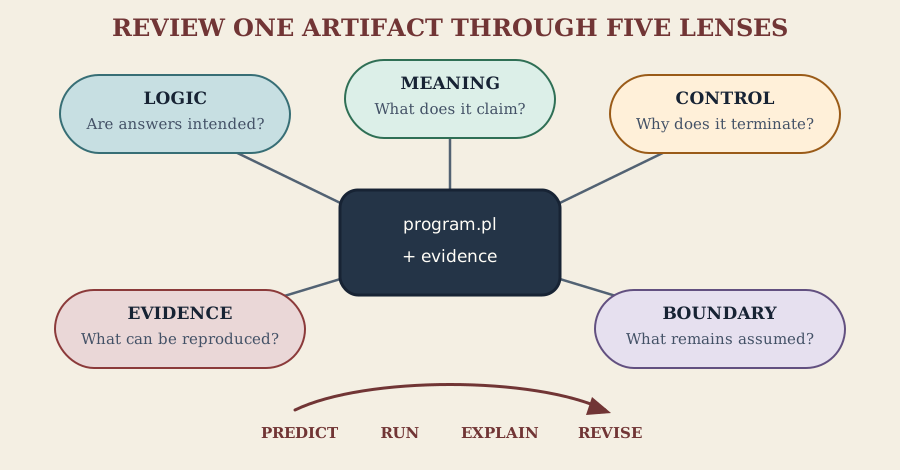
Foundations: Chapters 1–10
Chapter 1. parent(ada, byron) says that Ada is a parent of Byron.
webentail --goal 'child(X, Y)' program.pl asks for every ground child–parent pair derivable by the
program. Adding parent(diego, elena). adds child(elena, diego).; it does not
change the earlier three child answers.
Chapter 2. point(X, X) unifies with point(red, red) by binding X to
red. It does not unify with point(red, blue) because one variable cannot
be both distinct atoms. [Head | Tail] unifies with [a, b, c] using
Head = a and Tail = [b, c].
Chapter 3. In
adult(Person) :- age(Person, Years), Years >= 18., a ground reading is:
every person with a recorded age of at least 18 is an adult. Operationally,
age/2 supplies Person and Years before >=/2 checks the numeric bound.
Reversing those goals asks >=/2 to inspect unbound terms.
Chapter 4. With ada → byron → clara → diego, direct ancestor answers are
the three edges. Recursive answers additionally include
ancestor(ada, clara), ancestor(byron, diego), and
ancestor(ada, diego). A successful derivation advances along a known parent
edge until a direct parent clause closes the proof.
Chapter 5. joins([a], [b, c], Whole) yields [a, b, c]. With the whole
list bound, the prefix/suffix splits are:
[]          and [a, b, c]
[a]         and [b, c]
[a, b]      and [c]
[a, b, c]   and []
[a | Tail] is not yet known to be proper because Tail might never resolve
to a finite chain ending in [].
Chapter 6. is/2, is/2, is/2, comparisons, and the recursive
arithmetic steps require their documented numeric inputs. In
between(1, 10, N), an unbound N is generated from a finite interval; a
bound N is checked for membership in that interval.
Chapter 7. user(User), \+ blocked(User) first selects each known user,
then asks a ground absence question for that user.
\+ blocked(User), user(User) first asks whether the database contains no
blocked user at all. Calling either result “allowed” requires a justified,
complete user and blocked-status boundary.
Chapter 8. Over an empty nested search, findall/3 produces [],
countall/2 produces 0, and sumall/3 produces numeric zero.
aggregate_min/5 and aggregate_max/5 fail because no candidate can supply a
best key. The goal passed into the aggregate, not the aggregate’s punctuation,
must establish finiteness.
Chapter 9. message/2 is asserted as an atomic formula. Its context
argument is structured data. The program-defined context_member/2 relation
examines members inside that term; it does not add those members as globally
callable source facts.
Chapter 10. The complete coloring has six answers. Removing A \= C
leaves the requirements A ≠ B and B ≠ C, producing twelve answers. The six
new answers are those with equal first and third colors:
red–green–red, red–blue–red, green–red–green,
green–blue–green, blue–red–blue, and blue–green–blue.
Trust and construction: Chapters 11–20
Use this table to check that the checkpoint response separates concepts that are often collapsed:
| Chapter | A sound response distinguishes |
|---|---|
| 11 | ground answer, successful proof, failed search branches, and source trust |
| 12 | ordinary absence, invalid theory, process exit, and resource failure |
| 13 | structural descent, finite table growth, and unbounded term construction |
| 14 | source evidence, derived concepts, policy decisions, and integrity |
| 15 | RDF term preservation, graph membership, and application-specific inference |
| 16 | host validation, solver derivation, proof retention, and operational ceilings |
| 17 | ground meaning, intended mode, answer set, first answer, and proof shape |
| 18 | examples, near misses, finite generators, invariants, and presentation |
| 19 | partial correctness, completeness in a mode, and termination in that mode |
| 20 | semantic regression, observable control change, and measured improvement |
A response that says only “the program works” is incomplete. It should name the claim, the mode, the evidence inspected, and the boundary that remains outside that evidence.
Advanced work: Chapters 21–33
Later checkpoints often admit several good programs. Evaluate them with five questions:
- Meaning: is the disputed or transformed ground relation stated clearly?
- Scope: are modes, finite domains, equivalence notions, and trust assumptions explicit?
- Observation: were answers, failures, proofs, and statistics used for the different questions they can actually answer?
- Preservation: if a program changed, which semantic and observable properties were expected to remain invariant?
- Evidence: is the result reproducible as a query, test, golden output, counterexample, proof, or preserved source snapshot?
For mathematical checkpoints, add a sixth question: does the conclusion claim only what the computation warrants? One witness proves existence; one counterexample refutes a universal claim; an exhausted finite carrier proves a property only for that model; repeated bounded confirmations do not become an unbounded theorem.
For laboratory checkpoints, leave an artifact. A useful completion is not
merely a paragraph: it is a small source file, predicted output, actual output,
and one sentence explaining any difference. The extracted chapter examples,
top-level goldens, and npm test demonstrate that rhythm at repository scale.
Part XII — Development note
46. AI-assisted editing
GPT-5.6 was used during the development of this book to assist with chapter reorganisation, refinement of explanations, and review of examples and diagrams.
All suggestions were evaluated and directed by the author, who remains responsible for the book’s claims, choices, and any remaining errors.