peye
A package holiday under two rulebooks
One tour operator, eight cancellations, and EU holiday rules about to change: who pays, who gets their money back, and what would change?
package-holiday.py · output · proof · check · try it in the playground
The situation
A package holiday bundles travel and a stay, say a flight and a hotel, sold together by a tour operator. When a traveller cancels, two things decide what happens:
- The operator’s own terms: who may cancel, and what it costs.
- EU law, the Package Travel Directive, which can override those terms, for instance when a hurricane hits the destination.
That law is changing. The 2015 Directive was revised after the pandemic, when many travellers waited months for refunds or got vouchers they did not want. Parliament approved the revision on 12 March 2026, and the Council then adopted it. So we decide every cancellation twice: under the 2015 rules and under the revision.
The whole decision on one page
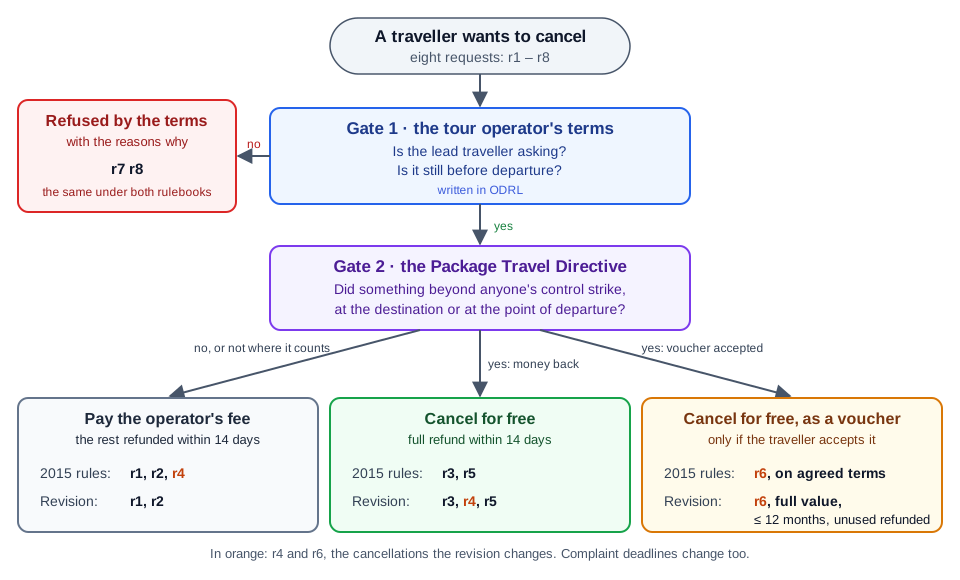
Each request passes two gates, in order. A “no” at the first gate ends it. The picture already shows every result; the rest of this deck explains why.
Gate 1: the operator’s terms
The terms are written in ODRL, the W3C language for machine-readable “who may do what” rules. In plain words: the lead traveller may cancel, before departure, paying a fee that depends on how soon the trip is:
| Days before departure | Fee |
|---|---|
| 60 or more | 25 % of the price |
| 30 to 59 | 50 % |
| 1 to 29 | 100 % |
fact(t('ex:cancellation', 'odrl:constraint', 'ex:conditions'))
fact(t('ex:conditions', 'odrl:and', ['ex:byLeadTraveller', 'ex:beforeDeparture']))
fact(t('ex:beforeDeparture', 'odrl:leftOperand', 'ex:daysBeforeDeparture'))
fact(t('ex:beforeDeparture', 'odrl:operator', 'odrl:gt'))
fact(t('ex:beforeDeparture', 'odrl:rightOperand', 0))
The program reads these triples to decide: the policy is data, not a
comment. Delete any one of its 15 triples and the outcome changes;
peye --unused checks exactly that.
Gate 2: the Directive, 2015 and revised
| 2015 rules | Revision | |
|---|---|---|
| Cancel for free when something beyond anyone’s control strikes… | at the destination | at the destination or the point of departure |
| Money back | within 14 days | within 14 days |
| Vouchers instead of money | no rules | optional: full value, at most 12 months, unused value refunded |
| Complaints | no EU deadlines | acknowledged within 7 days, answered within 60 |
“Beyond anyone’s control” is the plain-words version of the law’s unavoidable and extraordinary circumstances.
The eight cancellations
| Request | What happened | 2015 rules | Revision |
|---|---|---|---|
| r1 | changed plans, 90 days ahead (€2,400) | fee €600, €1,800 back | the same |
| r2 | changed plans, 20 days ahead (€1,800) | fee €1,800, nothing back | the same |
| r3 | hurricane at the destination (€1,500) | free, €1,500 back | the same |
| r4 | departure airport closed by floods (€2,100) | fee €2,100, nothing back | free, €2,100 back |
| r5 | hurricane; refuses the voucher offered (€1,200) | free, €1,200 back | the same |
| r6 | hurricane; accepts the voucher (€1,600) | voucher, on agreed terms | voucher with guarantees |
| r7 | asks two days into the trip | refused by the terms | the same |
| r8 | Hugo asks, but Ivy booked the trip | refused by the terms | the same |
Every refund is due within 14 days.
What the revision changes
changed(cancellation('r4'), struct('from', pay_fee(percent(100), fee(2100), refund(0), within_days(14))), to(refund(2100, within_days(14))))
changed(cancellation('r6'), struct('from', voucher(value(1600), terms('as_agreed'))), to(voucher(value(1600), valid_months(12), 'unused_value_refunded')))
- r4: the floods were at the airport of departure, not at the destination. Under the 2015 rules David loses all €2,100; under the revision he cancels for free.
- r6: Farid’s voucher now comes with guarantees: worth the full €1,600, valid for at most 12 months, and any unused value is paid back.
Both complaints change as well: from “whatever national law says” to an acknowledgement within 7 days and a reasoned reply within 60.
Why: the proof in plain words
Take r4 under the revision. The proof records, step by step:
- The booking is with SunTrips, the offer’s assigner, and the request is the
offer’s action,
ex:cancel. Of itsodrl:andconstraint, both operands hold: David is the lead traveller, and 5 days left is more than 0. So the terms permit the cancellation. - The floods struck at the point of departure, which the revision counts: the cancellation is free.
- So David gets the full price back, €2,100 within 14 days (Art. 12(4)).
Under the 2015 rules, step 2 goes the other way: departure does not count, so the fee band for 1 to 29 days in the duty’s fee scale applies, 100 %, computed as €2,100.
Checked, with nothing taken on trust
A separate checker read all 218 steps: 185 were matched to a program line, and 33 comparisons and calculations, such as the fees and refunds, were redone and agreed. Verdict: checked.
Nothing is taken on trust: the policy’s odrl:and constraint lists its
conditions, and each is decided either way, so no step rests on “there is
nothing else”. The proof even passes
--strict-proof, which rejects any trusted step.
What the certificate does not show: that the law is modelled completely, or that the operator’s fees are reasonable, as the Directive requires. It shows that the outcomes follow from these rules and these facts.
Try it
python -m peye examples/package-holiday.py            # the answers
python -m peye --proof examples/package-holiday.py    # answers with their proof
python -m peye --proof examples/package-holiday.py > /tmp/holiday-proof.py
python -m peye --strict-proof --check-proof /tmp/holiday-proof.py examples/package-holiday.py
Or open it in the playground. Two experiments, one at each gate:
- let Ivy ask instead of Hugo (
by('hugo')→by('ivy')in r8): the terms now permit it, and at 40 days the fee is 50 %, €650 of €1,300; - move r1’s request to 45 days (
days(90)→days(45)): the fee rises from 25 % to 50 %, €1,200 of €2,400.
Takeaway
Holiday rules decide real money: here, whether David loses €2,100. When the rules change, peye shows what changes, for whom and why, and a machine checks every step, without taking anything on trust.
Sources and assumptions
Directive (EU) 2015/2302 · European Parliament, 12 March 2026 · ODRL 2.2
The revision applies only after Member States transpose it (28 months) and start applying it (6 more months); it is modelled as if it applied. Whether circumstances are unavoidable and extraordinary, and significantly affect the holiday, is given as input. The fee scale is the operator’s; its reasonableness is not assessed. National rules and the revision’s other changes are outside this model.