
One hospital, one research policy, two sets of device rules: which research sessions may go ahead, and what would change?
research-portal.py · output · proof · check · try it in the playground
The question
A hospital runs a portal through which partners in a research consortium use patients’ lab results: sensitive health data. Eleven research sessions, r1 to r11, are planned.
Two different questions decide whether a planned session may go ahead:
- Does the hospital’s research policy allow this use of the data?
- The portal page also places a cookie or tracker on the visitor’s device. Is that allowed, and does it need the visitor’s consent?
The second question is about to get new rules: the European Commission’s Digital Omnibus proposal (19 November 2025) would change them. So we ask both questions twice: under the rules today and under the proposal.
For each session, may it go ahead today, may it go ahead under the proposal, and what exactly would the proposal change?
The whole decision on one page
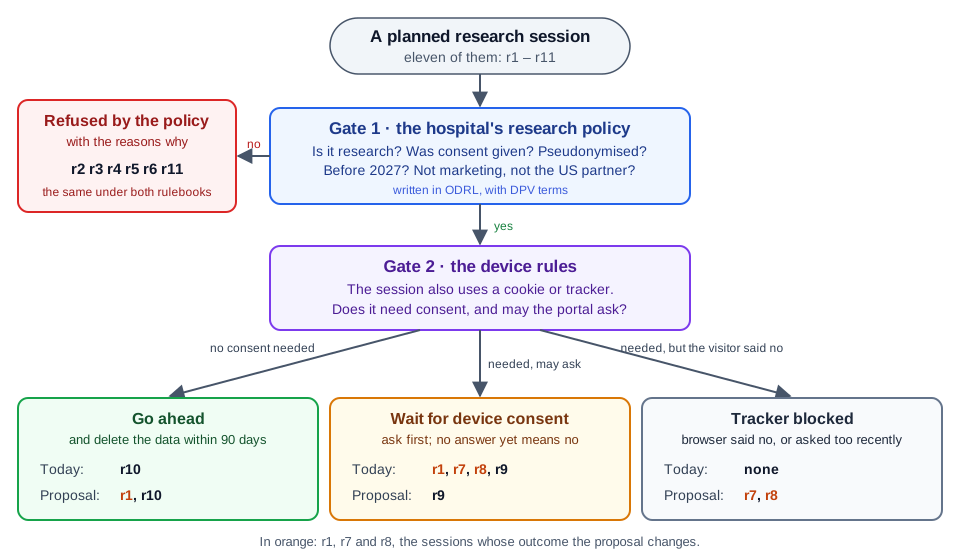
Each session passes two gates, in order. A “no” at the first gate ends it, whatever the device rules say. The picture already shows every result; the rest of this deck explains why.
What we tell eyekind: gate 1, the research policy
The policy is written in ODRL, the W3C language for machine-readable “who may do what with which data” rules, using terms from DPV, the Data Privacy Vocabulary. In plain words, consortium partners may use the lab results for research, only with the patient’s consent, only pseudonymised (names replaced by codes), and only before 2027. Two things are forbidden outright: passing the data on for marketing, and any use by the US partner.
The policy is stored as data: 24 small sentences of the form
t(subject, predicate, object), such as
fact(t('ex:policy', 'odrl:permission', 'ex:research'))
fact(t('ex:research', 'odrl:constraint', 'ex:underConsent'))
fact(constraint('ex:underConsent', 'ex:legalBasis', 'odrl:eq', 'dpv:Consent'))
which read the policy contains a permission called research, that
permission has a condition called underConsent, and underConsent requires
the legal basis to equal Consent. Each session is one fact:
fact(
  process(
    'ex:r1',
    'ex:hospital',
    'ex:partnerBE',
    'dpv:Use',
    'ex:labResults',
    'dpv:AcademicResearch',
    'dpv:Consent',
    'dpv:ConsentGiven',
    'dpv:Pseudonymisation',
    20261115,
  ),
)
This is session r1: for the hospital, the data controller, the Belgian partner wants to use the lab results for academic research, on consent (given), pseudonymised, on 15 November 2026. DPV knows that academic research is research, so the purpose fits.
The rules that read the policy are backward rules, written
implied_by(conclusion, conditions): definitions eyekind consults when a
question needs them. For example, a permission applies to a session when
it addresses that session and the list of its unmet conditions is empty:
implied_by(applies(P, Rule), [addresses(P, Rule), findall(Why, unmet(P, Rule, Why), [])])
Capitalized names such as P and Rule are variables: placeholders that
take whatever values fit. findall(Why, unmet(P, Rule, Why), List) gathers
every unmet condition into one list; requiring that list to be [] says
“no condition is unmet”. The policy is data the program reads, not a
comment: change one of its sentences and the decisions change with it.
What we tell eyekind: gate 2, the device rules
Each session also names its kind of tracker and what the visitor did before,
such as fact(session('ex:r8', 'advertising', refused(completed_months(5)))):
r8 uses an advertising tracker, and the visitor refused five months ago. Two
small tables, one row per rulebook, say what each kind needs:
| Today (ePrivacy Directive) | Proposal (new GDPR Art. 88a–b) | |
|---|---|---|
| The portal’s own visitor statistics | consent needed | no consent needed |
| The visitor’s browser says “no tracking” | not binding | must be respected |
| The visitor refused earlier | may ask again | not again within 6 months |
| Strictly needed to run the requested service | no consent needed | no consent needed |
Finally, forward rules, written implies(conditions, conclusion), combine
both gates into an assessment for each rulebook and session, citing the
articles they rest on. The device question is separate from the research
question: a tracker that needs no consent does not stand in for the
patient’s consent to research.
What eyekind concludes
37 conclusions. A selection:
// Conclusions: the facts the program derives, in the order derived.
assessment('in_force', 'ex:r4', deny_policy(not_permitted([unmet('ex:consentGiven', 'ex:consentStatus', 'dpv:ConsentWithdrawn', 'odrl:eq', 'dpv:ConsentGiven')])), basis(['ex:policy']))
assessment('in_force', 'ex:r6', deny_policy(prohibited_by('ex:noTransferUS')), basis(['ex:policy']))
assessment('in_force', 'ex:r10', permit('ex:research'), basis(['ex:policy', 'ePrivacy Art. 5(3)']))
assessment('omnibus_proposal', 'ex:r1', permit('ex:research'), basis(['ex:policy', 'GDPR Art. 88a(3)(c)']))
assessment('in_force', 'ex:r1', await_device_consent('ex:research'), basis(['ex:policy', 'ePrivacy Art. 5(3)']))
assessment('omnibus_proposal', 'ex:r8', deny_device('do_not_ask_again'), basis(['ex:policy', 'GDPR Art. 88a(1)', 'GDPR Art. 88a(4)(c)']))
planned_duty('omnibus_proposal', 'ex:r1', 'odrl:delete', within_days(90))
policy_conflict('ex:r6', resolved_by('odrl:prohibit', 'ex:noTransferUS', overrides('ex:research')))
// … 29 more
The first line is a comment saying what follows. An assessment names the
rulebook ('in_force' for today, 'omnibus_proposal' for the proposal), the
session, the result, and the basis it rests on. A refusal lists its reasons:
r4 is refused because its consent status is “withdrawn” where “given” is
required. planned_duty attaches the policy’s duty to delete the data within
90 days to every session that may go ahead. policy_conflict notes that for
r6 a permission and a prohibition both apply, and the prohibition wins. The
rest are the 22 assessments in full, six breach plans, and the five changes
below.
The eleven sessions
| Session | What is special about it | Today | Proposal |
|---|---|---|---|
| r1 | valid research; the portal’s own statistics | wait for consent | go ahead |
| r2 | personalised advertising, on legitimate interest, not consent | refused | refused |
| r3 | passing the data on for advertising | refused (forbidden) | refused (forbidden) |
| r4 | the patient withdrew consent | refused | refused |
| r5 | encrypted, not pseudonymised; after 2026 | refused | refused |
| r6 | the US partner | refused (forbidden) | refused (forbidden) |
| r7 | valid research; ad tracker; browser says no | wait for consent | blocked |
| r8 | valid research; ad tracker; refused 5 months ago | wait for consent | blocked |
| r9 | valid research; ad tracker; refused 6 months ago | wait for consent | wait for consent |
| r10 | valid research; only what the service needs | go ahead | go ahead |
| r11 | passing the data to a partner, for research | refused (no permission) | refused (no permission) |
“Wait for consent” means: ask first, and do nothing until the visitor agrees. “Blocked” means this session may not run with its tracker; the research itself could go ahead if the tracker were removed.
What the proposal changes
changed(session('ex:r1'), from(await_device_consent('ex:research')), to(permit('ex:research')))
changed(session('ex:r7'), from(await_device_consent('ex:research')), to(deny_device('refused_by_signal')))
changed(session('ex:r8'), from(await_device_consent('ex:research')), to(deny_device('do_not_ask_again')))
(The program spells the “from” part struct('from', Old); it is the same
term, and eyekind writes it back as from(...).)
- r1 may now go ahead: the portal’s own statistics need no consent.
- r7 is blocked: the browser’s “no” now has to be respected.
- r8 is blocked: the visitor said no five months ago, too recently to ask.
Just as telling: r4 uses the same statistics as r1, but stays refused, because the patient withdrew consent to research. Easier device rules cannot fix that. And r11 shows how precise the policy is: the marketing ban does not catch sharing for research, but nothing permits that sharing either.
Data breaches: a separate duty
The hospital already holds data, so it also plans what to do if that data leaks. Here too the proposal changes the rules:
| What leaked (assessed risk) | Tell the regulator: today | Tell the regulator: proposal | Tell the patients |
|---|---|---|---|
| encrypted laptop, key safe (unlikely) | no | no | no |
| researchers’ contact addresses (some) | within 72 hours | no | no |
| patients’ lab records (high) | within 72 hours | within 96 hours, via one EU entry point | without undue delay, in both |
Every breach is recorded internally, even when nobody must be told. The two
changed breach plans, b2 and b3, are the other two changed(...)
conclusions.
The proof, line by line
eyekind --proof writes down how it reached each conclusion. The full proof
is 413 lines (about 95 KB) with 273 steps, so here is its opening, a selection
of its 97 clauses, and the complete steps behind one conclusion: under the
proposal, r1 may go ahead. The
full proof
is online.
// Conclusions: the facts the program derives, in the order derived.
// … 22 conclusions
assessment('omnibus_proposal', 'ex:r1', permit('ex:research'), basis(['ex:policy', 'GDPR Art. 88a(3)(c)']))
// … 14 more conclusions, 37 in total

// Clauses: the program clauses the steps cite, by clause number.
// … 19 clauses
clause(36, fact(process('ex:r1', 'ex:hospital', 'ex:partnerBE', 'dpv:Use', 'ex:labResults', 'dpv:AcademicResearch', 'dpv:Consent', 'dpv:ConsentGiven', 'dpv:Pseudonymisation', 20261115)))
// … 19 clauses
clause(71, implied_by(addresses(P, Rule), [t(P, 'ex:requestedBy', Who), t(Rule, 'odrl:assignee', Assignee), party(Who, Assignee), t(P, 'dpv:hasProcessing', Processing), action(Processing, Action), t(Rule, 'odrl:action', Action), t(P, 'dpv:hasPersonalData', Data), t(Rule, 'odrl:target', Data)]))
clause(74, implied_by(applies(P, Rule), [addresses(P, Rule), findall(Why, unmet(P, Rule, Why), [])]))
clause(75, implied_by(governs(Policy, P), [t(Policy, 'rdf:type', 'odrl:Agreement'), t(Policy, 'odrl:assigner', Controller), t(P, 'dpv:hasDataController', Controller)]))
clause(76, implied_by(permitted(P, Rule), [governs(Policy, P), t(Policy, 'odrl:permission', Rule), applies(P, Rule)]))
// … 2 clauses
clause(79, implied_by(policy_ready(P), [governs(Policy, P), findall(S, t(Policy, 'odrl:conflict', S), ['odrl:prohibit'])]))
clause(80, implied_by(policy_result(P, permit(Rule)), [policy_ready(P), permitted(P, Rule), findall(R, prohibited(P, R), [])]))
// … 21 clauses
clause(102, fact(consent('omnibus_proposal', 'own_audience_measurement', 'not_needed', 'GDPR Art. 88a(3)(c)')))
// … 15 clauses
clause(118, implies([regime(R), policy_result(P, permit(Rule)), session(P, Kind, _0), consent(R, Kind, 'not_needed', Provision)], assessment(R, P, permit(Rule), basis(['ex:policy', Provision]))))
// … 12 more clauses, 97 in total

// Steps: each goal, what justifies it (a clause, a builtin, a control, or an
// absence or collection taken on trust), the bindings and the goals it uses.
// … 14 steps
step(regime('omnibus_proposal'), clause(96), {}, [])
// … 16 steps
step(t('ex:policy', 'rdf:type', 'odrl:Agreement'), clause(6), {}, [])
step(t('ex:policy', 'odrl:assigner', 'ex:hospital'), clause(7), {}, [])
// … 4 steps
step(t('ex:policy', 'odrl:permission', 'ex:research'), clause(9), {}, [])
// … 3 steps
step(t('ex:research', 'odrl:assignee', 'ex:consortium'), clause(10), {}, [])
// … 3 steps
step(action('dpv:Use', 'odrl:use'), clause(57), {}, [])
step(t('ex:research', 'odrl:action', 'odrl:use'), clause(11), {}, [])
// … 1 step
step(t('ex:research', 'odrl:target', 'ex:labResults'), clause(12), {}, [])
// … 22 steps
step(party('ex:partnerBE', 'ex:consortium'), clause(70), {Who: 'ex:partnerBE', Group: 'ex:consortium'}, [t('ex:partnerBE', 'odrl:partOf', 'ex:consortium')])
step(t('ex:partnerBE', 'odrl:partOf', 'ex:consortium'), clause(4), {}, [])
// … 95 steps
step(assessment('omnibus_proposal', 'ex:r1', permit('ex:research'), basis(['ex:policy', 'GDPR Art. 88a(3)(c)'])), clause(118), {R: 'omnibus_proposal', P: 'ex:r1', Rule: 'ex:research', Kind: 'own_audience_measurement', _0: 'first_visit', Provision: 'GDPR Art. 88a(3)(c)'}, [regime('omnibus_proposal'), policy_result('ex:r1', permit('ex:research')), session('ex:r1', 'own_audience_measurement', 'first_visit'), consent('omnibus_proposal', 'own_audience_measurement', 'not_needed', 'GDPR Art. 88a(3)(c)')])
step(policy_result('ex:r1', permit('ex:research')), clause(80), {P: 'ex:r1', Rule: 'ex:research', R: Z}, [policy_ready('ex:r1'), permitted('ex:r1', 'ex:research'), findall(Z, prohibited('ex:r1', Z), [])])
step(policy_ready('ex:r1'), clause(79), {P: 'ex:r1', Policy: 'ex:policy', S: A1}, [governs('ex:policy', 'ex:r1'), findall(A1, t('ex:policy', 'odrl:conflict', A1), ['odrl:prohibit'])])
step(governs('ex:policy', 'ex:r1'), clause(75), {Policy: 'ex:policy', P: 'ex:r1', Controller: 'ex:hospital'}, [t('ex:policy', 'rdf:type', 'odrl:Agreement'), t('ex:policy', 'odrl:assigner', 'ex:hospital'), t('ex:r1', 'dpv:hasDataController', 'ex:hospital')])
step(t('ex:r1', 'dpv:hasDataController', 'ex:hospital'), clause(48), {P: 'ex:r1', X: 'ex:hospital', _0: 'ex:partnerBE', _1: 'dpv:Use', _2: 'ex:labResults', _3: 'dpv:AcademicResearch', _4: 'dpv:Consent', _5: 'dpv:ConsentGiven', _6: 'dpv:Pseudonymisation', _7: 20261115}, [process('ex:r1', 'ex:hospital', 'ex:partnerBE', 'dpv:Use', 'ex:labResults', 'dpv:AcademicResearch', 'dpv:Consent', 'dpv:ConsentGiven', 'dpv:Pseudonymisation', 20261115)])
step(process('ex:r1', 'ex:hospital', 'ex:partnerBE', 'dpv:Use', 'ex:labResults', 'dpv:AcademicResearch', 'dpv:Consent', 'dpv:ConsentGiven', 'dpv:Pseudonymisation', 20261115), clause(36), {}, [])
step(findall(A1, t('ex:policy', 'odrl:conflict', A1), ['odrl:prohibit']), 'collected', {}, [])
step(permitted('ex:r1', 'ex:research'), clause(76), {P: 'ex:r1', Rule: 'ex:research', Policy: 'ex:policy'}, [governs('ex:policy', 'ex:r1'), t('ex:policy', 'odrl:permission', 'ex:research'), applies('ex:r1', 'ex:research')])
step(applies('ex:r1', 'ex:research'), clause(74), {P: 'ex:r1', Rule: 'ex:research', Why: B1}, [addresses('ex:r1', 'ex:research'), findall(B1, unmet('ex:r1', 'ex:research', B1), [])])
step(addresses('ex:r1', 'ex:research'), clause(71), {P: 'ex:r1', Rule: 'ex:research', Who: 'ex:partnerBE', Assignee: 'ex:consortium', Processing: 'dpv:Use', Action: 'odrl:use', Data: 'ex:labResults'}, [t('ex:r1', 'ex:requestedBy', 'ex:partnerBE'), t('ex:research', 'odrl:assignee', 'ex:consortium'), party('ex:partnerBE', 'ex:consortium'), t('ex:r1', 'dpv:hasProcessing', 'dpv:Use'), action('dpv:Use', 'odrl:use'), t('ex:research', 'odrl:action', 'odrl:use'), t('ex:r1', 'dpv:hasPersonalData', 'ex:labResults'), t('ex:research', 'odrl:target', 'ex:labResults')])
step(t('ex:r1', 'ex:requestedBy', 'ex:partnerBE'), clause(49), {P: 'ex:r1', Who: 'ex:partnerBE', _0: 'ex:hospital', _1: 'dpv:Use', _2: 'ex:labResults', _3: 'dpv:AcademicResearch', _4: 'dpv:Consent', _5: 'dpv:ConsentGiven', _6: 'dpv:Pseudonymisation', _7: 20261115}, [process('ex:r1', 'ex:hospital', 'ex:partnerBE', 'dpv:Use', 'ex:labResults', 'dpv:AcademicResearch', 'dpv:Consent', 'dpv:ConsentGiven', 'dpv:Pseudonymisation', 20261115)])
step(t('ex:r1', 'dpv:hasProcessing', 'dpv:Use'), clause(50), {P: 'ex:r1', X: 'dpv:Use', _0: 'ex:hospital', _1: 'ex:partnerBE', _2: 'ex:labResults', _3: 'dpv:AcademicResearch', _4: 'dpv:Consent', _5: 'dpv:ConsentGiven', _6: 'dpv:Pseudonymisation', _7: 20261115}, [process('ex:r1', 'ex:hospital', 'ex:partnerBE', 'dpv:Use', 'ex:labResults', 'dpv:AcademicResearch', 'dpv:Consent', 'dpv:ConsentGiven', 'dpv:Pseudonymisation', 20261115)])
step(t('ex:r1', 'dpv:hasPersonalData', 'ex:labResults'), clause(51), {P: 'ex:r1', X: 'ex:labResults', _0: 'ex:hospital', _1: 'ex:partnerBE', _2: 'dpv:Use', _3: 'dpv:AcademicResearch', _4: 'dpv:Consent', _5: 'dpv:ConsentGiven', _6: 'dpv:Pseudonymisation', _7: 20261115}, [process('ex:r1', 'ex:hospital', 'ex:partnerBE', 'dpv:Use', 'ex:labResults', 'dpv:AcademicResearch', 'dpv:Consent', 'dpv:ConsentGiven', 'dpv:Pseudonymisation', 20261115)])
step(findall(B1, unmet('ex:r1', 'ex:research', B1), []), 'collected', {}, [])
step(findall(Z, prohibited('ex:r1', Z), []), 'collected', {}, [])
step(session('ex:r1', 'own_audience_measurement', 'first_visit'), clause(84), {}, [])
step(consent('omnibus_proposal', 'own_audience_measurement', 'not_needed', 'GDPR Art. 88a(3)(c)'), clause(102), {}, [])
// … 88 more steps, 273 in total
It has three parts:
- The claims: the 37 conclusions the proof is about.
- The clauses: the program’s facts and rules that some step cites,
numbered in the order they appear in the program. A nameless
_in the program is written_0,_1, … so the steps can say what it matched. - The steps: one per thing established. A step reads
step(what, by what, with which values, using what). Steps are written once and shared, which is why r1’s steps are spread out: those it shares with conclusions derived earlier, the breach plans and r6’s policy conflict, come first.
Three kinds of justification occur in the whole proof: clause(N), an
instance of program line N; 'builtin', a comparison or test that anyone
checking the proof simply redoes, such as 5 < 6 months; and 'collected', a
findall list. A collected list’s items can be checked, but that nothing
is missing from it is taken on trust.
The 27 steps for r1, read from the conclusion down:
- Under the proposal, r1 may go ahead, on the policy and GDPR Art. 88a(3)(c) — by rule 118, because the proposal is a rulebook, the policy permits r1, r1 uses the portal’s own statistics, and under the proposal those need no consent.
- The proposal is a rulebook — fact 96.
- r1 uses the portal’s own statistics on a first visit — fact 84.
- Under the proposal, the portal’s own statistics need no consent, by GDPR Art. 88a(3)(c) — fact 102.
- The policy permits r1 — by rule 80, because the policy is ready for r1, its research permission applies to r1, and no prohibition applies.
- The policy is ready for r1 — by rule 79, because it governs r1 and its only conflict strategy is “prohibition wins”.
- The policy’s conflict strategies are exactly
['odrl:prohibit']—'collected', on trust. - The policy governs r1 — by rule 75, because it is an agreement (fact 6), assigned by the hospital (fact 7), and the hospital is r1’s data controller.
- The hospital is r1’s data controller — by rule 48, reading r1’s process fact.
- r1’s process fact — fact 36.
- The research permission is permitted for r1 — by rule 76, because the policy governs r1, contains that permission (fact 9), and it applies.
- The research permission applies to r1 — by rule 74, because it addresses r1 and no condition is unmet.
- The research permission addresses r1 — by rule 71, because the Belgian partner requests it and is part of the consortium the permission is for (fact 10), r1’s “use” is the ODRL action use (fact 57) that the permission covers (fact 11), and r1’s data are the lab results the permission targets (fact 12).
- to 16. r1 is requested by the Belgian partner, its processing is use, and its data are the lab results — by rules 49, 50 and 51, each reading r1’s process fact.
- The Belgian partner counts as the consortium — by rule 70, because it is part of the consortium (fact 4).
- The unmet conditions of the research permission for r1 are
[]—'collected', on trust. - The prohibitions that apply to r1 are
[]—'collected', on trust. - to 27. The remaining facts: the policy is an agreement (6), assigned by the hospital (7), contains the research permission (9), for the consortium (10), for the action use (11), on the lab results (12); the Belgian partner is part of the consortium (4); “use” is ODRL use (57).
Note what the proof does not contain: a step showing, condition by condition, that r1 meets each of the five policy conditions. That r1 meets them is carried by step 18, a list of unmet conditions that eyekind found to be empty, and the checker takes its completeness on trust.
Checked: what the report says
A proof is only worth something if someone else can check it. eyekind -c
generates the proof and checks it against the program; --check-proof checks
a saved proof. The checker never reasons by itself: it only confirms each step
against the program. This is the complete report:
// Answers checked subject to the obligations below.
breach_plan('in_force', 'b1', notify(authority('none'), people('none')), 'document_breach', basis(['GDPR Art. 33(1)', 'GDPR Art. 34(1)', 'GDPR Art. 33(5)']))
breach_plan('in_force', 'b2', notify(authority(within_hours(72)), people('none')), 'document_breach', basis(['GDPR Art. 33(1)', 'GDPR Art. 34(1)', 'GDPR Art. 33(5)']))
breach_plan('in_force', 'b3', notify(authority(within_hours(72)), people('without_undue_delay')), 'document_breach', basis(['GDPR Art. 33(1)', 'GDPR Art. 34(1)', 'GDPR Art. 33(5)']))
breach_plan('omnibus_proposal', 'b1', notify(authority('none'), people('none')), 'document_breach', basis(['GDPR Art. 33(1) as amended', 'GDPR Art. 34(1)', 'GDPR Art. 33(5)']))
breach_plan('omnibus_proposal', 'b2', notify(authority('none'), people('none')), 'document_breach', basis(['GDPR Art. 33(1) as amended', 'GDPR Art. 34(1)', 'GDPR Art. 33(5)']))
breach_plan('omnibus_proposal', 'b3', notify(authority(within_hours_via_single_entry_point(96)), people('without_undue_delay')), 'document_breach', basis(['GDPR Art. 33(1) as amended', 'GDPR Art. 34(1)', 'GDPR Art. 33(5)']))
changed(breach('b2'), from(notify(authority(within_hours(72)), people('none'))), to(notify(authority('none'), people('none'))))
changed(breach('b3'), from(notify(authority(within_hours(72)), people('without_undue_delay'))), to(notify(authority(within_hours_via_single_entry_point(96)), people('without_undue_delay'))))
policy_conflict('ex:r6', resolved_by('odrl:prohibit', 'ex:noTransferUS', overrides('ex:research')))
assessment('in_force', 'ex:r2', deny_policy(not_permitted([unmet('ex:forResearch', 'odrl:purpose', 'dpv:PersonalisedAdvertising', 'odrl:isA', 'dpv:ResearchAndDevelopment'), unmet('ex:underConsent', 'ex:legalBasis', 'dpv:LegitimateInterest', 'odrl:eq', 'dpv:Consent'), unmet('ex:consentGiven', 'ex:consentStatus', 'dpv:ConsentUnknown', 'odrl:eq', 'dpv:ConsentGiven')])), basis(['ex:policy']))
assessment('in_force', 'ex:r3', deny_policy(prohibited_by('ex:noMarketing')), basis(['ex:policy']))
assessment('in_force', 'ex:r4', deny_policy(not_permitted([unmet('ex:consentGiven', 'ex:consentStatus', 'dpv:ConsentWithdrawn', 'odrl:eq', 'dpv:ConsentGiven')])), basis(['ex:policy']))
assessment('in_force', 'ex:r5', deny_policy(not_permitted([unmet('ex:pseudonymised', 'ex:technicalMeasure', 'dpv:Encryption', 'odrl:eq', 'dpv:Pseudonymisation'), unmet('ex:before2027', 'odrl:dateTime', 20270301, 'odrl:lt', 20270101)])), basis(['ex:policy']))
assessment('in_force', 'ex:r6', deny_policy(prohibited_by('ex:noTransferUS')), basis(['ex:policy']))
assessment('in_force', 'ex:r11', deny_policy('no_matching_permission'), basis(['ex:policy']))
assessment('omnibus_proposal', 'ex:r2', deny_policy(not_permitted([unmet('ex:forResearch', 'odrl:purpose', 'dpv:PersonalisedAdvertising', 'odrl:isA', 'dpv:ResearchAndDevelopment'), unmet('ex:underConsent', 'ex:legalBasis', 'dpv:LegitimateInterest', 'odrl:eq', 'dpv:Consent'), unmet('ex:consentGiven', 'ex:consentStatus', 'dpv:ConsentUnknown', 'odrl:eq', 'dpv:ConsentGiven')])), basis(['ex:policy']))
assessment('omnibus_proposal', 'ex:r3', deny_policy(prohibited_by('ex:noMarketing')), basis(['ex:policy']))
assessment('omnibus_proposal', 'ex:r4', deny_policy(not_permitted([unmet('ex:consentGiven', 'ex:consentStatus', 'dpv:ConsentWithdrawn', 'odrl:eq', 'dpv:ConsentGiven')])), basis(['ex:policy']))
assessment('omnibus_proposal', 'ex:r5', deny_policy(not_permitted([unmet('ex:pseudonymised', 'ex:technicalMeasure', 'dpv:Encryption', 'odrl:eq', 'dpv:Pseudonymisation'), unmet('ex:before2027', 'odrl:dateTime', 20270301, 'odrl:lt', 20270101)])), basis(['ex:policy']))
assessment('omnibus_proposal', 'ex:r6', deny_policy(prohibited_by('ex:noTransferUS')), basis(['ex:policy']))
assessment('omnibus_proposal', 'ex:r11', deny_policy('no_matching_permission'), basis(['ex:policy']))
assessment('in_force', 'ex:r10', permit('ex:research'), basis(['ex:policy', 'ePrivacy Art. 5(3)']))
assessment('omnibus_proposal', 'ex:r1', permit('ex:research'), basis(['ex:policy', 'GDPR Art. 88a(3)(c)']))
assessment('omnibus_proposal', 'ex:r10', permit('ex:research'), basis(['ex:policy', 'GDPR Art. 88a(3)(b)']))
assessment('in_force', 'ex:r1', await_device_consent('ex:research'), basis(['ex:policy', 'ePrivacy Art. 5(3)']))
assessment('in_force', 'ex:r7', await_device_consent('ex:research'), basis(['ex:policy', 'ePrivacy Art. 5(3)']))
assessment('in_force', 'ex:r8', await_device_consent('ex:research'), basis(['ex:policy', 'ePrivacy Art. 5(3)']))
assessment('in_force', 'ex:r9', await_device_consent('ex:research'), basis(['ex:policy', 'ePrivacy Art. 5(3)']))
assessment('omnibus_proposal', 'ex:r9', await_device_consent('ex:research'), basis(['ex:policy', 'GDPR Art. 88a(1)', 'GDPR Art. 88a(4)(c)']))
assessment('omnibus_proposal', 'ex:r7', deny_device('refused_by_signal'), basis(['ex:policy', 'GDPR Art. 88a(1)', 'GDPR Art. 88b(1)-(2)']))
assessment('omnibus_proposal', 'ex:r8', deny_device('do_not_ask_again'), basis(['ex:policy', 'GDPR Art. 88a(1)', 'GDPR Art. 88a(4)(c)']))
planned_duty('in_force', 'ex:r10', 'odrl:delete', within_days(90))
planned_duty('omnibus_proposal', 'ex:r1', 'odrl:delete', within_days(90))
planned_duty('omnibus_proposal', 'ex:r10', 'odrl:delete', within_days(90))
changed(session('ex:r1'), from(await_device_consent('ex:research')), to(permit('ex:research')))
changed(session('ex:r7'), from(await_device_consent('ex:research')), to(deny_device('refused_by_signal')))
changed(session('ex:r8'), from(await_device_consent('ex:research')), to(deny_device('do_not_ask_again')))

// C1-C8: resolution, acyclicity, justification, coverage,
// re-decision, boundary consistency, relevance and witness integrity.
condition('C1', 'resolution', 'ok', 225)
condition('C2', 'well_founded', 'ok', 273)
condition('C3', 'justification', 'ok', 273)
condition('C4', 'coverage', 'ok', 474)
condition('C5', 're_decision', 'ok', 15)
condition('C6', 'boundary_consistency', 'ok', 22)
condition('C7', 'relevance', 'ok', 310)
condition('C8', 'witness_integrity', 'ok', 0)

// Obligations: absence and collection completeness are taken on trust.
obligation('collected', 'theory_scoped', findall(A, t('ex:policy', 'odrl:conflict', A), ['odrl:prohibit']))
obligation('collected', 'theory_scoped', findall(A, unmet('ex:r6', 'ex:research', A), []))
obligation('collected', 'theory_scoped', findall(A, unmet('ex:r6', 'ex:noTransferUS', A), []))
obligation('collected', 'theory_scoped', findall(A, t('ex:policy', 'odrl:conflict', A), ['odrl:prohibit']))
obligation('collected', 'theory_scoped', findall(A, permitted('ex:r2', A), []))
obligation('collected', 'theory_scoped', findall(A, prohibited('ex:r2', A), []))
obligation('collected', 'theory_scoped', findall(A, and(governs(B, 'ex:r2'), t(B, 'odrl:permission', C), unmet('ex:r2', C, A)), [unmet('ex:forResearch', 'odrl:purpose', 'dpv:PersonalisedAdvertising', 'odrl:isA', 'dpv:ResearchAndDevelopment'), unmet('ex:underConsent', 'ex:legalBasis', 'dpv:LegitimateInterest', 'odrl:eq', 'dpv:Consent'), unmet('ex:consentGiven', 'ex:consentStatus', 'dpv:ConsentUnknown', 'odrl:eq', 'dpv:ConsentGiven')]))
obligation('collected', 'theory_scoped', findall(A, t('ex:policy', 'odrl:conflict', A), ['odrl:prohibit']))
obligation('collected', 'theory_scoped', findall(A, unmet('ex:r3', 'ex:noMarketing', A), []))
obligation('collected', 'theory_scoped', findall(A, t('ex:policy', 'odrl:conflict', A), ['odrl:prohibit']))
obligation('collected', 'theory_scoped', findall(A, permitted('ex:r4', A), []))
obligation('collected', 'theory_scoped', findall(A, prohibited('ex:r4', A), []))
obligation('collected', 'theory_scoped', findall(A, and(governs(B, 'ex:r4'), t(B, 'odrl:permission', C), unmet('ex:r4', C, A)), [unmet('ex:consentGiven', 'ex:consentStatus', 'dpv:ConsentWithdrawn', 'odrl:eq', 'dpv:ConsentGiven')]))
obligation('collected', 'theory_scoped', findall(A, t('ex:policy', 'odrl:conflict', A), ['odrl:prohibit']))
obligation('collected', 'theory_scoped', findall(A, permitted('ex:r5', A), []))
obligation('collected', 'theory_scoped', findall(A, prohibited('ex:r5', A), []))
obligation('collected', 'theory_scoped', findall(A, and(governs(B, 'ex:r5'), t(B, 'odrl:permission', C), unmet('ex:r5', C, A)), [unmet('ex:pseudonymised', 'ex:technicalMeasure', 'dpv:Encryption', 'odrl:eq', 'dpv:Pseudonymisation'), unmet('ex:before2027', 'odrl:dateTime', 20270301, 'odrl:lt', 20270101)]))
obligation('collected', 'theory_scoped', findall(A, t('ex:policy', 'odrl:conflict', A), ['odrl:prohibit']))
obligation('collected', 'theory_scoped', findall(A, candidate('ex:r11', A), []))
obligation('collected', 'theory_scoped', findall(A, prohibited('ex:r11', A), []))
obligation('collected', 'theory_scoped', findall(A, t('ex:policy', 'odrl:conflict', A), ['odrl:prohibit']))
obligation('collected', 'theory_scoped', findall(A, unmet('ex:r10', 'ex:research', A), []))
obligation('collected', 'theory_scoped', findall(A, prohibited('ex:r10', A), []))
obligation('collected', 'theory_scoped', findall(A, t('ex:policy', 'odrl:conflict', A), ['odrl:prohibit']))
obligation('collected', 'theory_scoped', findall(A, unmet('ex:r1', 'ex:research', A), []))
obligation('collected', 'theory_scoped', findall(A, prohibited('ex:r1', A), []))
obligation('collected', 'theory_scoped', findall(A, t('ex:policy', 'odrl:conflict', A), ['odrl:prohibit']))
obligation('collected', 'theory_scoped', findall(A, unmet('ex:r7', 'ex:research', A), []))
obligation('collected', 'theory_scoped', findall(A, prohibited('ex:r7', A), []))
obligation('collected', 'theory_scoped', findall(A, unmet('ex:r8', 'ex:research', A), []))
obligation('collected', 'theory_scoped', findall(A, prohibited('ex:r8', A), []))
obligation('collected', 'theory_scoped', findall(A, unmet('ex:r9', 'ex:research', A), []))
obligation('collected', 'theory_scoped', findall(A, prohibited('ex:r9', A), []))

// Proof statistics: recorded steps and how they were checked.
steps(273)
verified(225)
recomputed(15)
composed(0)
trusted(33)
claims(37)

// This verdict applies to the claims above; it does not establish completeness.
verdict('checked_with_obligations')
The report first repeats the 37 conclusions, “checked subject to the
obligations below”. Each condition line then names a check, says 'ok',
and counts what it looked at:
- C1 resolution (225): the 225 steps that cite a rule or fact really are
instances of it with the values shown, such as step 1 above being rule 118
with
R= the proposal andP= r1. - C2 well-founded (273): none of the 273 steps depends on itself, even indirectly.
- C3 justification (273): every step says how it was justified, in a form the checker understands.
- C4 coverage (474): the 37 claims and the 437 things the steps use are each backed by a step.
- C5 re-decision (15): the 15 built-in steps were redone by the checker and agree: comparisons of months (5 < 6, 6 ≥ 6, and that they are whole numbers), and tests that two results really differ, such as “wait for consent” and “go ahead” for r1.
- C6 boundary consistency (22): 22 of the 33 collected lists were
confronted with the evidence in the proof and the program, and none is
contradicted: the 9 conflict-strategy lists (against the policy’s
tfacts), the 9 lists of prohibitions, the 3 empty lists of permissions and the 1 empty list of candidate permissions (against the proof’sprohibited,permittedandcandidatesteps). For example, the proof shows prohibitions only for r3 and r6, so none applies to r1. The other 11 are left undecided: the 3 lists of reasons for refusing r2, r4 and r5 are gathered over a combined condition, which the checker cannot confront, and the 8 lists of unmet conditions have nothing to be confronted with, since no fact or step ofunmetexists. They rest on trust alone. - C7 relevance (310): the 37 claims are the program’s conclusions, and all 273 steps serve at least one of them.
- C8 witness integrity (0): no rule invented a new, unnamed thing, so there is no invented name to verify.
The 33 obligation lines are the collected lists taken on trust, in plain
words: nine times, “the policy’s only conflict strategy is prohibition
wins”; for the sessions that pass gate 1 (r1, r7, r8, r9, r10), “no
condition of the research permission is unmet” and “no prohibition applies”;
for r6, “no condition of the research permission is unmet, and none of the
US ban”; for r3, “no condition of the marketing ban is unmet”; for r2, r4 and r5, “nothing is permitted, nothing is
prohibited, and these are all the unmet conditions”; for r11, “no
permission even addresses it, and no prohibition applies”. 'theory_scoped'
means each holds relative to this program, not necessarily to the world.
The statistics repeat this: 273 steps, 225 verified against the program, 15 recomputed, 33 taken on trust. The verdict is checked with obligations: every conclusion follows from the program, provided those 33 lists are complete.
What the certificate does not show: that the program has no other conclusions, that the rules are legally correct, that consent was really given, or that the data was really deleted. It shows that the conclusions follow from these rules and these facts.
Try it
eyekind examples/research-portal.py
eyekind --goal "policy_result('ex:r4', Result)" examples/research-portal.py
Or open it in the playground. The question asks gate 1 about r4 alone, and answers that r4 is refused, listing the one unmet condition: consent withdrawn. Two experiments, one at each gate:
- give r4 consent again (
'dpv:ConsentWithdrawn'→'dpv:ConsentGiven'): it now passes gate 1; today it waits for device consent, the proposal lets it go ahead with the 90-day deletion duty, and a fourth session change appears; - change r7’s tracker from
'advertising'to'requested_service': gate 2 no longer needs consent, so r7 goes ahead under both rulebooks.
Sources and assumptions
ODRL 2.2 · DPV 2.3 · the Commission proposal, COM(2025) 837 · ePrivacy Directive Art. 5(3) · GDPR Arts. 33–34
The proposal is under negotiation, not law; it is modelled as if its provisions applied, without later amendments, national exceptions or transition dates. The portal is not a media service. Whether a tracker is strictly necessary, aggregated or for the portal’s own use, how many months ago a visitor refused, and the risk of a breach are given as inputs.
Takeaway
When rules change, the question is never just “is this allowed?” but “what changes, for whom, and why?” Here every answer is traced to a policy condition or an article, and a machine has checked the reasoning.
Sources and assumptions
ODRL 2.2 · DPV 2.3 · the Commission proposal, COM(2025) 837 · ePrivacy Directive Art. 5(3) · GDPR Arts. 33–34
The proposal is under negotiation, not law; it is modelled as if its provisions applied, without later amendments, national exceptions or transition dates. The portal is not a media service. Whether a tracker is strictly necessary, aggregated or for the portal’s own use, how many months ago a visitor refused, and the risk of a breach are given as inputs.